Loading...
Antti Rinne vs David Cameron
David Cameron leads by 15.8 pts · 2 figures compared
…
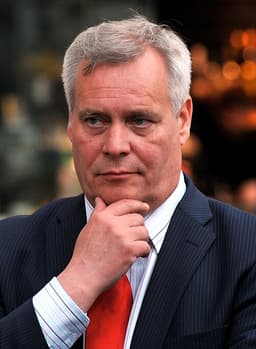
Antti Rinne
Politician · Modern
39.6Total

David Cameron
Politician · Modern
55.4Total
Basic Information
Born
1962
1966
Died
—
—
Era
Modern
Modern
Nationality
Finland
United Kingdom
Occupation
Politician
Politician
Civilization
Western
Western
Score Comparison
Military (10%)
49.9
49.1
Political (20%)
32.2
72.0
Influence (20%)
45.5
61.0
Legacy (20%)
35.8
56.0
Leadership (15%)
34.6
40.0
Strategy (15%)
42.8
44.2
TOTAL
39.6
55.4
Antti Rinne — Complete Timeline
2005 AD
Served as President of the Finnish Trade Union ConfederationPolitical Action
Rinne served as President of the Finnish Trade Union Confederation (SAK) from 2005 to 2014. He represented Finnish workers in collective bargaining and labor policy discussions, building his political base.
Trade UnionLabor
Impact: nationalconstructive
2014 AD
Elected Leader of the Social Democratic PartyPolitical Action◆ Major
Rinne was elected leader of the Social Democratic Party of Finland in May 2014, succeeding Jutta Urpilainen. He led the party to a narrow victory in the 2019 parliamentary elections, becoming Prime Minister.
Party LeadershipElection
Impact: nationalconstructive
2019 AD
Appointed Prime Minister of FinlandPolitical Action◆ Major
Antti Rinne became Prime Minister of Finland in June 2019, leading a coalition government of five parties. His tenure lasted only six months, ending in December 2019 after a political crisis over the handling of a postal service strike.
GovernmentCoalition
Impact: national
Resigned as Prime MinisterPolitical Action◆ Major
Rinne resigned as Prime Minister in December 2019 following a no-confidence vote triggered by the Centre Party. The crisis stemmed from his handling of a postal workers' strike and disagreements over wage policies.
ResignationPolitical Crisis
Impact: nationaldestructive
David Cameron — Complete Timeline
2010 AD
Formed the First Coalition Government Since WWIIPolitical Action◆ Major
Cameron formed a coalition government with the Liberal Democrats after the 2010 general election resulted in a hung parliament. This was the first coalition government in the UK since World War II, with Nick Clegg as Deputy Prime Minister.
Coalition GovernmentLiberal DemocratsPolitical Agreement
Impact: national
2013 AD
Introduced Same-Sex Marriage in England and WalesReform◆ Major
Cameron's government passed the Marriage (Same Sex Couples) Act, legalizing same-sex marriage in England and Wales. The legislation was a major social reform, despite opposition from some Conservative MPs.
Social ReformLGBT RightsMarriage Equality
Impact: nationalprogressive
2015 AD
Won the 2015 General ElectionPolitical Action◆ Major
Cameron led the Conservative Party to an unexpected majority victory in the 2015 general election. This was the first time the Conservatives had won a majority since 1992, and it allowed Cameron to govern without coalition partners.
General ElectionConservative VictoryMajority Government
Impact: national
2016 AD
Called the Brexit ReferendumPolitical Action
Cameron called a referendum on the UK's membership of the European Union, promising to renegotiate the terms of membership. The referendum resulted in a 52% vote to leave, a decision that reshaped British politics and led to his resignation.
BrexitReferendumEuropean Union
Impact: global
Resigned as Prime MinisterPolitical Action◆ Major
Cameron resigned as prime minister following the Leave vote in the Brexit referendum. He stated that he would not be the right person to lead the UK through the process of leaving the European Union.
BrexitResignationPolitical Consequence
Impact: nationaltragic
Expert Analysis
Origins
Antti Rinne was born on November 3, 1962, in Helsinki, Finland. He grew up in a working-class family and became a lawyer, specializing in labor law. He began his career as a legal advisor for the Finnish Trade Union Confederation (SAK) and later served as its president from 2005 to 2014. David Cameron was born on October 9, 1966, in London, England, into an upper-class family. He was educated at Eton College and Brasenose College, Oxford, where he studied Philosophy, Politics, and Economics. After university, he worked as a researcher for the Conservative Party and later as a corporate affairs director at Carlton Communications.
Rise to Power
Rinne entered politics as a member of the Social Democratic Party (SDP). He was elected to the Finnish Parliament in 2014 and became party leader the same year. After leading the SDP to a narrow victory in the 2019 parliamentary election, he formed a five-party coalition government and became Prime Minister in June 2019. Cameron's rise was faster. He was elected to Parliament in 2001, became Conservative leader in 2005, and after the 2010 general election formed the first coalition government since World War II, becoming Prime Minister at age 43.
Leadership & Governance
Rinne's leadership was marked by coalition management. His government faced internal disputes over economic policy, particularly the handling of a postal strike. He scored 34.6 in leadership. Cameron, scoring 40.0, led a coalition government that implemented austerity measures to reduce the budget deficit. He introduced same-sex marriage in 2013 and held a referendum on Scottish independence in 2014. His governance style was more confrontational, especially within his own party over Europe.
Triumph & Tragedy
Rinne's triumph was becoming Prime Minister after a tight election. However, his tragedy was his short tenure: he resigned in December 2019 after losing a confidence vote over his handling of the postal strike. Cameron's triumphs include winning the 2015 general election outright and legalizing same-sex marriage. His tragedy was the Brexit referendum: he called it to settle internal party divisions but lost, leading to his resignation and a period of political turmoil.
Character & Destiny
Rinne was seen as a skilled negotiator from his union days, but his cautious approach failed to manage coalition tensions. His total score is 39.6. Cameron was a pragmatic centrist, but his decision to call the referendum was a gamble that backfired. He scored 55.4 overall. Both leaders' fates were shaped by their inability to control events: Rinne by coalition infighting, Cameron by the referendum outcome.
Legacy
Rinne's legacy is limited due to his short term; he is remembered as a caretaker PM. His influence score is 45.5. Cameron's legacy is immense: he called the Brexit referendum, which led to the UK leaving the EU, and his government's austerity policies reshaped British society. His political score is 72.0, influence 61.0, and legacy 56.0.
Conclusion
David Cameron had greater impact. His total score of 55.4 against Rinne's 39.6 reflects his longer tenure and the far-reaching consequences of his actions. While Rinne's brief premiership had little lasting effect, Cameron's decision to hold the Brexit referendum changed the course of British and European history.
Rankings
🥇
David CameronLeader
Mil: 49.1Pol: 72.0Inf: 61.0
55.4
🥈
Antti Rinne
Mil: 49.9Pol: 32.2Inf: 45.5
39.6
+15.8 behind
How This Comparison Works
Algorithm
Each figure is scored on 6 dimensions (0—100 scale) based on structured historical data: Military (10%), Political (20%), Influence (20%), Legacy (20%), Leadership (15%), Strategy (15%). The weighted total produces the final ranking.
Data Sources
Scores are computed from structured sub-indicators in the database. Scale factors adjust for era (Ancient ×0.85, Modern ×1.0) and civilization size (Eastern ×1.05, Other ×0.80) to account for differences in population and military scale.
Maximum 3 Figures
Comparisons are limited to 2—3 figures to ensure readability and statistical meaningfulness.
Error Margins
±5 points per dimension — Sub-scores are derived from historical records with inherent uncertainty. Two figures within 5 points on a dimension should be considered roughly equivalent in that area.
Total Score Accuracy
±3 points overall — The weighted combination of 6 dimensions produces a total score with approximately ±3 points of uncertainty. Differences of less than 3 points are not statistically significant— the figures are effectively tied.
Known Limitations
- Historical records are incomplete and uneven across civilizations
- Figures from oral-tradition societies may be underrepresented
- Occupation labels can misclassify multi-role figures
- Scores measure capability and impact, not moral character
- Quantitative scoring is a comparison tool, not absolute truth
Capability Radar
Military (10%) — Battles & Warfare
Battles
27
26
Win Rate
34
34
Expansion
35
37
Political (20%) — Governance & Reform
Reform
20
55
Diplomacy
25
60
Economy
20
55
Influence (20%) — Cultural & Global Reach
Cultural
5
40
Global
5
55
Legacy (20%) — Historical Impact
Historical
10
60
Longevity
5
50
Leadership (15%) — Power & Stability
Tenure
10
65
Stability
10
30
Strategy (15%) — Tactics & Innovation
Strategy
37
38
Tactics
42
43
Reform
45
47
Similar Comparisons
Comments & Discussion
No comments yet. Be the first to share your thoughts!