Loading...
Antoninus Pius vs Napoleon Bonaparte
Napoleon Bonaparte leads by 17.4 pts · 2 figures compared
…
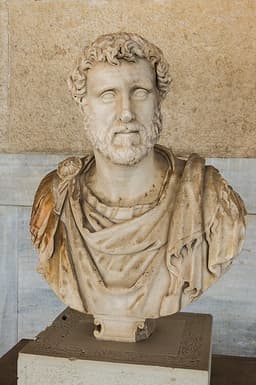
Antoninus Pius
Emperor · Ancient
53.5Total

Napoleon Bonaparte
General · Modern
70.9Total
Basic Information
Born
86
1769
Died
161
1821
Era
Ancient
Modern
Nationality
Roman Empire
France
Occupation
Emperor
General
Civilization
Western
Western
Score Comparison
Military (10%)
21.2
94.0
Political (20%)
70.0
72.0
Influence (20%)
54.9
40.0
Legacy (20%)
47.5
80.0
Leadership (15%)
78.0
78.0
Strategy (15%)
35.7
90.0
TOTAL
53.5
70.9
Antoninus Pius — Complete Timeline
132 AD
Suppression of the Jewish RevoltWar
Antoninus Pius, as governor of Asia, was involved in suppressing the Bar Kokhba revolt in Judea. The revolt was crushed with heavy casualties, and Jews were expelled from Jerusalem. This event occurred before his accession to the throne.
Jewish RevoltSuppressionJudea
Impact: regionaldestructive
138 AD
Reign of Peace and ProsperityPolitical Action◆ Major
Antoninus Pius became Roman emperor upon the death of Hadrian. His reign was characterized by internal stability, legal reforms, and economic prosperity, with no major military campaigns. He maintained the borders through diplomacy and client kingdoms.
Pax RomanaStabilityGood Emperor
Impact: globalconstructive
Adoption of Marcus Aurelius and Lucius VerusPolitical Action◆ Major
Following Hadrian's death, Antoninus Pius adopted Marcus Aurelius and Lucius Verus as his sons and heirs, as required by Hadrian's will. This ensured a smooth succession and continued the system of adoptive emperors.
SuccessionAdoptionDynasty
Impact: globalconstructive
142 AD
Construction of the Antonine WallOther◆ Major
Antoninus Pius ordered the construction of a turf and stone fortification across the narrowest part of Scotland, north of Hadrian's Wall. The wall marked the northernmost boundary of the Roman Empire in Britain and was manned for about 20 years before being abandoned.
FrontierFortificationBritain
Impact: regional
Napoleon Bonaparte — Complete Timeline
1799 AD
Coup of 18 BrumaireOther◆ Major
Napoleon Bonaparte, with support from his brother Lucien and key political figures, overthrew the Directory in a bloodless coup. He established the Consulate with himself as First Consul, effectively becoming the ruler of France. This event ended the French Revolution's most unstable period.
French RevolutionCoupRise to Power
Impact: regional
1804 AD
Promulgation of the Napoleonic CodeOther◆ Major
Napoleon enacted the Civil Code of the French, known as the Napoleonic Code, a comprehensive set of laws that replaced the fragmented feudal legal systems. The code established legal equality, protected property rights, and secularized law. It became the basis for legal systems in many European and world countries.
Legal ReformNapoleonic CodeCivil Law
Impact: globalconstructive
1805 AD
Battle of AusterlitzWar◆ Major
Napoleon's Grande Arm
Napoleonic WarsBattleDecisive Victory
Impact: global
1812 AD
Invasion of RussiaWar◆ Major
Napoleon led the Grande Arm
Napoleonic WarsInvasionDisaster
Impact: globaldestructive
1815 AD
Battle of WaterlooWar◆ Major
Napoleon's French army was defeated by the combined forces of the Duke of Wellington's Anglo-Allied army and Gebhard Leberecht von Bl
Napoleonic WarsBattleFinal Defeat
Impact: globaldestructive
Expert Analysis
antoninus-pius-vs-napoleon-bonaparte
### The Peaceful Emperor and the God of War
History has a curious way of pairing opposites. Imagine two men, both at the pinnacle of human power, yet whose lives could not have been more different. One, a Corsican artillery officer, would stride across a continent like a thunderstorm, leaving behind a trail of shattered thrones and a new code of law. The other, a Roman senator in his fifties, would inherit an empire at its zenith and spend the next two decades ensuring nothing much happened at all. Napoleon Bonaparte and Antoninus Pius: the one a whirlwind, the other a placid lake. What drove these two men, both of whom achieved greatness, to take such radically different paths? The answer lies not just in their talents, but in the worlds they were born into.
### Origins
Napoleon was born in 1769 on the island of Corsica, a place only recently annexed by France. He was a child of the periphery, speaking Italian-accented French, acutely aware that he was an outsider. This hunger for acceptance, for proving himself, was forged in the crucible of a modest, ambitious family. He was a product of the Enlightenment and the chaos of the French Revolution—a world where an officer could rise not by birth, but by brilliance and the cannon’s mouth. His era was one of violent upheaval, where the old order was being torn down, and a young man with a sword and a mind for mathematics could dream of empire.
Antoninus Pius, born in 86 AD, was the opposite. He was a child of the Roman aristocracy, born into the *nobiles* of the senatorial class. His world was one of established order, of law, of patronage. He was a quiet, competent administrator, serving as proconsul of Asia and a trusted advisor to Emperor Hadrian. His era was the Pax Romana, a time when the greatest threat to the empire was not a barbarian horde, but the whims of a single, often capricious, emperor. His path was not one of conquest, but of stewardship. He was chosen, not self-made.
### Rise to Power
Napoleon’s rise was a rocket’s ascent. He entered the historical stage at the Siege of Toulon in 1793, a 24-year-old artillery captain whose tactical genius dislodged the British fleet. From there, it was a blur of campaigns: the Italian campaign of 1796-97, where he turned a ragged army into a conquering force; the Egyptian expedition of 1798, a quixotic mix of science and conquest; and finally the *Coup of 18 Brumaire* in 1799, where he seized political power. His path was carved by audacity, by the willingness to gamble everything on a single, decisive battle. He was a man who believed that fortune favored the bold.
Antoninus Pius’s rise was a slow, deliberate ascent. He had proven himself a capable governor, suppressing the Bar Kokhba revolt in Judea in 132. This was not a glorious victory, but a grim, necessary pacification. He was a man who solved problems, not one who sought glory. When Hadrian died in 138, the emperor’s choice fell upon him, a steady hand for a stable empire. His rise was not a coup, but a succession—a quiet transfer of power from one good man to another. He did not seize history; he was given it.
### Leadership & Governance
Here, the two men diverge most starkly. Napoleon was a military genius, with a strategic score of 93. His battles—Austerlitz, Jena, Wagram—are studied to this day. He revolutionized warfare with his use of artillery, his speed of maneuver, and his ability to concentrate force at a decisive point. But his political wisdom was more uneven. The Napoleonic Code, his greatest peacetime achievement, rationalized French law and influenced legal systems across Europe. Yet his ambition was insatiable. He crowned himself Emperor in 1804, creating a new aristocracy, and his endless wars bled France dry. His leadership was a paradox: a man of immense personal charisma who could inspire armies, yet who could not see the limits of his own power.
Antoninus Pius, by contrast, was a peacetime emperor. His military score of 52.4 reflects a reign of almost total tranquility. He built the Antonine Wall in Scotland, a turf and stone barrier that marked the northernmost boundary of the Roman Empire. But his true genius was political. He was a master of administration, of law, of quiet diplomacy. His reign, from 138 to 161, was a golden age of internal stability. He reformed the legal system, improved infrastructure, and ensured a smooth succession by adopting Marcus Aurelius and Lucius Verus as his heirs. His leadership was not about conquest, but about preservation. He was the gardener, not the storm.
### Triumph & Tragedy
Napoleon’s greatest moment was Austerlitz in 1805, where he destroyed the combined armies of Russia and Austria. It was a masterpiece of strategy, a triumph that seemed to confirm his destiny. His greatest tragedy was the invasion of Russia in 1812—a catastrophic miscalculation that cost him his Grand Army and, ultimately, his empire. He was exiled to Elba, returned for the Hundred Days, and was finally defeated at Waterloo in 1815. His end was a lonely death on the island of Saint Helena.
Antoninus Pius had no single, dramatic triumph. His greatest moment was the quiet prosperity of his reign. His tragedy was the opposite of Napoleon’s: he was so successful at peace that he is often forgotten. He died in 161, in his bed, surrounded by family. There was no dramatic fall, no final battle. His tragedy was being too good at his job to be remembered.
### Character & Destiny
Napoleon’s character was forged by ambition, by a restless energy that could not be contained. He once said, “Glory is fleeting, but obscurity is forever.” He was a man of immense will, who believed he could shape the world by force of mind. This drove him to conquer, but it also blinded him to the limits of power. His destiny was to rise and fall, a comet that burned bright and then vanished.
Antoninus Pius’s character was shaped by duty. He was a man of moderation, of patience. He famously said, “It is better to be a good man than a good citizen.” His destiny was to be a caretaker, to hand over the empire in better shape than he found it. He succeeded. His personality was not one of conquest, but of stewardship.
### Legacy
Napoleon’s legacy is immense. He reshaped Europe, spread the ideals of the French Revolution, and created a legal framework that endures. He is remembered as a military genius, a flawed titan, a man who changed the world. His legacy score of 78 reflects both his achievements and his failures.
Antoninus Pius’s legacy is quieter. He is remembered as one of the Five Good Emperors, a man who presided over a golden age. But his name is not a household word. He is the emperor who kept the peace, who built a wall, who did not burn Rome. His legacy score of 66.7 reflects a life well-lived, but not a life that changed the world.
### Conclusion
Napoleon and Antoninus Pius are two faces of the same coin: power. One sought to bend the world to his will; the other sought to keep it steady. One was a storm; the other was a harbor. They remind us that greatness is not a single thing. It can be the flash of a sword or the steady hand of a ruler. The question is not which is better, but which is needed. In times of chaos, we need a Napoleon. In times of peace, we need an Antoninus. History, in its wisdom, gave us both.
Rankings
🥇
Napoleon BonaparteLeader
Mil: 94.0Pol: 72.0Inf: 40.0
70.9
🥈
Antoninus Pius
Mil: 21.2Pol: 70.0Inf: 54.9
53.5
+17.4 behind
How This Comparison Works
Algorithm
Each figure is scored on 6 dimensions (0—100 scale) based on structured historical data: Military (10%), Political (20%), Influence (20%), Legacy (20%), Leadership (15%), Strategy (15%). The weighted total produces the final ranking.
Data Sources
Scores are computed from structured sub-indicators in the database. Scale factors adjust for era (Ancient ×0.85, Modern ×1.0) and civilization size (Eastern ×1.05, Other ×0.80) to account for differences in population and military scale.
Maximum 3 Figures
Comparisons are limited to 2—3 figures to ensure readability and statistical meaningfulness.
Error Margins
±5 points per dimension — Sub-scores are derived from historical records with inherent uncertainty. Two figures within 5 points on a dimension should be considered roughly equivalent in that area.
Total Score Accuracy
±3 points overall — The weighted combination of 6 dimensions produces a total score with approximately ±3 points of uncertainty. Differences of less than 3 points are not statistically significant— the figures are effectively tied.
Known Limitations
- Historical records are incomplete and uneven across civilizations
- Figures from oral-tradition societies may be underrepresented
- Occupation labels can misclassify multi-role figures
- Scores measure capability and impact, not moral character
- Quantitative scoring is a comparison tool, not absolute truth
Capability Radar
Military (10%) — Battles & Warfare
Battles
5
95
Win Rate
10
90
Expansion
5
95
Political (20%) — Governance & Reform
Reform
70
95
Diplomacy
85
80
Economy
80
85
Influence (20%) — Cultural & Global Reach
Cultural
50
85
Global
40
90
Legacy (20%) — Historical Impact
Historical
55
95
Longevity
50
90
Leadership (15%) — Power & Stability
Tenure
85
85
Stability
95
70
Strategy (15%) — Tactics & Innovation
Strategy
15
95
Tactics
10
98
Reform
20
92
Similar Comparisons
Comments & Discussion
No comments yet. Be the first to share your thoughts!