Loading...
This comparison has not been analyzed yet.
One-time AI generation (~1 minute). Scores and timeline are already available below.
Anies Baswedan vs Kim Yo-jong
Anies Baswedan leads by 12.4 pts · 2 figures compared
…
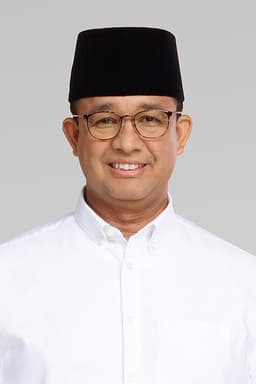
Anies Baswedan
Politician · Modern
47.7Total

Kim Yo-jong
Politician · Modern
35.3Total
Basic Information
Born
1969
1987
Died
—
—
Era
Modern
Modern
Nationality
Indonesia
North Korea
Occupation
Politician
Politician
Civilization
Eastern
Eastern
Score Comparison
Military (10%)
12.3
15.7
Political (20%)
68.0
26.4
Influence (20%)
53.3
48.6
Legacy (20%)
42.5
35.8
Leadership (15%)
65.0
34.6
Strategy (15%)
26.0
35.1
TOTAL
47.7
35.3
Anies Baswedan — Complete Timeline
2017 AD
Elected Governor of JakartaPolitical Action◆ Major
Anies Baswedan won the Jakarta gubernatorial election against incumbent Basuki Tjahaja Purnama. His campaign utilized identity politics, leading to a divisive election. He served as governor from 2017 to 2022.
ElectionJakartaIdentity Politics
Impact: regional
2018 AD
Flood Management and Land Subsidence PoliciesReform
As governor, Anies implemented policies to address Jakarta's chronic flooding and land subsidence, including river normalization and coastal embankment projects. The effectiveness of these measures was debated.
Flood ControlInfrastructureJakarta
2024 AD
Presidential Candidacy in 2024 ElectionPolitical Action◆ Major
Anies ran as a presidential candidate in the 2024 Indonesian election, positioning himself as a reformist alternative. He lost to Prabowo Subianto, receiving 24.9% of the vote.
Presidential ElectionIndonesiaReform
Impact: national
Kim Yo-jong — Complete Timeline
2014 AD
Appointed Vice Director of the Propaganda and Agitation DepartmentPolitical Action◆ Major
Kim Yo-jong was appointed vice director of the Workers' Party of Korea Propaganda and Agitation Department, making her a key figure in shaping North Korea's domestic and international image. This role placed her at the center of the regime's media strategy.
North KoreaPropagandaKim Family
Impact: national
2018 AD
Attended PyeongChang Winter Olympics as special envoyPolitical Action◆ Major
Kim Yo-jong traveled to South Korea as a special envoy of Kim Jong-un to attend the PyeongChang Winter Olympics. This was the first visit by a member of the North Korean ruling family to the South since the Korean War, signaling a temporary diplomatic thaw.
North KoreaSouth KoreaDiplomacyOlympics
Impact: regionalconstructive
2020 AD
Elected to the Politburo of the Workers' Party of KoreaPolitical Action◆ Major
Kim Yo-jong was elected as a full member of the Politburo of the Workers' Party of Korea, solidifying her position as one of the most powerful figures in the regime. This elevation made her the first female member of the ruling family to hold such a high-ranking party position.
North KoreaPolitburoKim FamilyWomen in Politics
Impact: national
Ordered the destruction of the Inter-Korean Liaison OfficePolitical Action◆ Major
Kim Yo-jong ordered the demolition of the Inter-Korean Liaison Office in Kaesong, a symbol of inter-Korean cooperation. This act dramatically escalated tensions with South Korea and marked a shift toward a more confrontational policy.
North KoreaSouth KoreaInter-Korean RelationsDestruction
Impact: regionaldestructive
This comparison has not been analyzed yet.
One-time AI generation (~1 minute). Scores and timeline are already available below.
Rankings
🥇
Anies BaswedanLeader
Mil: 12.3Pol: 68.0Inf: 53.3
47.7
🥈
Kim Yo-jong
Mil: 15.7Pol: 26.4Inf: 48.6
35.3
+12.4 behind
How This Comparison Works
Algorithm
Each figure is scored on 6 dimensions (0—100 scale) based on structured historical data: Military (10%), Political (20%), Influence (20%), Legacy (20%), Leadership (15%), Strategy (15%). The weighted total produces the final ranking.
Data Sources
Scores are computed from structured sub-indicators in the database. Scale factors adjust for era (Ancient ×0.85, Modern ×1.0) and civilization size (Eastern ×1.05, Other ×0.80) to account for differences in population and military scale.
Maximum 3 Figures
Comparisons are limited to 2—3 figures to ensure readability and statistical meaningfulness.
Error Margins
±5 points per dimension — Sub-scores are derived from historical records with inherent uncertainty. Two figures within 5 points on a dimension should be considered roughly equivalent in that area.
Total Score Accuracy
±3 points overall — The weighted combination of 6 dimensions produces a total score with approximately ±3 points of uncertainty. Differences of less than 3 points are not statistically significant— the figures are effectively tied.
Known Limitations
- Historical records are incomplete and uneven across civilizations
- Figures from oral-tradition societies may be underrepresented
- Occupation labels can misclassify multi-role figures
- Scores measure capability and impact, not moral character
- Quantitative scoring is a comparison tool, not absolute truth
Capability Radar
Military (10%) — Battles & Warfare
Battles
16
12
Win Rate
19
15
Expansion
18
23
Political (20%) — Governance & Reform
Reform
55
10
Diplomacy
50
20
Economy
40
5
Influence (20%) — Cultural & Global Reach
Cultural
40
15
Global
20
15
Legacy (20%) — Historical Impact
Historical
30
10
Longevity
25
5
Leadership (15%) — Power & Stability
Tenure
45
15
Stability
35
5
Strategy (15%) — Tactics & Innovation
Strategy
24
22
Tactics
26
26
Reform
31
31
Similar Comparisons
Comments & Discussion
No comments yet. Be the first to share your thoughts!