Loading...
Ange-Felix Patasse vs Dmytro Kuleba
Dmytro Kuleba leads by 8.7 pts · 2 figures compared
…
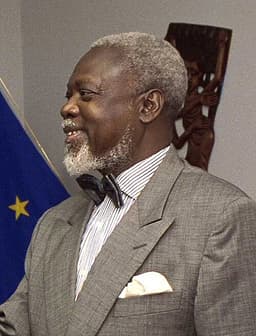
Ange-Felix Patasse
Politician · Modern
47.4Total

Dmytro Kuleba
Politician · Modern
56.1Total
Basic Information
Born
1937
1981
Died
—
—
Era
Modern
Modern
Nationality
Central African Republic
Ukraine
Occupation
Politician
Politician
Civilization
Other
Western
Score Comparison
Military (10%)
50.0
50.0
Political (20%)
39.4
68.0
Influence (20%)
49.4
59.0
Legacy (20%)
40.0
45.0
Leadership (15%)
67.0
67.0
Strategy (15%)
40.8
48.3
TOTAL
47.4
56.1
Ange-Felix Patasse — Complete Timeline
1993 AD
Elected President of CARPolitical Action◆ Major
Ange-Félix Patassé won the presidential election with 52.5% of the vote in the second round, becoming the first democratically elected president of the Central African Republic. His victory ended a period of military rule.
Central African RepublicDemocracyElection
Impact: nationalconstructive
1996 AD
Survived Army MutiniesWar
Three army mutinies erupted against Patass
Central African RepublicMutinyFrench Intervention
Impact: nationaldestructive
2003 AD
Overthrown by François BozizéPolitical Action◆ Major
While Patass
Central African RepublicCoupBozizé
Impact: nationaltragic
Dmytro Kuleba — Complete Timeline
2020 AD
Kuleba's appointment as Foreign MinisterPolitical Action◆ Major
Kuleba was appointed Minister of Foreign Affairs of Ukraine under President Volodymyr Zelenskyy. He was the youngest person to hold the post, at age 38. His appointment signaled a focus on European integration and countering Russian aggression.
AppointmentUkraineForeign policy
Impact: nationalconstructive
2022 AD
Kuleba's diplomatic efforts during the 2022 Russian invasionPolitical Action
Kuleba led Ukraine's diplomatic campaign after Russia's full-scale invasion, securing military aid, sanctions, and international support. He traveled extensively to NATO and EU capitals, advocating for Ukraine's defense and membership.
WarDiplomacyUkraine
Impact: globalconstructive
Kuleba's push for Ukraine's EU candidate statusPolitical Action◆ Major
Kuleba was instrumental in securing European Union candidate status for Ukraine, a historic step in Ukraine's European integration. The decision was made by the European Council in June 2022, during the war.
EUUkraineIntegration
Impact: regionalconstructive
Expert Analysis
Origins
Ange-Felix Patasse was born on January 25, 1937, in Paoua, French Ubangi-Shari (now Central African Republic). He hailed from a farming family and studied agriculture in France, later working as an agronomist. His early career included roles in the civil service before entering politics in the 1960s.
Dmytro Kuleba was born on April 19, 1981, in Sumy, Ukrainian SSR. His father was a diplomat, exposing him to international affairs. Kuleba studied international law at Taras Shevchenko National University of Kyiv, earning a degree in 2003. He began his career in the Ministry of Foreign Affairs and later served as Ukraine's ambassador to the Council of Europe.
Rise to Power
Patasse rose to prominence as a technocrat under President David Dacko, serving as Prime Minister from 1976 to 1978. After years of political instability, he won the 1993 presidential election with 52.5% of the vote in the second round, becoming the first democratically elected president of the Central African Republic. His victory marked a hopeful transition from authoritarian rule.
Kuleba's ascent was rapid within Ukraine's diplomatic corps. He became Minister of Foreign Affairs in March 2020 at age 38, the youngest in Ukraine's history. His appointment came under President Volodymyr Zelenskyy, who sought fresh faces. Kuleba's defining moment arrived with Russia's full-scale invasion in February 2022, thrusting him onto the global stage as Ukraine's chief diplomat.
Leadership & Governance
Patasse's governance was characterized by instability. He survived three army mutinies between 1996 and 1997, triggered by unpaid salaries and poor conditions. French troops intervened to restore order, but Patasse's reliance on foreign support weakened his authority. He struggled to control the country's vast territory, and corruption persisted. His political score of 39.4 reflects these governance challenges.
Kuleba's leadership during wartime has been strategic and proactive. He spearheaded diplomatic efforts to secure military aid, sanctions against Russia, and international isolation of Moscow. His key achievement was securing EU candidate status for Ukraine in June 2022, a historic step. Kuleba's political score of 68.0 underscores his effectiveness in navigating complex international relations.
Triumph & Tragedy
Patasse's greatest triumph was winning the 1993 election, ending decades of military and one-party rule. He also oversaw the adoption of a new constitution in 1995. However, his tragedy came in 2003 when, while abroad, rebel forces led by François Bozizé captured Bangui and overthrew him. Patasse spent the rest of his life in exile in Togo, dying in 2011. His legacy is marred by failure to consolidate democracy.
Kuleba's triumph has been his role in rallying global support for Ukraine during the war. He has traveled extensively, addressing the UN and NATO, and securing billions in aid. His influence score of 59.0 reflects his global recognition. A potential tragedy could be if Ukraine fails to achieve its war aims, but as of now, Kuleba remains a key figure in Ukraine's resistance.
Character & Destiny
Patasse was seen as a well-intentioned but weak leader, unable to control the military or curb corruption. His indecisiveness and reliance on external powers contributed to his downfall. Historians note that he lacked the ruthlessness needed to survive in CAR's volatile politics.
Kuleba is characterized by energy, eloquence, and strategic thinking. He has effectively used social media and international platforms to amplify Ukraine's message. His youth and adaptability have been assets in a crisis. His leadership score of 67.0 matches Patasse's, but Kuleba's context of war demands different skills.
Legacy
Patasse's legacy is mixed: he is remembered as the first democratically elected president, but also as a failed leader whose tenure ended in chaos. His impact on CAR's political development is limited; the country remains unstable. His legacy score of 40.0 reflects this.
Kuleba's legacy is still unfolding, but he has already left a mark on European security architecture. His push for EU candidate status for Ukraine may reshape the continent. His legacy score of 45.0 is higher, indicating greater potential for long-term impact.
Conclusion
While Patasse's election was a milestone for CAR, his inability to govern effectively and his overthrow limit his historical significance. Kuleba, on the other hand, has played a central role in Ukraine's survival as a sovereign state during a major war. With a total score of 56.1 against Patasse's 47.4, Kuleba's impact on global affairs and his nation's destiny is clearly greater. He has demonstrated that diplomacy can be a powerful weapon, even against a larger aggressor.
Rankings
🥇
Dmytro KulebaLeader
Mil: 50.0Pol: 68.0Inf: 59.0
56.1
🥈
Ange-Felix Patasse
Mil: 50.0Pol: 39.4Inf: 49.4
47.4
+8.7 behind
How This Comparison Works
Algorithm
Each figure is scored on 6 dimensions (0—100 scale) based on structured historical data: Military (10%), Political (20%), Influence (20%), Legacy (20%), Leadership (15%), Strategy (15%). The weighted total produces the final ranking.
Data Sources
Scores are computed from structured sub-indicators in the database. Scale factors adjust for era (Ancient ×0.85, Modern ×1.0) and civilization size (Eastern ×1.05, Other ×0.80) to account for differences in population and military scale.
Maximum 3 Figures
Comparisons are limited to 2—3 figures to ensure readability and statistical meaningfulness.
Error Margins
±5 points per dimension — Sub-scores are derived from historical records with inherent uncertainty. Two figures within 5 points on a dimension should be considered roughly equivalent in that area.
Total Score Accuracy
±3 points overall — The weighted combination of 6 dimensions produces a total score with approximately ±3 points of uncertainty. Differences of less than 3 points are not statistically significant— the figures are effectively tied.
Known Limitations
- Historical records are incomplete and uneven across civilizations
- Figures from oral-tradition societies may be underrepresented
- Occupation labels can misclassify multi-role figures
- Scores measure capability and impact, not moral character
- Quantitative scoring is a comparison tool, not absolute truth
Capability Radar
Military (10%) — Battles & Warfare
Battles
22
32
Win Rate
27
29
Expansion
29
33
Political (20%) — Governance & Reform
Reform
30
40
Diplomacy
40
75
Economy
20
30
Influence (20%) — Cultural & Global Reach
Cultural
20
30
Global
15
55
Legacy (20%) — Historical Impact
Historical
25
40
Longevity
15
20
Leadership (15%) — Power & Stability
Tenure
60
45
Stability
10
25
Strategy (15%) — Tactics & Innovation
Strategy
32
38
Tactics
32
40
Reform
39
43
Similar Comparisons
Comments & Discussion
No comments yet. Be the first to share your thoughts!