Loading...
This comparison has not been analyzed yet.
One-time AI generation (~1 minute). Scores and timeline are already available below.
Andrei Yeremenko vs Lord Chelmsford
Andrei Yeremenko leads by 3.0 pts · 2 figures compared
…
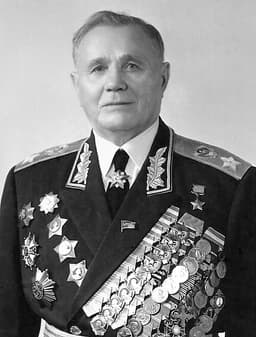
Andrei Yeremenko
General · Modern
45.9Total

Lord Chelmsford
General · Modern
42.9Total
Basic Information
Born
1892
1868
Died
1970
1933
Era
Modern
Modern
Nationality
USSR
United Kingdom
Occupation
General
General
Civilization
Western
Western
Score Comparison
Military (10%)
47.5
25.9
Political (20%)
29.3
29.3
Influence (20%)
51.8
49.4
Legacy (20%)
45.8
41.7
Leadership (15%)
47.3
61.1
Strategy (15%)
52.5
39.6
TOTAL
45.9
42.9
Andrei Yeremenko — Complete Timeline
1941 AD
Battle of MoscowWar
Yeremenko commanded the Bryansk Front during the Battle of Moscow. His forces were encircled and defeated at the Battle of Bryansk, but he escaped and later participated in the counteroffensive.
World War IIMoscowEncirclement
Impact: regionaltragic
1942 AD
Battle of StalingradWar◆ Major
Yeremenko commanded the Stalingrad Front during the Battle of Stalingrad. He coordinated the defense of the city and later the encirclement of the German 6th Army in Operation Uranus.
World War IIStalingradOperation Uranus
Impact: global
1944 AD
Crimean OffensiveWar
Yeremenko commanded the Separate Coastal Army during the Crimean Offensive. His forces liberated Sevastopol and cleared German and Romanian troops from the Crimea.
World War IICrimeaSevastopol
Impact: regional
1965 AD
Publication of memoirsCultural
Yeremenko published his memoirs, 'Stalingrad: Notes of a Front Commander'. The book provided a detailed account of the battle from the Soviet perspective, though it was criticized for exaggerating his own role.
MemoirStalingradHistoriography
Impact: national
Lord Chelmsford — Complete Timeline
1916 AD
Appointment as Viceroy of IndiaPolitical Action◆ Major
Chelmsford was appointed Viceroy of India during World War I. His tenure was dominated by the war effort, the rise of Indian nationalism, and the implementation of the Montagu-Chelmsford Reforms, which introduced limited self-government.
British IndiaViceroyWorld War I
Impact: regional
1919 AD
Amritsar MassacreWar
During Chelmsford's viceroyalty, British troops under General Dyer fired on unarmed Indian civilians in Jallianwala Bagh, Amritsar, killing hundreds. Chelmsford initially supported Dyer but later faced criticism for his handling of the aftermath, which fueled the Indian independence movement.
British IndiaMassacreNationalism
Impact: regionaltragic
Montagu-Chelmsford ReformsReform◆ Major
Chelmsford, with Secretary of State Edwin Montagu, introduced the Government of India Act 1919, which established dyarchy in the provinces. The reforms expanded Indian participation in government but retained British control over key areas, disappointing nationalists.
British IndiaReformSelf-Government
Impact: regional
Rowlatt ActPolitical Action◆ Major
Chelmsford's government passed the Rowlatt Act, extending wartime emergency powers to suppress political dissent. The act sparked widespread protests, including Gandhi's first nationwide satyagraha, and contributed to the atmosphere leading to the Amritsar Massacre.
British IndiaRepressionNationalism
Impact: regionaldestructive
This comparison has not been analyzed yet.
One-time AI generation (~1 minute). Scores and timeline are already available below.
Rankings
🥇
Andrei YeremenkoLeader
Mil: 47.5Pol: 29.3Inf: 51.8
45.9
🥈
Lord Chelmsford
Mil: 25.9Pol: 29.3Inf: 49.4
42.9
+3.0 behind
How This Comparison Works
Algorithm
Each figure is scored on 6 dimensions (0—100 scale) based on structured historical data: Military (10%), Political (20%), Influence (20%), Legacy (20%), Leadership (15%), Strategy (15%). The weighted total produces the final ranking.
Data Sources
Scores are computed from structured sub-indicators in the database. Scale factors adjust for era (Ancient ×0.85, Modern ×1.0) and civilization size (Eastern ×1.05, Other ×0.80) to account for differences in population and military scale.
Maximum 3 Figures
Comparisons are limited to 2—3 figures to ensure readability and statistical meaningfulness.
Error Margins
±5 points per dimension — Sub-scores are derived from historical records with inherent uncertainty. Two figures within 5 points on a dimension should be considered roughly equivalent in that area.
Total Score Accuracy
±3 points overall — The weighted combination of 6 dimensions produces a total score with approximately ±3 points of uncertainty. Differences of less than 3 points are not statistically significant— the figures are effectively tied.
Known Limitations
- Historical records are incomplete and uneven across civilizations
- Figures from oral-tradition societies may be underrepresented
- Occupation labels can misclassify multi-role figures
- Scores measure capability and impact, not moral character
- Quantitative scoring is a comparison tool, not absolute truth
Capability Radar
Military (10%) — Battles & Warfare
Battles
70
15
Win Rate
55
10
Expansion
20
5
Political (20%) — Governance & Reform
Reform
10
10
Diplomacy
20
20
Economy
10
10
Influence (20%) — Cultural & Global Reach
Cultural
20
5
Global
20
20
Legacy (20%) — Historical Impact
Historical
40
30
Longevity
25
10
Leadership (15%) — Power & Stability
Tenure
30
60
Stability
15
5
Strategy (15%) — Tactics & Innovation
Strategy
60
10
Tactics
65
10
Reform
30
5
Similar Comparisons
Comments & Discussion
No comments yet. Be the first to share your thoughts!