Loading...
Anawrahta vs Napoleon Bonaparte
Napoleon Bonaparte leads by 5.7 pts · 2 figures compared
…
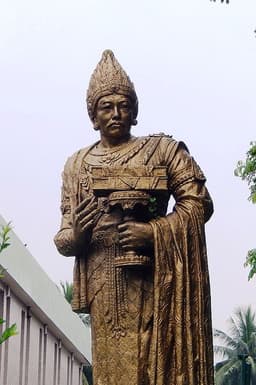
Anawrahta
Emperor · Medieval
65.2Total

Napoleon Bonaparte
General · Modern
70.9Total
Basic Information
Born
1014
1769
Died
1077
1821
Era
Medieval
Modern
Nationality
Myanmar
France
Occupation
Emperor
General
Civilization
Eastern
Western
Score Comparison
Military (10%)
70.0
94.0
Political (20%)
68.0
72.0
Influence (20%)
72.0
40.0
Legacy (20%)
55.0
80.0
Leadership (15%)
72.0
78.0
Strategy (15%)
55.0
90.0
TOTAL
65.2
70.9
Anawrahta — Complete Timeline
1044 AD
Founding of the Pagan EmpirePolitical Action
Anawrahta ascended the throne and unified the Irrawaddy River valley, founding the Pagan Empire. He conquered the Mon kingdom of Thaton and other neighboring states, creating the first unified Burmese kingdom and establishing Bagan as its capital.
UnificationEmpireBagan
Impact: regionalconstructive
1056 AD
Introduction of Theravada Buddhism to PaganCultural
Anawrahta adopted Theravada Buddhism after being converted by the Mon monk Shin Arahan. He made Theravada the state religion, replacing the existing Mahayana and animist practices. This religious shift had a lasting impact on Burmese culture and politics.
BuddhismReligionConversion
Impact: regionalconstructive
1057 AD
Conquest of the Thaton KingdomWar◆ Major
Anawrahta led a military campaign against the Mon kingdom of Thaton, capturing the city and bringing back Buddhist scriptures, monks, and artisans to Bagan. This conquest enriched Pagan's culture and solidified its dominance in the region.
ConquestMonCultural Exchange
Impact: regional
Napoleon Bonaparte — Complete Timeline
1799 AD
Coup of 18 BrumaireOther◆ Major
Napoleon Bonaparte, with support from his brother Lucien and key political figures, overthrew the Directory in a bloodless coup. He established the Consulate with himself as First Consul, effectively becoming the ruler of France. This event ended the French Revolution's most unstable period.
French RevolutionCoupRise to Power
Impact: regional
1804 AD
Promulgation of the Napoleonic CodeOther◆ Major
Napoleon enacted the Civil Code of the French, known as the Napoleonic Code, a comprehensive set of laws that replaced the fragmented feudal legal systems. The code established legal equality, protected property rights, and secularized law. It became the basis for legal systems in many European and world countries.
Legal ReformNapoleonic CodeCivil Law
Impact: globalconstructive
1805 AD
Battle of AusterlitzWar◆ Major
Napoleon's Grande Arm
Napoleonic WarsBattleDecisive Victory
Impact: global
1812 AD
Invasion of RussiaWar◆ Major
Napoleon led the Grande Arm
Napoleonic WarsInvasionDisaster
Impact: globaldestructive
1815 AD
Battle of WaterlooWar◆ Major
Napoleon's French army was defeated by the combined forces of the Duke of Wellington's Anglo-Allied army and Gebhard Leberecht von Bl
Napoleonic WarsBattleFinal Defeat
Impact: globaldestructive
Expert Analysis
anawrahta-vs-napoleon-bonaparte
# The Emperor and the Conqueror: Two Paths to Power
On a June morning in 1815, Napoleon Bonaparte stood on a muddy field near Waterloo, watching his Imperial Guard fall for the first time in history. Half a world away and eight centuries earlier, King Anawrahta of Pagan had stood on the banks of the Irrawaddy River, watching Buddhist monks unload sacred scriptures from captured Mon boats. One man built an empire that shook the foundations of Europe; the other built an empire that transformed Southeast Asia. Both were conquerors, yet their stories could not be more different. What separates a man who reshapes his civilization from one who reshapes the world?
Origins
Napoleon Bonaparte was born in 1769 on the Mediterranean island of Corsica, a place that had only become French the year before. His family was minor nobility, poor enough that young Napoleon often ate bread and milk for dinner. He spoke French with a thick Italian accent, and his schoolmates mocked him as a foreigner. The late 18th century was a time of revolution, when old orders crumbled and ambitious men could rise on talent alone.
Anawrahta was born in 1014 into a very different world. The Irrawaddy River valley of Myanmar was a patchwork of warring kingdoms, each worshipping different spirits and gods. He was a prince of the Pagan dynasty, but his kingdom was small, surrounded by more powerful Mon and Pyu states. The 11th century in Southeast Asia was an age of faith, when kings were judged not by their conquests but by their piety and the temples they built.
Rise to Power
Napoleon's ascent was a masterpiece of speed and opportunism. At age 24, he drove the British out of Toulon and was promoted to brigadier general. By 26, he had saved the French Directory from a royalist uprising with a "whiff of grapeshot." In 1799, at just 30, he staged a coup d'état and became First Consul of France. His rise was explosive, fueled by the chaos of revolution and his own relentless ambition.
Anawrahta's path was slower and more deliberate. He ascended the throne of Pagan in 1044, inheriting a small kingdom in the dry zone of Myanmar. For the first decade of his reign, he consolidated power, building irrigation systems and fortifications. His turning point came not from a battlefield but from a monastery. In 1056, a Mon monk named Shin Arahan arrived at his court and converted him to Theravada Buddhism. This was not a personal conversion but a political masterstroke—Anawrahta saw that a unifying religion could bind his fractious kingdom together.
Leadership & Governance
Napoleon governed through sheer force of will. He reorganized French law into the Napoleonic Code, creating a uniform legal system that still influences much of the world. He centralized the government, established the Bank of France, and reformed education. But his true genius was military. At Austerlitz in 1805, he destroyed an Austro-Russian army with a feigned retreat that remains a textbook example of tactical deception. His score of 94 for military prowess and 93 for strategy reflects a commander who changed how wars were fought.
Anawrahta was a different kind of ruler. His military score of 55 and strategy score of 58 suggest he was no Napoleon on the battlefield. In 1057, he conquered the Mon kingdom of Thaton, but the victory was less about military brilliance and more about religious purpose—he brought back Buddhist scriptures, monks, and artisans. His true strength was political: a score of 88 in politics. He made Theravada Buddhism the state religion, built thousands of pagodas, and created a cultural identity that would define Myanmar for a millennium. Where Napoleon conquered through cannon and code, Anawrahta conquered through faith and architecture.
Triumph & Tragedy
Napoleon's greatest triumph was also his greatest tragedy. He conquered most of Europe, installed his brothers on thrones, and seemed invincible. But his invasion of Russia in 1812 was catastrophic—600,000 men marched east, fewer than 100,000 returned. The Grande Armée was destroyed, and with it, Napoleon's aura of invincibility. He was exiled to Elba, returned for a final hundred days, and met his end at Waterloo in 1815.
Anawrahta's tragedy was subtler. He unified Myanmar and established Pagan as a great empire, but his successors could not maintain his vision. After his death in 1077, the empire fragmented. The magnificent temples he built—over 10,000 pagodas in Pagan alone—stood as monuments to his ambition, but the political unity he created did not survive him. His triumph was cultural, not political.
Character & Destiny
Napoleon was restless, brilliant, and consumed by ambition. "Impossible," he once said, "is a word to be found only in the dictionary of fools." He trusted no one completely, drove his body to exhaustion, and believed he was destined for greatness. His personality shaped every decision—the invasion of Russia was hubris, the escape from Elba was audacity, the final stand at Waterloo was refusal to accept defeat.
Anawrahta was more patient, more spiritual. He understood that power required legitimacy, not just force. He adopted a foreign religion, integrated conquered peoples, and built monuments that would outlast his empire. His character was that of a builder, not a destroyer. Where Napoleon saw the world as something to be conquered, Anawrahta saw it as something to be transformed.
Legacy
Napoleon's legacy is global. His legal code, his military tactics, his administrative reforms—these spread across Europe and beyond. He is remembered as both a liberator who spread revolutionary ideals and a tyrant who caused endless war. His total score of 82.4 reflects a figure of immense but controversial impact.
Anawrahta's legacy is more contained but no less profound. He is remembered as the father of Myanmar, the king who brought Buddhism and unity to the Irrawaddy valley. His score of 70.6 reflects a regional rather than global influence, but for the people of Myanmar, he remains a foundational figure, the king who made them who they are.
Conclusion
Two conquerors, two worlds. Napoleon tried to conquer the world and failed; Anawrahta tried to build a nation and succeeded. One is remembered by every schoolchild in the West; the other is known only to specialists. Yet both faced the same fundamental question: How do you turn power into permanence? Napoleon believed the answer was force; Anawrahta believed it was faith. History suggests that neither answer is complete—but that the builders, not the destroyers, leave the deepest marks on the human soul.
Rankings
🥇
Napoleon BonaparteLeader
Mil: 94.0Pol: 72.0Inf: 40.0
70.9
🥈
Anawrahta
Mil: 70.0Pol: 68.0Inf: 72.0
65.2
+5.7 behind
How This Comparison Works
Algorithm
Each figure is scored on 6 dimensions (0—100 scale) based on structured historical data: Military (10%), Political (20%), Influence (20%), Legacy (20%), Leadership (15%), Strategy (15%). The weighted total produces the final ranking.
Data Sources
Scores are computed from structured sub-indicators in the database. Scale factors adjust for era (Ancient ×0.85, Modern ×1.0) and civilization size (Eastern ×1.05, Other ×0.80) to account for differences in population and military scale.
Maximum 3 Figures
Comparisons are limited to 2—3 figures to ensure readability and statistical meaningfulness.
Error Margins
±5 points per dimension — Sub-scores are derived from historical records with inherent uncertainty. Two figures within 5 points on a dimension should be considered roughly equivalent in that area.
Total Score Accuracy
±3 points overall — The weighted combination of 6 dimensions produces a total score with approximately ±3 points of uncertainty. Differences of less than 3 points are not statistically significant— the figures are effectively tied.
Known Limitations
- Historical records are incomplete and uneven across civilizations
- Figures from oral-tradition societies may be underrepresented
- Occupation labels can misclassify multi-role figures
- Scores measure capability and impact, not moral character
- Quantitative scoring is a comparison tool, not absolute truth
Capability Radar
Military (10%) — Battles & Warfare
Battles
55
95
Win Rate
60
90
Expansion
60
95
Political (20%) — Governance & Reform
Reform
65
95
Diplomacy
60
80
Economy
55
85
Influence (20%) — Cultural & Global Reach
Cultural
70
85
Global
55
90
Legacy (20%) — Historical Impact
Historical
75
95
Longevity
70
90
Leadership (15%) — Power & Stability
Tenure
70
85
Stability
60
70
Strategy (15%) — Tactics & Innovation
Strategy
55
95
Tactics
50
98
Reform
45
92
Similar Comparisons
Comments & Discussion
No comments yet. Be the first to share your thoughts!