Loading...
Amenemhat I vs Napoleon Bonaparte
Napoleon Bonaparte leads by 16.7 pts · 2 figures compared
…
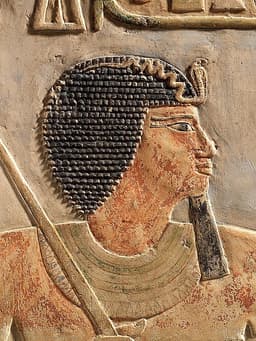
Amenemhat I
Emperor · Ancient
54.2Total

Napoleon Bonaparte
General · Modern
70.9Total
Basic Information
Born
-1970
1769
Died
-1940
1821
Era
Ancient
Modern
Nationality
Middle Kingdom Egypt
France
Occupation
Emperor
General
Civilization
Middle Eastern
Western
Score Comparison
Military (10%)
30.0
94.0
Political (20%)
45.0
72.0
Influence (20%)
61.0
40.0
Legacy (20%)
54.0
80.0
Leadership (15%)
65.0
78.0
Strategy (15%)
60.0
90.0
TOTAL
54.2
70.9
Amenemhat I — Complete Timeline
1970 BC
Accession as pharaohPolitical Action◆ Major
Amenemhat I, formerly vizier to Mentuhotep IV, seized the throne and founded the 12th Dynasty. His accession marked a new era of strong central authority and administrative reform in the Middle Kingdom.
Accession12th DynastyMiddle Kingdom
Impact: nationalconstructive
1965 BC
Foundation of ItjtawyPolitical Action◆ Major
Amenemhat I founded a new capital city called Itjtawy ('Seizer of the Two Lands'), located near modern Lisht. This move shifted the political center from Thebes to a more central location, improving control over both Upper and Lower Egypt.
CapitalAdministrationReform
Impact: nationalconstructive
1960 BC
Construction of the 'Walls of the Ruler'War◆ Major
Amenemhat I built a series of fortifications in the eastern Delta, known as the 'Walls of the Ruler', to protect Egypt from Asiatic incursions. These defenses strengthened Egypt's borders and controlled trade routes into the Levant.
FortificationDefenseBorder Control
Impact: regionalconstructive
1955 BC
Military campaigns in NubiaWar◆ Major
Amenemhat I led military campaigns into Nubia, extending Egyptian control to the Second Cataract. These conquests secured access to gold mines and trade routes, and established Egyptian forts such as Buhen.
Nubian CampaignConquestGold
Impact: regional
1940 BC
Assassination in palace conspiracyPolitical Action◆ Major
Amenemhat I was assassinated in a palace conspiracy, as recorded in the 'Teaching of Amenemhat' text. The plot involved members of his own court, including possibly his guards and harem. His son Senusret I, who was on a campaign, returned to secure the throne.
AssassinationConspiracyPalace Intrigue
Impact: nationaltragic
Napoleon Bonaparte — Complete Timeline
1799 AD
Coup of 18 BrumaireOther◆ Major
Napoleon Bonaparte, with support from his brother Lucien and key political figures, overthrew the Directory in a bloodless coup. He established the Consulate with himself as First Consul, effectively becoming the ruler of France. This event ended the French Revolution's most unstable period.
French RevolutionCoupRise to Power
Impact: regional
1804 AD
Promulgation of the Napoleonic CodeOther◆ Major
Napoleon enacted the Civil Code of the French, known as the Napoleonic Code, a comprehensive set of laws that replaced the fragmented feudal legal systems. The code established legal equality, protected property rights, and secularized law. It became the basis for legal systems in many European and world countries.
Legal ReformNapoleonic CodeCivil Law
Impact: globalconstructive
1805 AD
Battle of AusterlitzWar◆ Major
Napoleon's Grande Arm
Napoleonic WarsBattleDecisive Victory
Impact: global
1812 AD
Invasion of RussiaWar◆ Major
Napoleon led the Grande Arm
Napoleonic WarsInvasionDisaster
Impact: globaldestructive
1815 AD
Battle of WaterlooWar◆ Major
Napoleon's French army was defeated by the combined forces of the Duke of Wellington's Anglo-Allied army and Gebhard Leberecht von Bl
Napoleonic WarsBattleFinal Defeat
Impact: globaldestructive
Expert Analysis
amenemhat-i-vs-napoleon-bonaparte
# The Emperor and the Vizier: Two Paths to Power, Two Roads to Ruin
On a June morning in 1815, Napoleon Bonaparte watched his dream of empire crumble in the mud of Waterloo. On a palace night nearly four thousand years earlier, Amenemhat I felt the cold steel of assassins’ blades pierce his royal flesh. One died in exile on a remote Atlantic island, the other in his own bedchamber, betrayed by those he trusted most. Both had risen from nothing to rule everything. Both fell because they forgot that power, once seized, must be constantly defended—not just from enemies abroad, but from the shadows within.
Origins
Napoleon was born in 1769 on the island of Corsica, a place that had only recently become French. His family was minor nobility, impoverished and resentful of French rule. He spoke Italian before French, and carried throughout his life the chip-on-the-shoulder ambition of a provincial outsider. The French Revolution, which erupted when he was twenty, shattered the old order and opened paths unimaginable under the Bourbon monarchy. A brilliant artillery officer could become emperor—if he had the nerve to seize the opportunity.
Amenemhat I came from even humbler beginnings. Born around 1970 BCE, he was not of royal blood. He served as vizier to Pharaoh Mentuhotep IV, the last ruler of the 11th Dynasty. In ancient Egypt, the vizier was the highest-ranking official after the king—a position of immense power, but also immense danger. Amenemhat watched his master closely, learned the levers of palace politics, and waited. When the moment came, he did not hesitate.
Both men understood that birth mattered less than will. But Napoleon’s world was one of revolutionary upheaval, where merit could carry a man to the top of a continent. Amenemhat’s world was one of rigid hierarchy, where a vizier could become pharaoh only through the most ruthless calculation.
Rise to Power
Napoleon’s ascent was a masterpiece of opportunism. In 1793, he drove British forces from Toulon, earning promotion to brigadier general at twenty-four. In 1796, he took command of a starving, demoralized army in Italy and turned it into a conquering force, winning battle after battle against the Austrians. By 1799, he had enough fame and loyal soldiers to stage a coup, overthrowing the Directory and installing himself as First Consul. Within five years, he crowned himself Emperor of the French.
Amenemhat’s path was quieter but no less dramatic. He did not win glittering victories; he won the trust of a pharaoh, then the loyalty of key officials. When Mentuhotep IV died—perhaps not of natural causes—Amenemhat declared himself pharaoh, founding the 12th Dynasty. His accession was not a coup d’état in the Napoleonic sense, but a palace revolution that shifted power from Thebes to a new capital he built at Itjtawy, meaning “Seizer of the Two Lands.” The name itself was a statement of ambition.
The difference is instructive. Napoleon rose through military glory, visible to the world. Amenemhat rose through bureaucratic cunning, hidden from history’s gaze. One conquered armies; the other conquered corridors.
Leadership & Governance
As emperor, Napoleon was a whirlwind of energy and reform. He centralized the French state, created the Bank of France, and most famously, codified French law into the Napoleonic Code—a system that influenced legal frameworks across Europe and beyond. He built roads, schools, and a modern bureaucracy. His military genius is beyond dispute: his campaigns in Italy, Egypt, and Austria rewrote the rules of warfare. He could move armies faster than his enemies could think, and he understood that morale was the soul of battle.
Amenemhat governed differently. He did not conquer Europe; he consolidated Egypt. He built the “Walls of the Ruler,” a series of fortifications in the eastern Delta, to protect against Asiatic incursions. He led campaigns into Nubia, extending Egyptian control to the Second Cataract, securing gold mines and trade routes. He moved his capital north to better control both Upper and Lower Egypt, a strategic decision that stabilized the kingdom for decades.
Napoleon’s governance was expansionist, restless, almost manic. He could not stop. Amenemhat’s was defensive, patient, focused on endurance. The difference reflects their worlds: Napoleon lived in an age of revolution, where borders shifted overnight; Amenemhat lived in an age of cycles, where a pharaoh’s duty was to maintain ma’at—cosmic order—against chaos.
Triumph & Tragedy
Napoleon’s greatest moment was probably Austerlitz in 1805, where he crushed the combined armies of Russia and Austria in a single day of tactical perfection. His greatest failure was the invasion of Russia in 1812, a catastrophe that destroyed his Grand Army and shattered the myth of his invincibility. He was exiled to Elba in 1814, escaped in 1815, and met final defeat at Waterloo. His last years were spent on Saint Helena, writing memoirs and blaming others.
Amenemhat’s greatest achievement was founding a dynasty that would rule Egypt for two centuries, a golden age of stability and cultural achievement. His greatest failure was his own death: assassinated in a palace conspiracy around 1940 BCE, as recorded in the “Teaching of Amenemhat,” a text that purports to be his ghostly advice to his son Senusret. “Beware of subjects who are nobodies,” the text warns. “Trust no brother, know no friend.” The irony is bitter: a man who rose through betrayal died by it.
Character & Destiny
Napoleon was driven by an insatiable hunger for glory. “I live only for posterity,” he once said. He was brilliant, charismatic, and utterly ruthless. He believed in destiny, but he also believed he could shape it. His personality—arrogant, impatient, unable to delegate—led him to overreach. He could not share power, and so he could not build institutions that outlasted him.
Amenemhat was more cautious, more calculating. He built walls, not armies; dynasties, not empires. His personality was shaped by the precariousness of his position. He knew that a vizier who becomes pharaoh lives in constant danger. His tragedy was that even his precautions failed.
Both men were shaped by their eras. Napoleon’s world rewarded boldness; Amenemhat’s rewarded patience. But both discovered that power, once seized, is never safe. The same ambition that lifts a man to the throne can topple him from it.
Legacy
Napoleon is remembered as one of history’s greatest generals, a reformer who reshaped Europe, and a cautionary tale about the limits of ambition. His code, his military tactics, and his legend endure. He is a figure of romance and tragedy, studied in war colleges and debated in seminars.
Amenemhat is less famous, but no less significant. He founded a dynasty that produced some of Egypt’s greatest literature and art. The “Teaching of Amenemhat” became a classic of Egyptian wisdom literature, read for centuries. His “Walls of the Ruler” foreshadowed the defensive strategies of later empires. He is remembered not as a conqueror, but as a founder—the man who gave Egypt stability when it needed it most.
Conclusion
Napoleon and Amenemhat never met, never could have met. One commanded armies of hundreds of thousands; the other ruled a kingdom of farmers and priests. One died in exile, the other in his own palace. Yet their stories echo each other across four millennia. Both rose from obscurity to supreme power. Both were undone by the very forces they thought they had mastered. Napoleon’s fall was spectacular, a drama played out on a continental stage. Amenemhat’s was silent, a murder in the dark.
Which is the greater tragedy? The emperor who lost an empire, or the vizier who lost his life? Perhaps the answer is that all power is borrowed, and all rulers—whether of France or Egypt, whether crowned in Notre-Dame or in the halls of Itjtawy—must one day answer for what they built and what they destroyed. In the end, they both left behind the same lesson: that the seat of power is never comfortable, and the view from the top is always lonely.
Rankings
🥇
Napoleon BonaparteLeader
Mil: 94.0Pol: 72.0Inf: 40.0
70.9
🥈
Amenemhat I
Mil: 30.0Pol: 45.0Inf: 61.0
54.2
+16.7 behind
How This Comparison Works
Algorithm
Each figure is scored on 6 dimensions (0—100 scale) based on structured historical data: Military (10%), Political (20%), Influence (20%), Legacy (20%), Leadership (15%), Strategy (15%). The weighted total produces the final ranking.
Data Sources
Scores are computed from structured sub-indicators in the database. Scale factors adjust for era (Ancient ×0.85, Modern ×1.0) and civilization size (Eastern ×1.05, Other ×0.80) to account for differences in population and military scale.
Maximum 3 Figures
Comparisons are limited to 2—3 figures to ensure readability and statistical meaningfulness.
Error Margins
±5 points per dimension — Sub-scores are derived from historical records with inherent uncertainty. Two figures within 5 points on a dimension should be considered roughly equivalent in that area.
Total Score Accuracy
±3 points overall — The weighted combination of 6 dimensions produces a total score with approximately ±3 points of uncertainty. Differences of less than 3 points are not statistically significant— the figures are effectively tied.
Known Limitations
- Historical records are incomplete and uneven across civilizations
- Figures from oral-tradition societies may be underrepresented
- Occupation labels can misclassify multi-role figures
- Scores measure capability and impact, not moral character
- Quantitative scoring is a comparison tool, not absolute truth
Capability Radar
Military (10%) — Battles & Warfare
Battles
30
95
Win Rate
35
90
Expansion
55
95
Political (20%) — Governance & Reform
Reform
70
95
Diplomacy
65
80
Economy
60
85
Influence (20%) — Cultural & Global Reach
Cultural
55
85
Global
50
90
Legacy (20%) — Historical Impact
Historical
65
95
Longevity
60
90
Leadership (15%) — Power & Stability
Tenure
60
85
Stability
40
70
Strategy (15%) — Tactics & Innovation
Strategy
45
95
Tactics
40
98
Reform
50
92
Similar Comparisons
Comments & Discussion
PharaohFall6/17/2026
"Waterloo was a tactical failure, but Amenemhat's assassination reveals a deeper truth: no empire survives internal rot. Napoleon's Grande Armée collapsed from within after Russia, while Amenemhat built a stable dynasty that lasted 200+ years. The French emperor couldn't even manage his own marshals; the Egyptian founder understood that loyalty begins at the vizier's desk, not the battlefield."
尼罗河枪骑兵6/17/2026
"别拿炮兵天才和埃及官僚比。拿破仑打了六十场胜仗,从马伦戈到奥斯特里茨,指挥艺术前无古人。阿蒙涅姆赫特一世最了不起的事就是被别人暗杀成功?他统治二十九年,连个像样的对外征服都没有。历史记住拿破仑是因为他改变了欧洲地图,而这位法老不过是埃及王朝更替中的一颗棋子。"
ShadowEmperor6/17/2026
"Both men seized power through strategic networks, not sheer military might. Napoleon's 18 Brumaire coup relied on political allies; Amenemhat's accession came after serving as vizier under Mentuhotep IV. The real comparison is how they held power: Napoleon lost his empire in a decade of overreach, while Amenemhat's assassination proves that even paranoid rulers in their own palaces can't escape the daggers of disloyalty."
黄沙中的权谋者6/17/2026
"历史总爱美化战胜者。拿破仑的滑铁卢是军事失误,阿蒙涅姆赫特的死是政治愚蠢?别傻了。法老至少有先见之明写下《阿蒙涅姆赫特一世训诫》,警告儿子提防亲近之人。拿破仑连这觉悟都没有——他被放逐厄尔巴岛时还天真以为人民会念他旧恩。一个死在自己床上,一个死在英军的监视下。谁更可悲?"
EnigmaWanderer6/17/2026
"Here's what matters: Amenemhat's Egypt was a bronze-age power with iron-fisted bureaucracy lasting centuries; Napoleon's France burned bright and fast. The Egyptian founded a dynasty that built the Kahun pyramid complex—physical proof of systems thinking. Napoleon's legacy is ephemeral: a legal code, yes, but Waterloo erased his empire in a single day. One built civilizations, the other built castles in the air."
旧纸堆里的考古匠6/17/2026
"滑铁卢和阿蒙涅姆赫特遇刺毫无可比性。一个是被欧洲联军打败的军事结局,一个是宫廷政变的个人悲剧。拿破仑死时五十岁,统治十五年;法老活到六十多岁,统治二十九年。拿破仑影响了全世界,从法律到军事;阿蒙涅姆赫特不过是埃及中王国众多统治者之一,他的金字塔还在,但他的名字有几个人记得?数据不会撒谎:前者改变了人类历史进程,后者只是地区王朝的注脚。"