Loading...
This comparison has not been analyzed yet.
One-time AI generation (~1 minute). Scores and timeline are already available below.
Altan Khan vs Nasir-ud-Daulah
Altan Khan leads by 15.7 pts · 2 figures compared
…
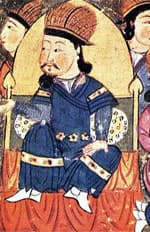
Altan Khan
Emperor · Modern
61.8Total

Nasir-ud-Daulah
Emperor · Modern
46.1Total
Basic Information
Born
1507
1794
Died
1582
1857
Era
Modern
Modern
Nationality
Mongolia
India
Occupation
Emperor
Emperor
Civilization
Eastern
Indian
Score Comparison
Military (10%)
65.0
20.0
Political (20%)
55.0
43.7
Influence (20%)
68.0
47.9
Legacy (20%)
55.0
37.5
Leadership (15%)
72.0
72.0
Strategy (15%)
55.0
54.3
TOTAL
61.8
46.1
Altan Khan — Complete Timeline
1571 AD
Peace Treaty with Ming ChinaPolitical Action◆ Major
Altan Khan negotiated a peace treaty with the Ming dynasty, ending decades of conflict. The treaty established trade relations and recognized Altan Khan's authority, bringing stability to the border region.
Peace TreatyMing DynastyTrade
Impact: regionalconstructive
1578 AD
Establishment of Ties with the Dalai LamaCultural
Altan Khan met with Sonam Gyatso, the third Dalai Lama, and granted him the title 'Dalai Lama'. This meeting formalized the alliance between the Mongols and the Gelug school of Tibetan Buddhism, strengthening Buddhist influence in Mongolia.
Dalai LamaTibetan BuddhismAlliance
Impact: regionalconstructive
1580 AD
Foundation of HohhotCultural◆ Major
Altan Khan founded the city of Hohhot, which became a major center for trade and Buddhism in Inner Mongolia. The city served as his capital and facilitated economic and cultural exchange with the Ming dynasty.
City FoundationHohhotTrade
Impact: regionalconstructive
Nasir-ud-Daulah — Complete Timeline
1829 AD
Became Nizam of HyderabadPolitical Action◆ Major
Nasir-ud-Daulah ascended the throne of Hyderabad after the death of his father, Sikandar Jah. His reign was marked by loyalty to the British East India Company and a focus on internal administration.
SuccessionHyderabadNizam
Impact: regional
1855 AD
Established the Nizam's CollegeCultural
Nasir-ud-Daulah established the Nizam's College in Hyderabad, an institution for higher education. This was part of his efforts to modernize the state's educational system and promote learning among the elite.
EducationCollegeHyderabad
constructive
1857 AD
Remained loyal to the British during the Indian Rebellion of 1857Political Action◆ Major
During the Indian Rebellion of 1857, Nasir-ud-Daulah refused to join the uprising and maintained his alliance with the British East India Company. He provided military support to the British, which helped suppress the rebellion in the Deccan.
Indian Rebellion of 1857LoyaltyBritish East India Company
Impact: regional
This comparison has not been analyzed yet.
One-time AI generation (~1 minute). Scores and timeline are already available below.
Rankings
🥇
Altan KhanLeader
Mil: 65.0Pol: 55.0Inf: 68.0
61.8
🥈
Nasir-ud-Daulah
Mil: 20.0Pol: 43.7Inf: 47.9
46.1
+15.7 behind
How This Comparison Works
Algorithm
Each figure is scored on 6 dimensions (0—100 scale) based on structured historical data: Military (10%), Political (20%), Influence (20%), Legacy (20%), Leadership (15%), Strategy (15%). The weighted total produces the final ranking.
Data Sources
Scores are computed from structured sub-indicators in the database. Scale factors adjust for era (Ancient ×0.85, Modern ×1.0) and civilization size (Eastern ×1.05, Other ×0.80) to account for differences in population and military scale.
Maximum 3 Figures
Comparisons are limited to 2—3 figures to ensure readability and statistical meaningfulness.
Error Margins
±5 points per dimension — Sub-scores are derived from historical records with inherent uncertainty. Two figures within 5 points on a dimension should be considered roughly equivalent in that area.
Total Score Accuracy
±3 points overall — The weighted combination of 6 dimensions produces a total score with approximately ±3 points of uncertainty. Differences of less than 3 points are not statistically significant— the figures are effectively tied.
Known Limitations
- Historical records are incomplete and uneven across civilizations
- Figures from oral-tradition societies may be underrepresented
- Occupation labels can misclassify multi-role figures
- Scores measure capability and impact, not moral character
- Quantitative scoring is a comparison tool, not absolute truth
Capability Radar
Military (10%) — Battles & Warfare
Battles
65
5
Win Rate
60
5
Expansion
70
5
Political (20%) — Governance & Reform
Reform
55
20
Diplomacy
80
40
Economy
50
30
Influence (20%) — Cultural & Global Reach
Cultural
70
10
Global
65
5
Legacy (20%) — Historical Impact
Historical
75
15
Longevity
70
10
Leadership (15%) — Power & Stability
Tenure
65
60
Stability
45
50
Strategy (15%) — Tactics & Innovation
Strategy
60
5
Tactics
55
5
Reform
50
5
Similar Comparisons
Comments & Discussion
No comments yet. Be the first to share your thoughts!