Loading...
This comparison has not been analyzed yet.
One-time AI generation (~1 minute). Scores and timeline are already available below.
Ali bin Said vs Humaid bin Rashid Al Nuaimi
Humaid bin Rashid Al Nuaimi leads by 6.0 pts · 2 figures compared
…
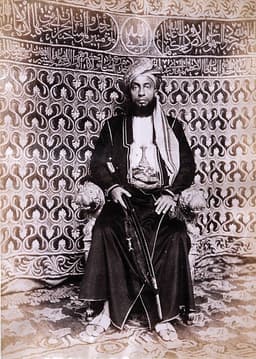
Ali bin Said
Emperor · Modern
39.6Total

Humaid bin Rashid Al Nuaimi
Emperor · Modern
45.6Total
Basic Information
Born
1854
1931
Died
1893
—
Era
Modern
Modern
Nationality
Zanzibar
UAE
Occupation
Emperor
Emperor
Civilization
Other
Middle Eastern
Score Comparison
Military (10%)
43.3
47.0
Political (20%)
26.4
40.8
Influence (20%)
46.3
47.1
Legacy (20%)
34.2
35.0
Leadership (15%)
38.1
65.0
Strategy (15%)
54.3
44.6
TOTAL
39.6
45.6
Ali bin Said — Complete Timeline
1890 AD
Accession to the ThronePolitical Action◆ Major
Ali bin Said became the fourth sultan of Zanzibar following the death of his brother Khalifa bin Said. His reign began during the height of European colonial competition in East Africa, with Zanzibar already under British influence.
SuccessionSultanateColonial Era
Signing of the Heligoland-Zanzibar TreatyPolitical Action
Ali bin Said's government accepted the Heligoland-Zanzibar Treaty between Britain and Germany. This treaty defined colonial spheres of influence, with Zanzibar becoming a British protectorate while Germany gained control over mainland Tanganyika.
Colonial TreatyBritish ProtectorateScramble for Africa
Impact: regional
Establishment of British ProtectoratePolitical Action◆ Major
Ali bin Said formally accepted British protectorate status over Zanzibar. This gave Britain control over Zanzibar's foreign affairs and defense while the sultan retained internal authority, effectively ending Zanzibar's sovereignty.
British ProtectorateLoss of SovereigntyColonial Rule
Impact: regional
Humaid bin Rashid Al Nuaimi — Complete Timeline
1981 AD
Accession as Ruler of AjmanPolitical Action◆ Major
Humaid bin Rashid Al Nuaimi became the Ruler of Ajman on September 6, 1981, following the death of his father, Rashid bin Humaid Al Nuaimi. He is the current ruler and has served as a member of the UAE Supreme Council.
SuccessionMonarchyAjman
1988 AD
Establishment of Ajman Free ZoneReform◆ Major
Humaid bin Rashid established the Ajman Free Zone in 1988 to attract foreign businesses and boost the emirate's economy. The free zone offered 100% foreign ownership and tax exemptions, contributing to Ajman's industrial and commercial growth.
EconomyFree ZoneInvestment
constructive
1990 AD
Development of Ajman PortReform
Under Ruler Humaid bin Rashid, the Port of Ajman was expanded and modernized to handle increased cargo traffic. The port became a key commercial hub for the emirate, supporting trade and economic diversification.
InfrastructurePortTrade
constructive
This comparison has not been analyzed yet.
One-time AI generation (~1 minute). Scores and timeline are already available below.
Rankings
🥇
Humaid bin Rashid Al NuaimiLeader
Mil: 47.0Pol: 40.8Inf: 47.1
45.6
🥈
Ali bin Said
Mil: 43.3Pol: 26.4Inf: 46.3
39.6
+6.0 behind
How This Comparison Works
Algorithm
Each figure is scored on 6 dimensions (0—100 scale) based on structured historical data: Military (10%), Political (20%), Influence (20%), Legacy (20%), Leadership (15%), Strategy (15%). The weighted total produces the final ranking.
Data Sources
Scores are computed from structured sub-indicators in the database. Scale factors adjust for era (Ancient ×0.85, Modern ×1.0) and civilization size (Eastern ×1.05, Other ×0.80) to account for differences in population and military scale.
Maximum 3 Figures
Comparisons are limited to 2—3 figures to ensure readability and statistical meaningfulness.
Error Margins
±5 points per dimension — Sub-scores are derived from historical records with inherent uncertainty. Two figures within 5 points on a dimension should be considered roughly equivalent in that area.
Total Score Accuracy
±3 points overall — The weighted combination of 6 dimensions produces a total score with approximately ±3 points of uncertainty. Differences of less than 3 points are not statistically significant— the figures are effectively tied.
Known Limitations
- Historical records are incomplete and uneven across civilizations
- Figures from oral-tradition societies may be underrepresented
- Occupation labels can misclassify multi-role figures
- Scores measure capability and impact, not moral character
- Quantitative scoring is a comparison tool, not absolute truth
Capability Radar
Military (10%) — Battles & Warfare
Battles
5
24
Win Rate
5
28
Expansion
5
30
Political (20%) — Governance & Reform
Reform
10
30
Diplomacy
20
35
Economy
15
30
Influence (20%) — Cultural & Global Reach
Cultural
10
10
Global
5
10
Legacy (20%) — Historical Impact
Historical
10
10
Longevity
5
10
Leadership (15%) — Power & Stability
Tenure
15
40
Stability
10
40
Strategy (15%) — Tactics & Innovation
Strategy
5
30
Tactics
5
33
Reform
5
36
Similar Comparisons
Comments & Discussion
No comments yet. Be the first to share your thoughts!