Loading...
Alfred Jodl vs Fedor von Bock
Alfred Jodl leads by 1.9 pts · 2 figures compared
…

Alfred Jodl
General · Modern
52.1Total
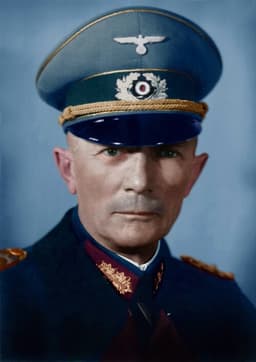
Fedor von Bock
General · Modern
50.2Total
Basic Information
Born
1890
1880
Died
1946
1945
Era
Modern
Modern
Nationality
Germany
Germany
Occupation
General
General
Civilization
Western
Western
Score Comparison
Military (10%)
61.7
80.0
Political (20%)
33.6
27.9
Influence (20%)
56.4
58.0
Legacy (20%)
48.3
50.0
Leadership (15%)
54.2
40.4
Strategy (15%)
66.3
50.0
TOTAL
52.1
50.2
Alfred Jodl — Complete Timeline
1939 AD
Appointment as Chief of Operations at OKWPolitical Action◆ Major
Jodl was appointed Chief of the Operations Staff of the Oberkommando der Wehrmacht (OKW). He was responsible for planning and coordinating military operations under Hitler's direction. He played a key role in the planning of major campaigns, including the invasion of the Soviet Union.
World War IIMilitary CommandNazi Germany
Impact: global
1940 AD
Planning of Operation BarbarossaWar◆ Major
Jodl was involved in the planning of Operation Barbarossa, the German invasion of the Soviet Union. He helped draft the directive for the campaign, which began in June 1941. The invasion led to massive casualties and the expansion of the war in the East.
World War IIEastern FrontInvasion
Impact: globaldestructive
1945 AD
Signing of the Surrender of GermanyPolitical Action◆ Major
Jodl signed the instrument of unconditional surrender of German forces on May 7, 1945, at Reims, France. He acted on behalf of the German high command. This surrender ended hostilities in Europe, though it was later ratified in Berlin.
World War IISurrenderEnd of War
Impact: globaltragic
1946 AD
Nuremberg Trial and ExecutionPolitical Action◆ Major
Jodl was tried at the International Military Tribunal in Nuremberg for conspiracy, crimes against peace, war crimes, and crimes against humanity. He was found guilty on all counts and sentenced to death. He was executed by hanging on October 16, 1946.
Nuremberg TrialsWar CrimesExecution
Impact: globaltragic
Fedor von Bock — Complete Timeline
1939 AD
Commanded Army Group North in Invasion of PolandWar◆ Major
Von Bock commanded Army Group North during the invasion of Poland. His forces advanced from Pomerania and East Prussia, encircling Polish forces. The campaign ended with the surrender of Warsaw and the partition of Poland between Germany and the Soviet Union.
World War IIInvasion of PolandArmy Group North
Impact: regionaldestructive
1941 AD
Led Army Group Center in Operation BarbarossaWar
Von Bock commanded Army Group Center, the main German force in the invasion of the Soviet Union. His forces captured Minsk, Smolensk, and advanced to the outskirts of Moscow. The campaign stalled in winter, failing to capture Moscow.
World War IIOperation BarbarossaEastern Front
Impact: globaldestructive
Battle of Moscow - German DefeatWar
Von Bock's Army Group Center launched Operation Typhoon to capture Moscow. Soviet counterattacks and harsh winter conditions halted the German advance. The failure to take Moscow marked the first major German defeat on the Eastern Front.
World War IIBattle of MoscowDefeat
Impact: globaltragic
1942 AD
Relieved of Command and RetiredPolitical Action
After the failure at Moscow, von Bock was relieved of command by Hitler. He was briefly recalled in 1942 to command Army Group South but was again dismissed after disagreements with Hitler over strategy. He retired to his estate and was killed in an air raid in 1945.
World War IIDismissalEastern Front
Impact: national
Expert Analysis
Origins
Alfred Jodl was born on May 10, 1890, in Würzburg, Germany, into a military family. His father was a Bavarian artillery officer. Jodl attended the Bavarian Cadet Corps and the Military Academy, commissioning as a lieutenant in 1910. He served on the Western Front in World War I, earning the Iron Cross. After the war, he remained in the Reichswehr, rising through staff positions.
Fedor von Bock was born on December 3, 1880, in Küstrin, Prussia, into a noble military lineage. His father was a general. Von Bock entered the Prussian Cadet Corps and became a lieutenant in 1898. He served on the General Staff during World War I, receiving the Pour le Mérite. Like Jodl, he stayed in the Reichswehr, commanding troops and staff roles.
Rise to Power
Jodl's rise came through his staff expertise. By 1935, he was head of the National Defense Section in the Wehrmacht's High Command. In 1938, he became a major general and was appointed Chief of Operations Staff of the newly formed OKW (Oberkommando der Wehrmacht) in 1939. He coordinated the invasions of Poland, France, and the Balkans, gaining Hitler's trust.
Von Bock rose through field commands. He commanded Army Group North in the invasion of Poland (1939) and Army Group B in the invasion of France (1940), capturing Paris. His success earned him command of Army Group Center for Operation Barbarossa in 1941, the largest German army group, aimed at Moscow.
Leadership & Governance
Jodl was a strategic planner, not a field commander. He drafted directives for major campaigns, including Operation Barbarossa and the invasion of Norway. His leadership was characterized by meticulous planning but subservience to Hitler's strategic whims. Jodl rarely challenged Hitler, contributing to flawed decisions like the halt before Dunkirk and the no-retreat orders. He scored 54.2 in leadership, reflecting his staff efficiency but lack of independence.
Von Bock was a traditional field marshal, emphasizing disciplined attacks. He led from the front, pushing his armies to capture Minsk, Smolensk, and approach Moscow. However, he scored only 40.4 in leadership due to his inability to influence Hitler's decisions and his eventual relief after the Moscow failure. He followed orders without protest, even when they were tactically unsound.
Triumph & Tragedy
Jodl's greatest success was planning the rapid conquest of France in 1940, using the Manstein Plan. His greatest failure was the flawed planning of Operation Barbarossa, underestimating Soviet strength and logistics. He also signed the surrender of Germany on May 7, 1945, and was executed at Nuremberg in 1946 after being convicted of war crimes. His legacy score is 48.3, reflecting his role in Nazi atrocities.
Von Bock's triumph was leading Army Group Center to the gates of Moscow in 1941, capturing hundreds of thousands of Soviet soldiers. His tragedy was the failure to take Moscow due to Soviet counterattacks and winter, leading to his dismissal. He was recalled in 1942 but again relieved after disagreeing with Hitler over the Stalingrad campaign. He died in an air raid in 1945. His military score is 80.0, but his political score is 27.9, indicating his lack of influence beyond the battlefield.
Character & Destiny
Jodl was reserved, analytical, and loyal to Hitler. His character made him an effective staff officer but a passive executor of criminal orders. He was convicted at Nuremberg, where his defense that he was 'only following orders' failed. His destiny was to be hanged, a symbol of the Nazi military elite's culpability.
Von Bock was arrogant, ambitious, and politically naive. He focused on military glory, ignoring Nazi crimes. His character led him to obey Hitler until it cost him his command. He died in obscurity, unrepentant. His total score of 50.2 is slightly lower than Jodl's 52.1, but his military impact was greater.
Legacy
Jodl's legacy is tied to the OKW's role in planning aggressive war. His actions contributed to the deaths of millions. He is remembered as a war criminal, not a military genius. His influence score of 56.4 reflects his role in shaping German strategy, but his legacy is negative.
Von Bock's legacy is that of a capable but flawed field commander. He is studied for his operational leadership in Barbarossa, but his failure at Moscow and his political subservience limit his reputation. His legacy score of 50.0 is average. Neither man is celebrated; both are examples of the Wehrmacht's complicity in Nazism.
Conclusion
Alfred Jodl had a greater impact on the war's overall direction due to his strategic planning role, scoring 52.1 overall versus von Bock's 50.2. Jodl's directives shaped the entire Wehrmacht's operations, while von Bock's influence was confined to his army group. Jodl's involvement in war crimes also gives him a darker but more significant historical footprint. Von Bock was a better field commander (military 80.0 vs 61.7), but his lack of strategic influence and early dismissal reduce his overall impact. Jodl's higher total score reflects his broader, albeit destructive, role.
Rankings
🥇
Alfred JodlLeader
Mil: 61.7Pol: 33.6Inf: 56.4
52.1
🥈
Fedor von Bock
Mil: 80.0Pol: 27.9Inf: 58.0
50.2
+1.9 behind
How This Comparison Works
Algorithm
Each figure is scored on 6 dimensions (0—100 scale) based on structured historical data: Military (10%), Political (20%), Influence (20%), Legacy (20%), Leadership (15%), Strategy (15%). The weighted total produces the final ranking.
Data Sources
Scores are computed from structured sub-indicators in the database. Scale factors adjust for era (Ancient ×0.85, Modern ×1.0) and civilization size (Eastern ×1.05, Other ×0.80) to account for differences in population and military scale.
Maximum 3 Figures
Comparisons are limited to 2—3 figures to ensure readability and statistical meaningfulness.
Error Margins
±5 points per dimension — Sub-scores are derived from historical records with inherent uncertainty. Two figures within 5 points on a dimension should be considered roughly equivalent in that area.
Total Score Accuracy
±3 points overall — The weighted combination of 6 dimensions produces a total score with approximately ±3 points of uncertainty. Differences of less than 3 points are not statistically significant— the figures are effectively tied.
Known Limitations
- Historical records are incomplete and uneven across civilizations
- Figures from oral-tradition societies may be underrepresented
- Occupation labels can misclassify multi-role figures
- Scores measure capability and impact, not moral character
- Quantitative scoring is a comparison tool, not absolute truth
Capability Radar
Military (10%) — Battles & Warfare
Battles
65
75
Win Rate
60
70
Expansion
70
75
Political (20%) — Governance & Reform
Reform
10
10
Diplomacy
35
15
Economy
10
10
Influence (20%) — Cultural & Global Reach
Cultural
20
30
Global
50
50
Legacy (20%) — Historical Impact
Historical
55
55
Longevity
25
40
Leadership (15%) — Power & Stability
Tenure
40
20
Stability
15
15
Strategy (15%) — Tactics & Innovation
Strategy
75
70
Tactics
70
65
Reform
30
30
Similar Comparisons
Comments & Discussion
No comments yet. Be the first to share your thoughts!