Loading...
Alfred Deakin vs Hor Namhong
Alfred Deakin leads by 20.3 pts · 2 figures compared
…

Alfred Deakin
Politician · Modern
61.1Total
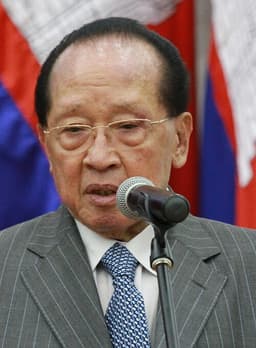
Hor Namhong
Politician · Modern
40.8Total
Basic Information
Born
1856
1935
Died
1919
—
Era
Modern
Modern
Nationality
Australia
Cambodia
Occupation
Politician
Politician
Civilization
Western
Eastern
Score Comparison
Military (10%)
50.0
10.5
Political (20%)
82.0
39.4
Influence (20%)
56.7
47.1
Legacy (20%)
55.0
39.2
Leadership (15%)
78.0
64.0
Strategy (15%)
42.0
26.3
TOTAL
61.1
40.8
Alfred Deakin — Complete Timeline
1903 AD
Became Prime Minister of Australia (First Term)Political Action◆ Major
Alfred Deakin became Prime Minister of Australia for the first time on September 24, 1903, succeeding Edmund Barton. He led a Protectionist government and focused on tariff policy and social legislation.
Prime MinisterProtectionistFirst Term
Impact: national
1908 AD
Introduced Old-Age PensionsReform◆ Major
Deakin's government passed the Invalid and Old-Age Pensions Act in 1908, establishing a national old-age pension system. This was a landmark social welfare reform, providing means-tested payments to Australians over 65.
Social WelfarePensionsReform
Impact: nationalprogressive
1910 AD
Resigned as Prime Minister (Third Term)Political Action
Deakin resigned as Prime Minister for the third and final time on April 29, 1910, after his Protectionist Party lost the federal election to the Labor Party under Andrew Fisher. He had served three non-consecutive terms totaling about five years.
ResignationElection LossThird Term
Impact: national
1911 AD
Established the Australian Capital TerritoryPolitical Action◆ Major
Deakin's government passed the Seat of Government Acceptance Act in 1909 and the Seat of Government (Administration) Act in 1910, leading to the establishment of the Australian Capital Territory in 1911 as the site for the national capital, Canberra.
CanberraCapital TerritoryNational Development
Impact: nationalconstructive
Hor Namhong — Complete Timeline
1979 AD
Appointed Minister of Foreign Affairs of CambodiaPolitical Action◆ Major
Hor Namhong was appointed Foreign Minister of the People's Republic of Kampuchea, the Vietnamese-backed government. He represented Cambodia in international forums during the Cold War, seeking recognition and aid.
Foreign MinisterDiplomacyCambodia
Impact: national
1991 AD
Led Cambodia's delegation to the Paris Peace AccordsPolitical Action◆ Major
Hor Namhong was a key negotiator for the Cambodian government during the Paris Peace Accords. His efforts helped secure the agreement that ended the Cambodian
Peace TreatyNegotiationCambodia
Impact: regionalconstructive
1998 AD
Served as Deputy Prime Minister and Foreign MinisterPolitical Action◆ Major
Hor Namhong was appointed Deputy Prime Minister and Minister of Foreign Affairs and International Cooperation in the coalition government. He held this position for over a decade, managing Cambodia's foreign relations and integration into ASEAN.
Foreign MinisterASEANDiplomacy
Impact: regionalconstructive
Expert Analysis
Origins
Alfred Deakin was born on August 3, 1856, in Fitzroy, Victoria, to William Deakin, a coach painter, and Sarah Bill. He studied law at the University of Melbourne and became a barrister. His early interest in spiritualism and literature shaped his intellectual outlook. Hor Namhong was born on November 11, 1935, in Phnom Penh, Cambodia. He studied law in France and later joined the civil service. His early career was interrupted by the Khmer Rouge regime, which imprisoned him and his family; he lost several relatives in the killing fields.
Rise to Power
Deakin entered colonial politics in 1879 as a member of the Victorian Legislative Assembly. He became a key figure in the Federation movement, attending the 1897-1898 Australasian Federal Convention. His eloquence and negotiation skills earned him the nickname "Affable Alfred." After Federation, he served as Attorney-General under Edmund Barton and succeeded him as Prime Minister in 1903. Hor Namhong's rise came after the fall of the Khmer Rouge. He joined the Vietnamese-backed People's Republic of Kampuchea and was appointed Foreign Minister in 1986. He represented Cambodia at the Paris Peace Accords (1989-1991), which led to the UN Transitional Authority in Cambodia (UNTAC). He remained Foreign Minister until 2013, serving under Prime Minister Hun Sen.
Leadership & Governance
Deakin's leadership style was conciliatory and reformist. As Prime Minister in three non-consecutive terms (1903-1904, 1905-1908, 1909-1910), he passed landmark legislation: the Invalid and Old-Age Pensions Act (1908) established Australia's first national pension system. He also laid the groundwork for the Australian Capital Territory (1909-1910). His government fostered a 'New Protection' policy linking tariff protection with fair wages. Hor Namhong's governance was diplomatic and survivalist. As Foreign Minister, he navigated Cambodia's isolation and reintegration. He played a key role in the Paris Peace Accords (1991), which ended the Cambodian-Vietnamese War and led to UN-supervised elections. However, his long tenure under Hun Sen's authoritarian regime drew criticism for suppressing dissent and aligning with Vietnamese interests.
Triumph & Tragedy
Deakin's greatest success was guiding Australia through early Federation, building national institutions. His old-age pension system scored high on social impact; his political score of 82.0 reflects his legislative achievements. However, his failure to secure a permanent majority led to instability. The Labor Party's rise forced him into fusion with former rivals, creating the Commonwealth Liberal Party, which lost the 1910 election. He retired disillusioned. Hor Namhong's triumph was the Paris Peace Accords, which ended decades of conflict. His leadership score of 64.0 helped him maintain Cambodia's foreign relations. Yet his legacy is tarnished by association with the Khmer Rouge's legacy and Hun Sen's crackdowns. He failed to promote human rights, and his political score of 39.4 indicates limited democratic impact.
Character & Destiny
Deakin was intellectual, idealistic, and prone to introspection. His spiritualism influenced his politics, but he lacked the ruthlessness for prolonged power struggles. He often resigned rather than fight. Hor Namhong was pragmatic, patient, and resilient. He survived the Khmer Rouge and adapted to shifting power structures. His strategy score of 26.3 suggests he was not a grand strategist but a tactician focused on survival. Both men's characters shaped their fates: Deakin's idealism built a nation but left him politically spent; Hor Namhong's pragmatism kept him in office for decades but at moral cost.
Legacy
Deakin's legacy is foundational: he helped create Australia's federal system, social welfare, and national capital. His influence score of 56.7 and legacy score of 55.0 reflect his role in shaping modern Australia. He is remembered as a father of Federation, with suburbs, electorates, and a university named after him. Hor Namhong's legacy is mixed: he helped end Cambodia's isolation but contributed to an authoritarian status quo. His legacy score of 39.2 indicates limited enduring impact beyond diplomatic circles. He is not widely celebrated.
Conclusion
Alfred Deakin had greater impact. His total score of 61.1 versus Hor Namhong's 40.8 reflects this. Deakin built a nation's institutions, while Hor Namhong served a regime. Deakin's reforms improved lives for millions; Hor Namhong's diplomacy ended war but entrenched autocracy. In the balance of history, Deakin's constructive legacy outweighs Hor Namhong's reactive one.
Rankings
🥇
Alfred DeakinLeader
Mil: 50.0Pol: 82.0Inf: 56.7
61.1
🥈
Hor Namhong
Mil: 10.5Pol: 39.4Inf: 47.1
40.8
+20.3 behind
How This Comparison Works
Algorithm
Each figure is scored on 6 dimensions (0—100 scale) based on structured historical data: Military (10%), Political (20%), Influence (20%), Legacy (20%), Leadership (15%), Strategy (15%). The weighted total produces the final ranking.
Data Sources
Scores are computed from structured sub-indicators in the database. Scale factors adjust for era (Ancient ×0.85, Modern ×1.0) and civilization size (Eastern ×1.05, Other ×0.80) to account for differences in population and military scale.
Maximum 3 Figures
Comparisons are limited to 2—3 figures to ensure readability and statistical meaningfulness.
Error Margins
±5 points per dimension — Sub-scores are derived from historical records with inherent uncertainty. Two figures within 5 points on a dimension should be considered roughly equivalent in that area.
Total Score Accuracy
±3 points overall — The weighted combination of 6 dimensions produces a total score with approximately ±3 points of uncertainty. Differences of less than 3 points are not statistically significant— the figures are effectively tied.
Known Limitations
- Historical records are incomplete and uneven across civilizations
- Figures from oral-tradition societies may be underrepresented
- Occupation labels can misclassify multi-role figures
- Scores measure capability and impact, not moral character
- Quantitative scoring is a comparison tool, not absolute truth
Capability Radar
Military (10%) — Battles & Warfare
Battles
30
17
Win Rate
30
18
Expansion
35
20
Political (20%) — Governance & Reform
Reform
85
20
Diplomacy
80
55
Economy
70
15
Influence (20%) — Cultural & Global Reach
Cultural
60
10
Global
55
10
Legacy (20%) — Historical Impact
Historical
70
20
Longevity
65
15
Leadership (15%) — Power & Stability
Tenure
65
65
Stability
75
10
Strategy (15%) — Tactics & Innovation
Strategy
37
23
Tactics
42
28
Reform
42
30
Similar Comparisons
Comments & Discussion
No comments yet. Be the first to share your thoughts!