Loading...
Alfonso X the Wise vs Julius Caesar
Julius Caesar leads by 27.3 pts · 2 figures compared
…
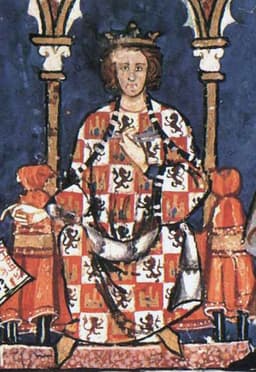
Alfonso X the Wise
Emperor · Medieval
55.5Total

Julius Caesar
General · Ancient
82.8Total
Basic Information
Born
1221
-100
Died
1284
-44
Era
Medieval
Ancient
Nationality
Castile
Roman Republic
Occupation
Emperor
General
Civilization
Western
Western
Score Comparison
Military (10%)
50.0
88.0
Political (20%)
53.8
78.0
Influence (20%)
68.0
85.0
Legacy (20%)
40.0
82.0
Leadership (15%)
74.0
80.0
Strategy (15%)
43.7
85.0
TOTAL
55.5
82.8
Alfonso X the Wise — Complete Timeline
1252 AD
Promotion of the Toledo School of TranslatorsCultural◆ Major
Alfonso X expanded the Toledo School of Translators, sponsoring the translation of Arabic works on astronomy, mathematics, philosophy, and medicine into Latin and Castilian. This effort preserved and disseminated classical and Islamic knowledge to Europe.
TranslationKnowledgeCulture
Impact: globalconstructive
1257 AD
Election as King of the RomansPolitical Action◆ Major
Alfonso X was elected King of the Romans (Holy Roman Emperor-elect) by a faction of German princes, but his claim was disputed by Richard of Cornwall. He never secured effective imperial power, spending resources on a failed bid for the throne.
ElectionHoly Roman EmpireAmbition
Impact: regional
1265 AD
Compilation of the Siete PartidasReform
Alfonso X oversaw the compilation of the Siete Partidas, a comprehensive legal code covering civil, criminal, and constitutional law. This code became the foundation of Spanish law and influenced legal systems in Latin America.
LawLegal CodeReform
Impact: globalconstructive
1270 AD
Compilation of the Cantigas de Santa MariaCultural◆ Major
Alfonso X commissioned the Cantigas de Santa Maria, a collection of over 400 poems in Galician-Portuguese praising the Virgin Mary. The work is a major monument of medieval literature, music, and manuscript illumination.
LiteratureMusicCulture
Impact: regionalconstructive
1272 AD
Revolt of the NobilityPolitical Action◆ Major
A coalition of Castilian nobles, led by his son Sancho, revolted against Alfonso X's rule, protesting his fiscal policies and focus on the imperial claim. The revolt weakened royal authority and led to a period of instability.
RevoltNobilityCivil Conflict
Impact: nationaldestructive
Julius Caesar — Complete Timeline
58 BC
Gallic WarsWar◆ Major
Caesar, as proconsul of Gaul, launched a series of campaigns that conquered all of Gaul (modern France, Belgium, and parts of Switzerland). He fought numerous battles, including against the Helvetii, the Belgae, and the Gallic chieftain Vercingetorix. The wars brought immense wealth and a loyal army to Caesar.
Gallic WarsConquestRoman Expansion
Impact: regional
49 BC
Crossing the RubiconPolitical Action◆ Major
Caesar led Legio XIII across the Rubicon River into Italy, defying the Roman Senate's order to disband his army. This act triggered a civil war against Pompey and the Optimates, ultimately leading to Caesar's dictatorship and the end of the Roman Republic.
Roman Civil WarEnd of RepublicPower Struggle
Impact: global
48 BC
Battle of PharsalusWar◆ Major
Caesar's outnumbered army defeated the larger forces of Pompey the Great at Pharsalus in Greece. Caesar's tactical use of a reserve line to counter Pompey's cavalry charge proved decisive. Pompey fled to Egypt, where he was assassinated, leaving Caesar as the undisputed master of the Roman world.
Roman Civil WarBattleDecisive Victory
Impact: regional
44 BC
Appointment as Dictator for LifePolitical Action◆ Major
The Roman Senate appointed Caesar dictator perpetuo (dictator for life), granting him unprecedented personal power. This move concentrated military, legislative, and judicial authority in one person, effectively ending the Roman Republic's traditional system of checks and balances and alarming many senators.
DictatorshipEnd of RepublicPower Consolidation
Impact: regionaldestructive
Assassination on the Ides of MarchPolitical Action◆ Major
A group of Roman senators, led by Marcus Junius Brutus and Gaius Cassius Longinus, stabbed Caesar to death at a meeting of the Senate in the Theatre of Pompey. The assassination was intended to restore the Republic, but instead triggered another civil war that led to the rise of the Roman Empire.
AssassinationRoman PoliticsEnd of Republic
Impact: globaldestructive
Expert Analysis
alfonso-x-the-wise-vs-julius-caesar
### The Conqueror and the Scholar: Two Paths to Immortality
History has a way of pairing strange bedfellows. Imagine this: in the year 1252, as Alfonso X of Castile was expanding his kingdom’s most famous institution—the Toledo School of Translators—he was also poring over star charts and legal codes, dreaming of a realm governed by reason and knowledge. A thousand miles away and thirteen centuries earlier, Julius Caesar was crossing the Rubicon River, a single act of defiance that would drown the Roman Republic in civil war. One man sought to conquer the world with legions; the other sought to codify it with laws. Both left indelible marks on Western civilization, yet their journeys could not have been more different. Why did Caesar’s ambition end in assassination and empire, while Alfonso’s ended in rebellion and a legacy of books? The answer lies not just in their deeds, but in the very nature of power itself.
### Origins
Caesar was born into the twilight of the Roman Republic, a world of patrician pride and brutal political competition. His family, the Julii, claimed descent from the goddess Venus, but their influence had waned. From his youth, Caesar was driven by a hunger for glory and a keen awareness that in Rome, reputation was currency. He spent his early years as a prisoner of pirates and a rising orator, honing the skills that would later command armies. Alfonso, by contrast, was a king born to rule. The son of Ferdinand III of Castile, he inherited a throne already consolidated by the Reconquista’s momentum. Yet his era was one of intellectual ferment, where the courts of Europe buzzed with translations from Arabic and the rediscovery of Aristotle. Where Caesar’s Rome was a crucible of ambition, Alfonso’s Castile was a library waiting to be built.
### Rise to Power
Caesar’s path was a ladder of military and political cunning. He rose through the ranks of Roman magistracies, forging the First Triumvirate with Pompey and Crassus, and then secured Gaul as his province. Between 58 and 50 BCE, he conquered a territory larger than Italy itself, turning Gaul into a proving ground for his legend. His Commentaries on the Gallic Wars were not just history—they were propaganda, crafted to make his name synonymous with victory. The Senate’s fear of his power forced his hand. In 49 BCE, he crossed the Rubicon, a river that marked the boundary between his province and Rome itself. It was a declaration of war against the Republic, and he made it with the famous words, “*Alea iacta est*”—the die is cast.
Alfonso’s rise was quieter but no less ambitious. Crowned in 1252, he did not need to conquer his throne; he needed to legitimize it. His election as King of the Romans in 1257—a title that made him Holy Roman Emperor-elect—was a political masterstroke, but it came with a fatal flaw. The German princes who elected him were divided, and his rival, Richard of Cornwall, had deeper pockets. Alfonso never set foot in Germany, spending vast sums on bribes that drained his treasury. Where Caesar used military force to seize power, Alfonso used diplomacy and coin—and both would prove costly.
### Leadership & Governance
As a leader, Caesar was a whirlwind of action. He reformed the Roman calendar, introduced land reforms for veterans, and centralized authority in his own hands. His military genius was unmatched: at the Siege of Alesia in 52 BCE, he defeated a Gallic coalition by building a ring of fortifications around both the enemy and his own army—a double siege that remains a textbook maneuver. Yet his political wisdom was flawed. He pardoned his enemies, hoping to heal the Republic, but his accumulation of titles—dictator for life, consul for ten years—smelled of monarchy. He ignored the old republican virtues, believing his personal charisma could substitute for institutions.
Alfonso governed through the pen. His greatest achievement, the *Siete Partidas* (Seven-Part Code), compiled in 1265, was a monumental legal code that covered everything from marriage to criminal law to royal succession. It was a vision of a unified, just kingdom, influenced by Roman law and the Church. But Alfonso’s rule was a study in contradictions. He poured resources into the Toledo School of Translators, sponsoring works on astronomy and mathematics that would later reach Copernicus. Yet he neglected the practical needs of his kingdom. The nobility revolted in 1272, led by his own son Sancho, furious over his fiscal policies and his obsession with the German crown. While Caesar’s enemies stabbed him in the Senate, Alfonso’s turned against him at home.
### Triumph & Tragedy
Caesar’s greatest triumph was his conquest of Gaul, which doubled Rome’s territory and made him the richest man in the Republic. His tragedy was the Ides of March, 44 BCE, when a conspiracy of senators—men he had pardoned—murdered him in the Theater of Pompey. He fell at the foot of a statue of his old rival, his blood staining the marble. His last words, according to legend, were “*Et tu, Brute?*”—a cry of betrayal.
Alfonso’s triumph was the *Cantigas de Santa Maria*, a collection of over 400 poems in Galician-Portuguese, praising the Virgin Mary. It was a cultural masterpiece, blending music, art, and devotion. His tragedy was his final years: the revolt of his nobles and his son left him isolated, his German ambitions a failure. He died in 1284, abandoned by his heir, his kingdom in turmoil. Where Caesar was killed by his peers, Alfonso was undone by his own family.
### Character & Destiny
Caesar was a man of relentless energy and calculated risk. He slept with his enemies’ wives, gambled on battles, and wrote his own history. His personality—arrogant, charismatic, and ruthless—shaped his destiny. He believed he was destined for greatness, and that belief became a self-fulfilling prophecy. But his arrogance blinded him to the Republic’s resilience. He thought he could bend the Senate to his will; instead, it broke him.
Alfonso was a scholar first, a king second. He was called “the Wise” for his learning, but his wisdom was theoretical. He could codify justice but not enforce it. He could translate Ptolemy but not pacify his nobles. His character—patient, intellectual, and detached—led him to prioritize legacy over power. He built a kingdom of the mind, but his earthly kingdom crumbled.
### Legacy
Caesar’s legacy is a paradox. He destroyed the Republic, but from its ashes rose the Roman Empire, which would endure for centuries. His name became a title: *Caesar* meant emperor in Latin, *Kaiser* in German, *Tsar* in Russian. His writings shaped military strategy for two millennia. He is remembered as a conqueror and a tyrant, a genius and a warning.
Alfonso’s legacy is quieter but profound. The *Siete Partidas* became the foundation of Spanish law and influenced legal systems across Latin America. The *Cantigas* are a treasure of medieval music. His Toledo School preserved knowledge that would spark the Renaissance. He is remembered not as a warrior, but as a patron of wisdom—a king who built with books, not swords.
### Conclusion
Standing at the edge of history, we see two men who sought immortality through very different means. Caesar crossed rivers of blood; Alfonso crossed seas of ink. One built an empire that would fall, only to rise again in name. The other built a code that would outlast his throne. Their fates remind us that power is not just about armies or laws—it is about understanding the world you live in. Caesar understood his Rome and bent it to his will, until it broke. Alfonso understood his Castile but could not govern it. In the end, both achieved what they sought: a name that would not be forgotten. The question is not which was greater, but which kind of greatness we choose to remember.
Rankings
🥇
Julius CaesarLeader
Mil: 88.0Pol: 78.0Inf: 85.0
82.8
🥈
Alfonso X the Wise
Mil: 50.0Pol: 53.8Inf: 68.0
55.5
+27.3 behind
How This Comparison Works
Algorithm
Each figure is scored on 6 dimensions (0—100 scale) based on structured historical data: Military (10%), Political (20%), Influence (20%), Legacy (20%), Leadership (15%), Strategy (15%). The weighted total produces the final ranking.
Data Sources
Scores are computed from structured sub-indicators in the database. Scale factors adjust for era (Ancient ×0.85, Modern ×1.0) and civilization size (Eastern ×1.05, Other ×0.80) to account for differences in population and military scale.
Maximum 3 Figures
Comparisons are limited to 2—3 figures to ensure readability and statistical meaningfulness.
Error Margins
±5 points per dimension — Sub-scores are derived from historical records with inherent uncertainty. Two figures within 5 points on a dimension should be considered roughly equivalent in that area.
Total Score Accuracy
±3 points overall — The weighted combination of 6 dimensions produces a total score with approximately ±3 points of uncertainty. Differences of less than 3 points are not statistically significant— the figures are effectively tied.
Known Limitations
- Historical records are incomplete and uneven across civilizations
- Figures from oral-tradition societies may be underrepresented
- Occupation labels can misclassify multi-role figures
- Scores measure capability and impact, not moral character
- Quantitative scoring is a comparison tool, not absolute truth
Capability Radar
Military (10%) — Battles & Warfare
Battles
20
95
Win Rate
15
92
Expansion
10
97
Political (20%) — Governance & Reform
Reform
85
90
Diplomacy
50
85
Economy
40
82
Influence (20%) — Cultural & Global Reach
Cultural
85
88
Global
65
94
Legacy (20%) — Historical Impact
Historical
80
95
Longevity
75
96
Leadership (15%) — Power & Stability
Tenure
60
75
Stability
30
60
Strategy (15%) — Tactics & Innovation
Strategy
15
94
Tactics
10
96
Reform
30
88
Similar Comparisons
Comments & Discussion
TiberiusScribe6/17/2026
Caesar wins this hands down, no contest. Alfonso was a bookworm king who let his nobles run rampant—his own son rebelled against him, and his legal code, the Siete Partidas, wasn't even fully implemented until centuries later. Caesar wrote his own history between battles, sure, but he conquered Gaul, invaded Britain, and crossed the Rubicon. That's impact. Alfonso’s "books" are just expensive dust-collectors compared to reshaping the Western world with a few legions.
星图判官6/17/2026
拿星盘去比剑刃?这本身就不公平。阿方索十世不是败了,他是选了一条更艰难的路。卡斯蒂利亚的王位在他手里摇摇欲坠,但他却撑着托莱多翻译院,把阿拉伯的天文学和亚里士多德的逻辑学塞进拉丁欧洲的脑子。恺撒流干了高卢的血来换一个独裁者的虚名,阿方索却用一本《天文知识》改变了欧洲人对宇宙的认识。哪个更不朽?你自己掂量。
LegionaryLogic6/17/2026
I’ll take a general who understood logistics over a king who understood star charts. Caesar’s Commentaries aren’t just propaganda—they’re a masterclass in military organization, from siege engines to supply lines. Alfonso got deposed by his own son because he couldn’t manage a civil war. You can’t codify your way out of a rebellion. Caesar proved that boots on the ground beat ink on parchment every single time.
笔墨铁血6/17/2026
世人只夸阿方索的《七法全书》,却忘了这本法典在他活着时根本没人买账。卡斯蒂利亚的贵族照样私斗,摩尔人照样在南方烧杀,他的儿子桑乔四世干脆把他赶下台——一个国王连政权都保不住,还谈什么遗产?恺撒死后罗马陷入了更长的内战,但至少他活着的时候,整个高卢和半个元老院都在他脚下。统治不是读书,是杀人,是收买,是让人怕你。
ClassicusRex6/17/2026
The comparison misses the deeper philosophical rift. Caesar represents the humanist ideal of *vita activa*—the life of action, rhetoric, and conquest. Alfonso embodies the *vita contemplativa*—the life of study, law, and order. Which lasts? Look at the medieval universities: Alfonso’s legal compilations and astronomical tables directly shaped scholastic thought for generations. Caesar’s legions just made him a footnote in one glorious, bloody chapter.