Loading...
Alfonso I of Aragon vs Napoleon Bonaparte
Napoleon Bonaparte leads by 13.7 pts · 2 figures compared
…
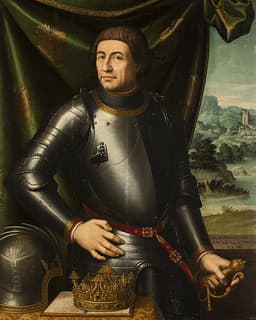
Alfonso I of Aragon
Emperor · Medieval
57.2Total

Napoleon Bonaparte
General · Modern
70.9Total
Basic Information
Born
1073
1769
Died
1134
1821
Era
Medieval
Modern
Nationality
Aragon
France
Occupation
Emperor
General
Civilization
Western
Western
Score Comparison
Military (10%)
60.0
94.0
Political (20%)
48.0
72.0
Influence (20%)
55.7
40.0
Legacy (20%)
49.2
80.0
Leadership (15%)
74.0
78.0
Strategy (15%)
66.3
90.0
TOTAL
57.2
70.9
Alfonso I of Aragon — Complete Timeline
1109 AD
Marriage to Urraca of Leon and CastilePolitical Action◆ Major
Alfonso I married Queen Urraca of Leon and Castile, uniting the kingdoms of Aragon, Navarre, Leon, and Castile. The union was politically unstable, leading to conflict with Urraca and the Church, and was annulled by the Pope in 1114.
MarriagePolitical UnionConflict
Impact: regional
1118 AD
Conquest of ZaragozaWar◆ Major
Alfonso I led a coalition of Aragonese, Navarrese, and French crusaders to capture the city of Zaragoza from the Almoravid Moors. This victory made Zaragoza the capital of Aragon and significantly expanded Christian territory in the Ebro valley.
ReconquistaConquestAragon
Impact: regionalconstructive
1120 AD
Battle of CutandaWar◆ Major
Alfonso I defeated a large Almoravid army at Cutanda, near Calamocha. This victory consolidated Christian control over the Ebro valley and opened the way for further Aragonese advances into Moorish territory.
ReconquistaBattleAragon
Impact: regionalconstructive
1134 AD
Battle of FragaWar◆ Major
Alfonso I was defeated and killed by Almoravid forces near Fraga while attempting to besiege the town. His death without direct heirs led to a succession crisis in Aragon and Navarre, separating the two kingdoms.
ReconquistaBattleDeath
Impact: regionaltragic
Napoleon Bonaparte — Complete Timeline
1799 AD
Coup of 18 BrumaireOther◆ Major
Napoleon Bonaparte, with support from his brother Lucien and key political figures, overthrew the Directory in a bloodless coup. He established the Consulate with himself as First Consul, effectively becoming the ruler of France. This event ended the French Revolution's most unstable period.
French RevolutionCoupRise to Power
Impact: regional
1804 AD
Promulgation of the Napoleonic CodeOther◆ Major
Napoleon enacted the Civil Code of the French, known as the Napoleonic Code, a comprehensive set of laws that replaced the fragmented feudal legal systems. The code established legal equality, protected property rights, and secularized law. It became the basis for legal systems in many European and world countries.
Legal ReformNapoleonic CodeCivil Law
Impact: globalconstructive
1805 AD
Battle of AusterlitzWar◆ Major
Napoleon's Grande Arm
Napoleonic WarsBattleDecisive Victory
Impact: global
1812 AD
Invasion of RussiaWar◆ Major
Napoleon led the Grande Arm
Napoleonic WarsInvasionDisaster
Impact: globaldestructive
1815 AD
Battle of WaterlooWar◆ Major
Napoleon's French army was defeated by the combined forces of the Duke of Wellington's Anglo-Allied army and Gebhard Leberecht von Bl
Napoleonic WarsBattleFinal Defeat
Impact: globaldestructive
Expert Analysis
alfonso-i-of-aragon-vs-napoleon-bonaparte
### The Conqueror and the Crusader
In the summer of 1815, a stocky, pale man in a gray greatcoat stood on a muddy hill in Belgium, watching his Imperial Guard march into the maw of British cannon. Within hours, Napoleon Bonaparte’s dream of European dominion would shatter at Waterloo. Eight centuries earlier, another warrior-king, Alfonso I of Aragon, lay dying on a Spanish battlefield near the town of Fraga, his body broken by Almoravid spears. One emperor fell in a blaze of global fame; the other vanished into the obscurity of medieval chronicles. Why did one man’s conquests reshape the modern world, while the other’s remain a footnote? The answer lies not in their ambition—both burned with it—but in the eras that forged them and the choices that doomed them.
### Origins
Napoleon was born in 1769 on the island of Corsica, a place conquered by France only months before his birth. His family were minor Italian nobility, resentful of French rule, but young Napoleon embraced the revolutionary energy that swept Paris in 1789. The Revolution was a furnace: it melted old hierarchies and promoted talent over birth. A boy who spoke French with a thick accent could become emperor. He devoured military history, studied artillery, and learned to exploit chaos.
Alfonso I, born in 1073, came from a world of iron and faith. The Kingdom of Aragon was a small Christian realm clinging to the Pyrenees, surrounded by the powerful Muslim taifas—fractured successor states of the Caliphate of Córdoba. His father, Sancho Ramírez, had been killed in battle against the Moors. Alfonso inherited a warrior’s ethos: the Reconquista was not a political project but a holy war. There was no revolutionary meritocracy here—only bloodlines, oaths, and the cross. For Alfonso, the world was static: Christian or Muslim, lord or vassal. For Napoleon, the world was malleable.
### Rise to Power
Napoleon’s ascent was meteoric. At 24, he drove the British out of Toulon. At 26, he suppressed a royalist uprising with a “whiff of grapeshot.” By 30, he had conquered Italy and Egypt, turning newspapers into propaganda tools. His coup of 18 Brumaire in 1799 made him First Consul of France. He understood that in a revolutionary age, the man who controlled the narrative controlled the state. Every victory was a headline; every defeat was rewritten as a strategic retreat.
Alfonso’s path was slower, harder. He became King of Aragon and Navarre in 1104, inheriting a kingdom of mountain valleys and small fortresses. His great opportunity came in 1109, when he married Queen Urraca of León and Castile—a political union meant to unite the Christian north. But Urraca was a fierce ruler in her own right, and their marriage became a civil war of raids, betrayals, and sieges. Unlike Napoleon, who could bend parliaments and constitutions, Alfonso could not bend his wife. The union collapsed into chaos, and by 1114, he was fighting his own stepson. His road to power was a tangled thicket of family feuds and feudal oaths, not a highway of national glory.
### Leadership & Governance
Napoleon governed with the precision of an artilleryman. He centralized the French state, created the Bank of France, and most famously, codified the Napoleonic Code—a legal system that enshrined equality before the law, property rights, and secular administration. He appointed prefects, built roads, and reformed education. His military genius (scoring 94.0 in strategy) lay in speed and deception: he split enemy armies, struck at their flanks, and lived off the land. At Austerlitz in 1805, he crushed the Austrian and Russian empires in a single day. He was a master of the decisive battle.
Alfonso ruled through charisma and the sword. His leadership score of 84.6 reflects a king who fought at the front, not from a tent. He conquered Zaragoza in 1118 after a brutal siege, leading a coalition of Aragonese, Navarrese, and French crusaders. The city was the greatest prize in the Ebro Valley, and its fall broke Almoravid power in the region. At the Battle of Cutanda in 1120, he annihilated a massive Almoravid army, securing Christian control over a vast territory. But his governance was thin—he granted lands to nobles and churches, but never built a bureaucracy. Aragon remained a patchwork of feudal loyalties, not a nation-state.
### Triumph & Tragedy
Napoleon’s greatest moment was the Empire’s peak in 1810–1812, when he controlled most of continental Europe. His tragic flaw was hubris: the invasion of Russia in 1812, with 600,000 men, ended in a frozen disaster. He lost his army, his mystique, and eventually his throne. Even his return in 1815, the Hundred Days, was a desperate gamble that ended at Waterloo. His political score of 75.0 reflects a man who could conquer but could not consolidate—he made enemies of Britain, Spain, and Russia, and could not forgive a defeat.
Alfonso’s triumph was the conquest of Zaragoza, a victory that reshaped the Reconquista. His tragedy came at the Battle of Fraga in 1134. He was 61 years old, still leading charges, still believing in holy war. The Almoravids had regrouped, and his army was ambushed. Alfonso died on the field, his body lost to the enemy. He left no children—his marriage to Urraca had produced no heir, and he never remarried. His kingdoms fractured: Aragon went to his brother, Navarre to a noble. All his conquests were nearly undone.
### Character & Destiny
Napoleon was a man of the Enlightenment who acted like a Roman emperor. He believed in reason, merit, and destiny—but also in his own myth. His personality was a paradox: a brilliant administrator who could not delegate, a liberator who crowned himself, a reformer who reinstated slavery. He was driven by an insatiable hunger for glory, writing, “Impossible is a word to be found only in the dictionary of fools.” That hunger built an empire and destroyed it.
Alfonso was a medieval warrior-king, simple and brutal. He was called “the Battler” for good reason—he fought at least 29 recorded battles. He had no interest in law codes or statecraft; he saw kingship as a military office. His piety was genuine: he donated lands to monasteries and crusaded with zeal. But he lacked Napoleon’s strategic depth (scoring only 58.1 in strategy) and political flexibility. He could win battles but not wars of attrition. His destiny was to be a hammer, not a sculptor.
### Legacy
Napoleon’s legacy is stamped on the modern world. The Napoleonic Code influences civil law from France to Brazil. He redrew the map of Europe, ended the Holy Roman Empire, and inspired nationalism in Germany and Italy. His memory is contested—hero to some, tyrant to others—but undeniable. His legacy score of 78.0 reflects a man who changed how we think about law, war, and power.
Alfonso’s legacy is quieter. He is remembered in Spain as a great Reconquista king, but his empire did not last. His conquest of Zaragoza secured the Ebro Valley for Christendom, but his death without an heir left Aragon vulnerable. His legacy score of 65.2 is a reminder that in the Middle Ages, personal rule was fragile—a king’s death could undo a lifetime of work. He is a footnote in textbooks, a statue in Zaragoza, a name in medieval chronicles.
### Conclusion
Standing at Waterloo, Napoleon could look back on a career that had remade the world. Alfonso, bleeding out near Fraga, could only look back on a life of struggle. Both were warriors, both died in defeat, but their differences reveal the chasm between two ages. Napoleon lived in an era of print, bureaucracy, and nationalism—tools that amplified his power and his failure. Alfonso lived in an age of faith, feudalism, and family—a world where a king’s sword was his only constitution. One conquered continents; the other conquered a river valley. One built a legal system; the other built a reputation. And in the end, both were betrayed by the very thing that made them great: the belief that a single man could shape history alone.
Rankings
🥇
Napoleon BonaparteLeader
Mil: 94.0Pol: 72.0Inf: 40.0
70.9
🥈
Alfonso I of Aragon
Mil: 60.0Pol: 48.0Inf: 55.7
57.2
+13.7 behind
How This Comparison Works
Algorithm
Each figure is scored on 6 dimensions (0—100 scale) based on structured historical data: Military (10%), Political (20%), Influence (20%), Legacy (20%), Leadership (15%), Strategy (15%). The weighted total produces the final ranking.
Data Sources
Scores are computed from structured sub-indicators in the database. Scale factors adjust for era (Ancient ×0.85, Modern ×1.0) and civilization size (Eastern ×1.05, Other ×0.80) to account for differences in population and military scale.
Maximum 3 Figures
Comparisons are limited to 2—3 figures to ensure readability and statistical meaningfulness.
Error Margins
±5 points per dimension — Sub-scores are derived from historical records with inherent uncertainty. Two figures within 5 points on a dimension should be considered roughly equivalent in that area.
Total Score Accuracy
±3 points overall — The weighted combination of 6 dimensions produces a total score with approximately ±3 points of uncertainty. Differences of less than 3 points are not statistically significant— the figures are effectively tied.
Known Limitations
- Historical records are incomplete and uneven across civilizations
- Figures from oral-tradition societies may be underrepresented
- Occupation labels can misclassify multi-role figures
- Scores measure capability and impact, not moral character
- Quantitative scoring is a comparison tool, not absolute truth
Capability Radar
Military (10%) — Battles & Warfare
Battles
70
95
Win Rate
75
90
Expansion
65
95
Political (20%) — Governance & Reform
Reform
45
95
Diplomacy
50
80
Economy
40
85
Influence (20%) — Cultural & Global Reach
Cultural
40
85
Global
35
90
Legacy (20%) — Historical Impact
Historical
55
95
Longevity
40
90
Leadership (15%) — Power & Stability
Tenure
60
85
Stability
45
70
Strategy (15%) — Tactics & Innovation
Strategy
70
95
Tactics
65
98
Reform
40
92
Similar Comparisons
Comments & Discussion
Conqueror's Ghost6/17/2026
Calling this a comparison is like comparing a wildfire to a bonfire. Napoleon burned through Europe in a decade, rewriting borders and laws that still echo today. Alfonso? He spent 30 years bashing heads in a regional scuffle that barely registered outside Iberia. Waterloo gave us modern geopolitics; Fraga gave us a dead king in a forgotten field. Scale matters, and one of these men altered the course of history for half a continent.
史记新读6/17/2026
拿皇是工业革命的第一位大统帅,他的推进速度与后勤改革,背后是现代国家的萌芽。阿方索一世再英勇,也只是中世纪教会棋局里的一枚卒子。数据上看,拿破仑动辄指挥十万大军跨越阿尔卑斯,阿方索的“大军”可能连一个现代师的补给都撑不过三天。时代的硬件决定了胜负的层级,这不叫公平对决,叫降维打击。
Classical Crusader6/17/2026
Alfonso I wasn't a "footnote"—he was the prototype. Before him, Aragon was a Pyrenean backwater; after his campaigns, it was a Mediterranean power. He pioneered the use of urban militias and feudal levies in tandem, a tactical innovation Napoleon would have recognized. And while Napoleon died in exile, Alfonso died in the saddle, fighting the same jihad that had defined his life. One ended as a legend, the other as a martyr. I know which I'd rather be.
数据求真侠6/17/2026
说拿破仑重塑世界?别急着盖棺。1815年俄国的人口是法国的三倍,英国的海军封锁吸干了法国的经济。拿破仑的帝国倒闭,根本原因不是军事失误,而是资源错配。反观阿方索一世,他用有限的土地养活了一支常备军,还从摩尔人手里抢来了萨拉戈萨—这战果的性价比,拿破仑在埃及和俄国能比吗?历史评价总偏心大场面。
Medieval Realist6/17/2026
Let's be honest: Alfonso I was a successful warlord in a world where "success" meant grabbing a few towns and dying before the Muslims got you. Napoleon was a world-historical phenomenon who mobilized entire nations and codified law codes we still use. Comparing them is like comparing a skilled village blacksmith to James Watt. One is admirable; the other is revolutionary. And revolutions are what move the needle of history.