Loading...
Alexios III Angelos vs Napoleon Bonaparte
Napoleon Bonaparte leads by 33.4 pts · 2 figures compared
…
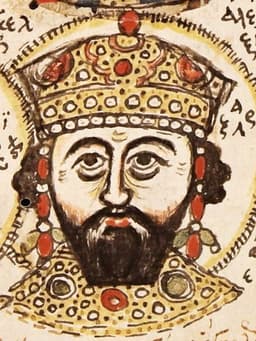
Alexios III Angelos
Emperor · Medieval
37.5Total

Napoleon Bonaparte
General · Modern
70.9Total
Basic Information
Born
1153
1769
Died
1211
1821
Era
Medieval
Modern
Nationality
Byzantine Empire
France
Occupation
Emperor
General
Civilization
Western
Western
Score Comparison
Military (10%)
20.0
94.0
Political (20%)
32.1
72.0
Influence (20%)
45.5
40.0
Legacy (20%)
35.8
80.0
Leadership (15%)
39.0
78.0
Strategy (15%)
45.0
90.0
TOTAL
37.5
70.9
Alexios III Angelos — Complete Timeline
1195 AD
Usurpation of the throne from Isaac IIPolitical Action◆ Major
Alexios III Angelos overthrew his brother Isaac II in a palace coup, blinding and imprisoning him. Alexios III then ruled as emperor, but his reign was marked by corruption, fiscal mismanagement, and the weakening of Byzantine defenses.
CoupDynastic ConflictUsurpation
Impact: nationaldestructive
1203 AD
Flight from Constantinople during the Fourth CrusadePolitical Action◆ Major
When the Fourth Crusade besieged Constantinople in 1203, Alexios III fled the city with the imperial treasury, abandoning his subjects. His cowardly flight left the capital defenseless and allowed the crusaders to restore Isaac II and Alexios IV, but also set the stage for the eventual sack of Constantinople in 1204.
Fourth CrusadeFlightAbandonment
Impact: regionaltragic
1211 AD
Capture and death in Nicaean captivityPolitical Action
Alexios III was captured by Theodore I Laskaris, the Nicaean emperor, after attempting to regain power with Seljuk support. He was imprisoned in a monastery in Nicaea, where he died later that year, ending his attempts to reclaim the Byzantine throne.
CaptivityNicaean EmpireSeljuk Alliance
tragic
Napoleon Bonaparte — Complete Timeline
1799 AD
Coup of 18 BrumaireOther◆ Major
Napoleon Bonaparte, with support from his brother Lucien and key political figures, overthrew the Directory in a bloodless coup. He established the Consulate with himself as First Consul, effectively becoming the ruler of France. This event ended the French Revolution's most unstable period.
French RevolutionCoupRise to Power
Impact: regional
1804 AD
Promulgation of the Napoleonic CodeOther◆ Major
Napoleon enacted the Civil Code of the French, known as the Napoleonic Code, a comprehensive set of laws that replaced the fragmented feudal legal systems. The code established legal equality, protected property rights, and secularized law. It became the basis for legal systems in many European and world countries.
Legal ReformNapoleonic CodeCivil Law
Impact: globalconstructive
1805 AD
Battle of AusterlitzWar◆ Major
Napoleon's Grande Arm
Napoleonic WarsBattleDecisive Victory
Impact: global
1812 AD
Invasion of RussiaWar◆ Major
Napoleon led the Grande Arm
Napoleonic WarsInvasionDisaster
Impact: globaldestructive
1815 AD
Battle of WaterlooWar◆ Major
Napoleon's French army was defeated by the combined forces of the Duke of Wellington's Anglo-Allied army and Gebhard Leberecht von Bl
Napoleonic WarsBattleFinal Defeat
Impact: globaldestructive
Expert Analysis
alexios-iii-angelos-vs-napoleon-bonaparte
The Emperor Who Conquered the World and the One Who Lost It
In the annals of history, few contrasts are as stark as that between Napoleon Bonaparte and Alexios III Angelos. One stands astride the early nineteenth century like a colossus, his name synonymous with military genius and imperial ambition; the other is a shadowy figure from the twilight of Byzantium, remembered—if at all—for a flight of such craven desperation that it sealed the fate of a thousand-year empire. Both wore crowns; both commanded armies; both faced moments of supreme crisis. Yet from almost identical positions of power, they diverged into polar extremes of triumph and catastrophe. What made the difference? The answer lies not merely in luck or circumstance, but in the marrow of character itself.
Origins
Napoleon Bonaparte was born in 1769 on the Mediterranean island of Corsica, a place that had only recently passed from Genoese to French rule. His family belonged to the minor nobility, but they were far from wealthy. The young Napoleon grew up speaking Italian-accented French, an outsider in the nation he would one day rule. This marginality forged in him a relentless drive to prove himself. He entered military school at nine, graduated at sixteen, and plunged into the chaos of the French Revolution—a world where old hierarchies crumbled and raw talent could ascend like a rocket.
Alexios III Angelos, born in 1153, came from an entirely different world: the court of the Byzantine Empire, that gilded labyrinth of intrigue, orthodoxy, and inherited legitimacy. His family, the Angeloi, were aristocrats of the highest rank, connected to the ruling Komnenos dynasty. But privilege bred complacency. Unlike Napoleon, who had to fight for every step, Alexios was born into a system where power was a matter of blood, not merit. The empire he inherited was already decaying—its treasury drained, its provinces slipping away, its army a shadow of the force that had once terrified the Mediterranean. Where Napoleon’s era was one of revolutionary upheaval, Alexios’s was one of slow, grinding decline.
Rise to Power
Napoleon’s ascent was a masterpiece of opportunism and audacity. In 1795, at just twenty-six, he saved the revolutionary government from a royalist mob with a “whiff of grapeshot”—a brutal display of artillery that made him a national hero. Two years later, he led a ragged army across the Alps into Italy and shattered the Austrian forces in a campaign that still dazzles military historians. By 1799, he had seized power in a coup, becoming First Consul. His path was not clean or noble; he manipulated factions, suppressed dissent, and crowned himself emperor in 1804. But every step was calculated, every risk weighed. He understood power because he had earned it.
Alexios III’s rise was far simpler—and far uglier. In 1195, while his brother Isaac II was away on campaign against the Bulgarians, Alexios staged a palace coup. He had Isaac blinded—a standard Byzantine punishment that disqualified a man from ruling—and thrown into a dungeon. Then he sat on the throne. No battlefield glory, no popular mandate, no revolutionary fervor. Just a cold, cowardly seizure of power. He ruled not by strength but by default, surrounded by sycophants and terrified of the very army that was supposed to protect him.
Leadership & Governance
Napoleon’s rule transformed Europe. He codified French law into the Napoleonic Code, a rational system that abolished feudalism, protected property rights, and established equality before the law—principles that still underpin legal systems across the continent. He reformed education, centralized the bureaucracy, and built roads and canals that bound France together. As a military commander, he was peerless: at Austerlitz in 1805, he destroyed a larger Russo-Austrian army with a trap so elegant it became a textbook maneuver. His leadership score of 80 and strategy score of 93 reflect a man who could inspire soldiers to die for him and outthink opponents on every battlefield.
Alexios III ruled in an atmosphere of paralysis. He did nothing to reform the Byzantine army, which had long relied on mercenaries. He did nothing to stabilize the economy, which was hemorrhaging gold. When the Fourth Crusade arrived at Constantinople’s walls in 1203—ostensibly to restore his blinded brother’s son to the throne—Alexios responded not with fortitude but with panic. He failed to organize a defense, failed to rally the populace, and failed to negotiate. Instead, he gathered the imperial treasury and fled into the night, leaving his capital to be sacked by men who had come as Christians but left as barbarians. His military score of 54 and political score of 48 are generous.
Triumph & Tragedy
Napoleon’s greatest moment was Austerlitz, where he crushed the Third Coalition and forced the Holy Roman Empire into dissolution. His tragedy was Russia. In 1812, he marched half a million men into the frozen vastness; only a fraction returned. The disaster broke his aura of invincibility, leading to his first abdication in 1814. He returned for the Hundred Days in 1815, only to meet final defeat at Waterloo—a battle he might have won had his generals performed better or the rain stopped earlier. Yet even in defeat, he retained a dignity that made him a legend.
Alexios III’s tragedy was not a single battle but a lifetime of failure. After fleeing Constantinople, he wandered the Byzantine remnants, trying to reclaim power with the help of Seljuk Turks. In 1211, he was captured by Theodore I Laskaris, the Nicaean emperor who was actually trying to rebuild Byzantium. Alexios died in captivity, forgotten and despised. His only “triumph” was the blinding of his brother—an act that brought him nothing but a brief, hollow reign.
Character & Destiny
Napoleon was a man of boundless energy, supreme self-confidence, and a mind that could hold entire armies in its grasp. He was also arrogant, ruthless, and consumed by ambition. His character drove him to conquer Europe—and also to overreach. He once said, “Power is my mistress. I have worked too hard at her conquest to allow anyone to take her from me.” That obsession made him great, but it also made him blind to the limits of his own power.
Alexios III was defined by fear. He seized the throne because he was too weak to earn it; he fled because he was too weak to fight for it. His decisions were not the product of grand strategy but of panic. He left no memorable quotes, no great reforms, no lasting mark except the shame of a capital lost. His character was not a tragic flaw but an absence of character altogether.
Legacy
Napoleon’s legacy is immense. He reshaped the map of Europe, spread the ideals of the French Revolution, and inspired nationalist movements across the continent. His military innovations are still studied; his legal code is still used. He is remembered as both a tyrant and a visionary, a man who liberated and enslaved in equal measure.
Alexios III’s legacy is a cautionary tale. He is a footnote in the story of Byzantium’s fall—a symbol of the corruption and cowardice that doomed a civilization. Where Napoleon’s name evokes awe, Alexios’s evokes pity. One built an empire; the other lost one. The difference was not in their times, but in themselves.
Conclusion
Standing on opposite ends of the historical spectrum, Napoleon and Alexios III reveal a truth as old as power itself: that the same stage can produce a titan or a ghost. Napoleon’s rise from Corsican outsider to master of Europe is a story of will; Alexios’s fall from imperial heir to fleeing fugitive is a story of its absence. One shaped the world; the other was swallowed by it. In the end, history does not judge by birth or circumstance, but by what a person does when the moment comes. Napoleon seized his moment with both hands; Alexios let his slip through trembling fingers. That is why one still echoes through the ages, and the other is barely a whisper.
Rankings
🥇
Napoleon BonaparteLeader
Mil: 94.0Pol: 72.0Inf: 40.0
70.9
🥈
Alexios III Angelos
Mil: 20.0Pol: 32.1Inf: 45.5
37.5
+33.4 behind
How This Comparison Works
Algorithm
Each figure is scored on 6 dimensions (0—100 scale) based on structured historical data: Military (10%), Political (20%), Influence (20%), Legacy (20%), Leadership (15%), Strategy (15%). The weighted total produces the final ranking.
Data Sources
Scores are computed from structured sub-indicators in the database. Scale factors adjust for era (Ancient ×0.85, Modern ×1.0) and civilization size (Eastern ×1.05, Other ×0.80) to account for differences in population and military scale.
Maximum 3 Figures
Comparisons are limited to 2—3 figures to ensure readability and statistical meaningfulness.
Error Margins
±5 points per dimension — Sub-scores are derived from historical records with inherent uncertainty. Two figures within 5 points on a dimension should be considered roughly equivalent in that area.
Total Score Accuracy
±3 points overall — The weighted combination of 6 dimensions produces a total score with approximately ±3 points of uncertainty. Differences of less than 3 points are not statistically significant— the figures are effectively tied.
Known Limitations
- Historical records are incomplete and uneven across civilizations
- Figures from oral-tradition societies may be underrepresented
- Occupation labels can misclassify multi-role figures
- Scores measure capability and impact, not moral character
- Quantitative scoring is a comparison tool, not absolute truth
Capability Radar
Military (10%) — Battles & Warfare
Battles
5
95
Win Rate
5
90
Expansion
5
95
Political (20%) — Governance & Reform
Reform
10
95
Diplomacy
10
80
Economy
10
85
Influence (20%) — Cultural & Global Reach
Cultural
5
85
Global
5
90
Legacy (20%) — Historical Impact
Historical
10
95
Longevity
5
90
Leadership (15%) — Power & Stability
Tenure
20
85
Stability
5
70
Strategy (15%) — Tactics & Innovation
Strategy
5
95
Tactics
5
98
Reform
5
92
Similar Comparisons
Comments & Discussion
数据侦探6/17/2026
统计上讲,这对比纯属胡闹。拿破仑统治法国14年,打过70多场战役,只输7次;亚历克西斯三世在位8年,主要成就是把国库都挖出来给十字军当贿赂——结果人家还是洗劫了君士坦丁堡。相似度为零。这图灵测试是不是算法故障了?
Legion Lector6/17/2026
The real difference isn't generalship—it's what they did with a dying empire. Napoleon tried to save revolutionary France, and even at Waterloo, he fought like a lion. Alexios III, by contrast, threw Byzantium under the proverbial bus. While the Fourth Crusade camped outside his walls in 1203, he fled, leaving his citizens to the Latin wolves. That’s not bad luck; that’s a hen with no spine.
历史红卫兵6/17/2026
说军事才能?拿破仑这个帝国主义乌鸦嘴确实打遍天下,但你看亚历克西斯三世——那叫“战略性撤退”,懂吗?人家可是拜占庭贵族圈里的终极玩家,利用特权把钱都堆成金库,最后逃到尼基米底亚还能统治几年。反观拿破仑,被送去圣赫勒拿岛就玩完了。谁更会玩升官发财死老婆?明显是拜占庭老狐狸。
Classics Contrarian6/17/2026
You’re all missing the meta: Alexios III wasn't a general—he was a bureaucrat’s emperor. Byzantium’s real strength was always its treasury and diplomacy, not battlefield heroics. Napoleon’s cannon fodder might win battles, but Alexios’s gold bought enemies. Too bad he spent it all on himself. Still, if you look at the Big Picture, both were just passengers on history’s Titanic—one hit the iceberg faster, that’s all.
Historian6556/17/2026
Let's be real: comparing these two is like putting a Ferrari next to a rusted-out oxcart. Napoleon humiliated Europe's finest armies at Austerlitz; Alexios III literally fled Constantinople when the Fourth Crusade showed up, hiding in a pouch with his wife. Sure, both had shaky claims to their thrones, but one built a legend from Corsican obscurity while the other inherited purple and pissed it away. Case closed.