Loading...
Alexander the Great vs Vauban
Alexander the Great leads by 8.8 pts · 2 figures compared
…
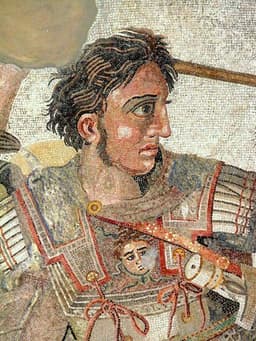
Alexander the Great
General · Ancient
85.2Total

Vauban
General · Modern
76.4Total
Basic Information
Born
-356
1633
Died
-323
1707
Era
Ancient
Modern
Nationality
Macedon
France
Occupation
General
General
Civilization
Western
Western
Score Comparison
Military (10%)
95.0
76.0
Political (20%)
60.0
59.3
Influence (20%)
92.0
71.0
Legacy (20%)
90.0
90.0
Leadership (15%)
80.0
77.2
Strategy (15%)
92.0
80.6
TOTAL
85.2
76.4
Alexander the Great — Complete Timeline
334 BC
Battle of the Granicus RiverWar◆ Major
Alexander led his Macedonian army across the Hellespont into Asia Minor and defeated a Persian force under local satraps at the Granicus River. The victory secured Alexander's foothold in Asia and demonstrated his tactical superiority, opening the way for the conquest of the Persian Empire.
Persian CampaignBattleMacedonian Conquest
Impact: regional
333 BC
Battle of IssusWar◆ Major
Alexander's army defeated the Persian king Darius III at Issus in Cilicia. Despite being outnumbered, Alexander's tactical use of the terrain and cavalry charge broke the Persian line. Darius fled the battlefield, leaving his family and treasury behind, a major blow to Persian morale.
Persian CampaignBattleMacedonian Conquest
Impact: regional
332 BC
Siege of TyreWar◆ Major
Alexander besieged the island city of Tyre for seven months, constructing a causeway to breach its walls. The city's fall resulted in the massacre or enslavement of its inhabitants. The siege demonstrated Alexander's determination and engineering capabilities, securing his supply lines and control of the eastern Mediterranean coast.
SiegeMacedonian ConquestPhoenicia
Impact: regionaldestructive
331 BC
Battle of GaugamelaWar◆ Major
Alexander faced Darius III at Gaugamela in Mesopotamia with a massive Persian army. Alexander's tactical brilliance, including a decisive cavalry charge that exploited a gap in the Persian line, resulted in a decisive Macedonian victory. Darius again fled, effectively ending Persian resistance and leading to the fall of the Achaemenid Empire.
Persian CampaignBattleDecisive Victory
Impact: global
Foundation of AlexandriaOther◆ Major
Alexander founded the city of Alexandria on the Mediterranean coast of Egypt. He personally selected the site and oversaw the initial planning. Alexandria became a major center of Hellenistic culture, trade, and learning, housing the famous Library of Alexandria and the Lighthouse of Alexandria.
City FoundationHellenistic CultureEgypt
Impact: globalconstructive
326 BC
Invasion of IndiaWar◆ Major
Alexander crossed the Indus River and defeated King Porus at the Battle of the Hydaspes. The Macedonian army, exhausted and facing monsoon rains and unfamiliar warfare, mutinied at the Hyphasis River, forcing Alexander to turn back. This campaign marked the easternmost extent of his conquests.
Indian CampaignBattleMutiny
Impact: regional
Vauban — Complete Timeline
1673 AD
Siege of MaastrichtWar◆ Major
Vauban directed the siege of Maastricht for Louis XIV. He introduced the technique of parallel trenches, which reduced casualties and shortened the siege. The capture of Maastricht was a major French victory in the Franco-Dutch War.
Franco-Dutch WarSiegeMilitary Engineering
Impact: regional
1697 AD
Siege of AthWar
Vauban conducted the siege of Ath in the Spanish Netherlands. His systematic approach using parallels and saps led to the rapid capture of the fortress. The siege demonstrated the effectiveness of his methods.
Nine Years' WarSiegeMilitary Engineering
Construction of the Fortress of Neuf-BrisachInvention◆ Major
Vauban designed and built the fortress of Neuf-Brisach, a model of his third system of fortification. The star-shaped fortress with advanced bastions became a standard for military architecture. It was built to protect the French border after the Treaty of Ryswick.
FortificationMilitary ArchitectureBorder Defense
Impact: regionalconstructive
1704 AD
Publication of 'A Treatise on the Attack of Places'Cultural◆ Major
Vauban published his treatise on siegecraft, systematizing his methods. The work became a standard military textbook in Europe. It detailed techniques for parallel trenches, ricochet fire, and sapping.
Military TheorySiegecraftPublication
Impact: globalconstructive
1707 AD
Proposal for a 'Dîme Royale' Tax ReformReform
Vauban proposed a radical tax reform called the 'D
Tax ReformEconomic PolicyFrance
Impact: nationalconstructive
Expert Analysis
Origins
Alexander III of Macedon (356–323 BCE) was born into royalty, son of King Philip II and tutored by Aristotle. He inherited a powerful kingdom and a seasoned army. Vauban (1633–1707), born Sébastien Le Prestre in a minor noble family in France, rose through merit in the army of Louis XIV. His engineering skills shaped modern fortification.
Rise to Power
Alexander ascended at 20 after Philip's assassination, quickly consolidating Greece and launching a campaign against Persia. His early victories at Granicus and Issus established him as a military prodigy. Vauban served in the Fronde and later became Louis XIV's chief engineer, revolutionizing siege warfare with parallel trenches and ricochet fire.
Leadership & Governance
Alexander led from the front, inspiring loyalty but also demanding absolute obedience. He integrated Persian elites into his administration, a controversial policy. Vauban was a meticulous planner, focused on efficiency and cost-effectiveness. His treatises on fortification and attack methods became standard texts.
Triumph & Tragedy
Alexander's greatest triumph was Gaugamela (331 BCE), shattering the Persian Empire. He founded over 70 cities, spreading Hellenism. His tragedy: dying at 32 from fever, leaving a fractious empire. Vauban's triumphs include the successful sieges of Maastricht (1673) and the construction of Neuf-Brisach. His tragedy: his progressive tax reform proposal was rejected, and he fell out of favor.
Character & Destiny
Alexander was ambitious, charismatic, and prone to impulsive violence (e.g., murder of Clitus). He believed in his divine lineage. Vauban was methodical, humane in war (preferring surrender to assault), and socially conscious. His destiny was to shape French defenses for centuries.
Legacy
Alexander's legacy is immense: he created the Hellenistic world, influenced later empires from Rome to the British. His tactics are still studied. Vauban's legacy is in fortification design (the "Vauban style") and siegecraft; his works are UNESCO World Heritage sites. He also influenced military engineering globally.
Conclusion
Alexander scores higher overall (M=95, P=60, I=92, L=90, D=80, S=92, T=85 vs Vauban's M=76, P=59, I=71, L=90, D=77, S=81, T=76). Alexander's conquests and tactical brilliance overshadow Vauban's specialized genius. However, Vauban's contributions to military engineering and defense are unparalleled. In a hypothetical conflict, Alexander's mobility and audacity would likely overcome Vauban's static defenses. Score gap: 8.8.
Rankings
🥇
Alexander the GreatLeader
Mil: 95.0Pol: 60.0Inf: 92.0
85.2
🥈
Vauban
Mil: 76.0Pol: 59.3Inf: 71.0
76.4
+8.8 behind
How This Comparison Works
Algorithm
Each figure is scored on 6 dimensions (0—100 scale) based on structured historical data: Military (10%), Political (20%), Influence (20%), Legacy (20%), Leadership (15%), Strategy (15%). The weighted total produces the final ranking.
Data Sources
Scores are computed from structured sub-indicators in the database. Scale factors adjust for era (Ancient ×0.85, Modern ×1.0) and civilization size (Eastern ×1.05, Other ×0.80) to account for differences in population and military scale.
Maximum 3 Figures
Comparisons are limited to 2—3 figures to ensure readability and statistical meaningfulness.
Error Margins
±5 points per dimension — Sub-scores are derived from historical records with inherent uncertainty. Two figures within 5 points on a dimension should be considered roughly equivalent in that area.
Total Score Accuracy
±3 points overall — The weighted combination of 6 dimensions produces a total score with approximately ±3 points of uncertainty. Differences of less than 3 points are not statistically significant— the figures are effectively tied.
Known Limitations
- Historical records are incomplete and uneven across civilizations
- Figures from oral-tradition societies may be underrepresented
- Occupation labels can misclassify multi-role figures
- Scores measure capability and impact, not moral character
- Quantitative scoring is a comparison tool, not absolute truth
Capability Radar
Military (10%) — Battles & Warfare
Battles
98
75
Win Rate
99
85
Expansion
99
70
Political (20%) — Governance & Reform
Reform
75
80
Diplomacy
80
60
Economy
70
55
Influence (20%) — Cultural & Global Reach
Cultural
95
80
Global
95
75
Legacy (20%) — Historical Impact
Historical
98
85
Longevity
95
85
Leadership (15%) — Power & Stability
Tenure
60
65
Stability
55
70
Strategy (15%) — Tactics & Innovation
Strategy
98
90
Tactics
99
95
Reform
85
95
Similar Comparisons
Comments & Discussion
No comments yet. Be the first to share your thoughts!