Loading...
Alexander the Great vs Suharto
Alexander the Great leads by 28.0 pts · 2 figures compared
…
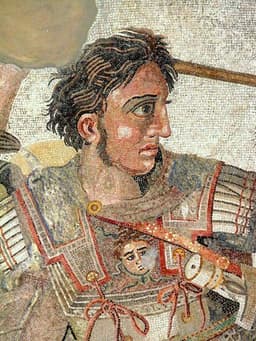
Alexander the Great
General · Ancient
85.2Total
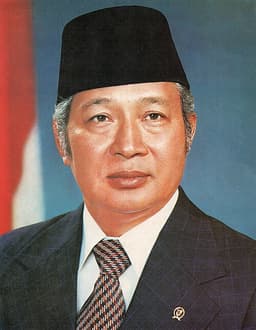
Suharto
General · Modern
57.2Total
Basic Information
Born
-356
1921
Died
-323
—
Era
Ancient
Modern
Nationality
Macedon
Indonesia
Occupation
General
General
Civilization
Western
Eastern
Score Comparison
Military (10%)
95.0
20.0
Political (20%)
60.0
59.3
Influence (20%)
92.0
60.0
Legacy (20%)
90.0
52.0
Leadership (15%)
80.0
82.0
Strategy (15%)
92.0
60.0
TOTAL
85.2
57.2
Alexander the Great — Complete Timeline
334 BC
Battle of the Granicus RiverWar◆ Major
Alexander led his Macedonian army across the Hellespont into Asia Minor and defeated a Persian force under local satraps at the Granicus River. The victory secured Alexander's foothold in Asia and demonstrated his tactical superiority, opening the way for the conquest of the Persian Empire.
Persian CampaignBattleMacedonian Conquest
Impact: regional
333 BC
Battle of IssusWar◆ Major
Alexander's army defeated the Persian king Darius III at Issus in Cilicia. Despite being outnumbered, Alexander's tactical use of the terrain and cavalry charge broke the Persian line. Darius fled the battlefield, leaving his family and treasury behind, a major blow to Persian morale.
Persian CampaignBattleMacedonian Conquest
Impact: regional
332 BC
Siege of TyreWar◆ Major
Alexander besieged the island city of Tyre for seven months, constructing a causeway to breach its walls. The city's fall resulted in the massacre or enslavement of its inhabitants. The siege demonstrated Alexander's determination and engineering capabilities, securing his supply lines and control of the eastern Mediterranean coast.
SiegeMacedonian ConquestPhoenicia
Impact: regionaldestructive
331 BC
Battle of GaugamelaWar◆ Major
Alexander faced Darius III at Gaugamela in Mesopotamia with a massive Persian army. Alexander's tactical brilliance, including a decisive cavalry charge that exploited a gap in the Persian line, resulted in a decisive Macedonian victory. Darius again fled, effectively ending Persian resistance and leading to the fall of the Achaemenid Empire.
Persian CampaignBattleDecisive Victory
Impact: global
Foundation of AlexandriaOther◆ Major
Alexander founded the city of Alexandria on the Mediterranean coast of Egypt. He personally selected the site and oversaw the initial planning. Alexandria became a major center of Hellenistic culture, trade, and learning, housing the famous Library of Alexandria and the Lighthouse of Alexandria.
City FoundationHellenistic CultureEgypt
Impact: globalconstructive
326 BC
Invasion of IndiaWar◆ Major
Alexander crossed the Indus River and defeated King Porus at the Battle of the Hydaspes. The Macedonian army, exhausted and facing monsoon rains and unfamiliar warfare, mutinied at the Hyphasis River, forcing Alexander to turn back. This campaign marked the easternmost extent of his conquests.
Indian CampaignBattleMutiny
Impact: regional
Suharto — Complete Timeline
1966 AD
Supersemar and Transfer of PowerPolitical Action
President Sukarno signed the Supersemar order, delegating authority to General Suharto to restore order after the 30 September Movement. Suharto used this to ban the Communist Party, purge leftists, and gradually assume executive power, effectively beginning his New Order regime.
SupersemarNew OrderIndonesia
Impact: nationaldestructive
1967 AD
New Order Economic DevelopmentReform◆ Major
Suharto implemented the New Order's economic policies, focusing on foreign investment, agricultural self-sufficiency, and industrialization. The government achieved high growth rates, reduced poverty, and stabilized the economy, but also fostered crony capitalism and corruption.
Economic GrowthDevelopmentIndonesia
Impact: nationalconstructive
1975 AD
Invasion of East TimorWar◆ Major
Suharto ordered the invasion of East Timor after Portugal withdrew. Indonesian forces occupied the territory, leading to a 24-year occupation marked by widespread human rights abuses, including massacres and forced displacement, resulting in an estimated 100,000-200,000 deaths.
East TimorOccupationHuman Rights
Impact: regionaldestructive
1998 AD
Asian Financial Crisis and Fall from PowerPolitical Action
The Asian Financial Crisis devastated Indonesia's economy, leading to massive unemployment and food shortages. Widespread protests and riots forced Suharto to resign in May 1998 after 31 years in power, ending his authoritarian rule and ushering in the Reformasi era.
Financial CrisisResignationReformasi
Impact: nationaltragic
Expert Analysis
Alexander the Great vs Suharto
### The Conqueror and the Strongman: Alexander and Suharto
In the annals of history, two generals stand at opposite ends of the spectrum of power: Alexander the Great, who by the age of thirty-two had carved an empire from Greece to India, and Suharto, who ruled Indonesia for thirty-one years with a grip as steady as a tropical storm. One died young, his conquests dissolving into legend; the other fell from power in disgrace, his legacy a tangle of economic growth and authoritarian brutality. What drives such different outcomes? The answer lies not in the size of their armies, but in the soil of their origins and the shape of their ambitions.
### Origins
Alexander was born in 356 BCE, the son of King Philip II of Macedon, a warrior-king who had unified the fractious Greek city-states. His tutor was Aristotle, who filled his mind with Homer’s epics and the philosophy of empire. From boyhood, Alexander breathed the air of conquest: his father’s campaigns, the stories of Achilles, the certainty that glory was the only measure of a man. His world was a canvas of ambition, where the horizon was a challenge to be overcome.
Suharto, by contrast, emerged from the mud of Java. Born in 1921 in a small village near Yogyakarta, he was the son of a minor irrigation official. His childhood was marked by poverty and the rigid hierarchies of Dutch colonial rule. He attended a Dutch-run school but never finished—the family could not afford it. Where Alexander was groomed for greatness, Suharto was shaped by survival. His world was not a canvas but a tightrope, where power was a game of patience and alliances.
### Rise to Power
Alexander’s ascent was swift and bloody. At sixteen, he led a cavalry charge against the Thracians; at twenty, after his father’s assassination, he crushed a rebellion in Thebes and razed the city to the ground. Within two years, he crossed the Hellespont into Asia, beginning a campaign that would never see him retreat. His path was a straight line of ambition.
Suharto’s rise was a slow, shadowy crawl. After Indonesia’s independence in 1945, he rose through the ranks of the army, a man of few words and many connections. The turning point came in 1966, when President Sukarno, amid chaos and inflation, signed the Supersemar order delegating authority to General Suharto to restore order. It was a quiet coup, a transfer of power that looked like a favor. Where Alexander took what he wanted, Suharto waited for it to be handed to him.
### Leadership & Governance
Alexander led from the front. At the Battle of Gaugamela in 331 BCE, he personally charged into the Persian center, risking death to break the enemy line. His military score of 96.0 reflects a genius for tactics—the oblique formation, the feigned retreat, the relentless pursuit. Yet his political score of 65.0 reveals a weakness: he could conquer but not consolidate. He burned Persepolis, married a Bactrian princess, and tried to fuse cultures, but his empire was a patchwork of loyalties held together by his presence alone.
Suharto was the opposite. His military score of 45.5 is modest, reflecting a career of logistics and politics rather than battlefield brilliance. But his political score of 68.8 and leadership score of 80.7 show a master of governance. He called his regime the “New Order,” focusing on economic development: foreign investment, agricultural self-sufficiency, and a stable currency. For two decades, Indonesia grew—poverty fell, schools rose, and a middle class emerged. Yet this came at a cost: the 1975 invasion of East Timor, where tens of thousands died, and a system of corruption and repression that silenced dissent.
### Triumph & Tragedy
Alexander’s greatest moment was the conquest of Persia—the fall of Babylon, Susa, and Persepolis. He wept when there were no more worlds to conquer. His tragedy was that he died young, likely of a fever in Babylon in 323 BCE, at thirty-two. His empire fractured into warring kingdoms, but his legend endured.
Suharto’s triumph was the 1998 Asian Financial Crisis, which became his tragedy. For thirty years, he had built a system of crony capitalism and state control. When the crisis hit, the rupiah collapsed, unemployment soared, and protests engulfed Jakarta. In May 1998, he resigned, a frail old man shuffled off the stage he had dominated. His economic miracle unraveled, revealing the rot beneath.
### Character & Destiny
Alexander was driven by *pothos*—a yearning for the unknown, a desire to push beyond the edge of the world. His character was a blaze of charisma, cruelty, and genius. He killed his friend Cleitus in a drunken rage, married a foreign princess, and demanded divine honors. His destiny was to be a tragic hero, a man who burned too bright.
Suharto was a creature of shadows. He was patient, calculating, and utterly pragmatic. He believed in order above all—order that he controlled. His character was a mask: calm, smiling, inscrutable. His destiny was to be a cautionary tale: power without principle, growth without justice. He died in 2008, his legacy contested, his family still rich, his country still grappling with his shadow.
### Legacy
Alexander’s legacy is the Hellenistic Age—the spread of Greek language, art, and thought from Egypt to India. He is remembered as a conqueror, a symbol of human ambition. His military score of 96.0 and influence score of 90.0 are etched into history. Suharto’s legacy is more ambiguous. His influence score of 75.7 and legacy score of 67.1 reflect a mixed record: he modernized Indonesia but tyrannized it. Today, his name is whispered in Jakarta as a ghost of development and dictatorship.
### Conclusion
Standing at the end of their stories, one sees two generals who shaped their worlds with iron and will. Alexander conquered the known world and died young, a meteor. Suharto held a nation for thirty-one years and fell, a stone crumbling into the sea. The difference is not in their achievements but in their ends: one became a legend, the other a lesson. In the end, history is not kind to those who rule only through fear—nor to those who dream only of conquest. The conqueror and the strongman both fade, but the light of one still burns across the centuries, while the other is a shadow in the archives.
Rankings
🥇
Alexander the GreatLeader
Mil: 95.0Pol: 60.0Inf: 92.0
85.2
🥈
Suharto
Mil: 20.0Pol: 59.3Inf: 60.0
57.2
+28.0 behind
How This Comparison Works
Algorithm
Each figure is scored on 6 dimensions (0—100 scale) based on structured historical data: Military (10%), Political (20%), Influence (20%), Legacy (20%), Leadership (15%), Strategy (15%). The weighted total produces the final ranking.
Data Sources
Scores are computed from structured sub-indicators in the database. Scale factors adjust for era (Ancient ×0.85, Modern ×1.0) and civilization size (Eastern ×1.05, Other ×0.80) to account for differences in population and military scale.
Maximum 3 Figures
Comparisons are limited to 2—3 figures to ensure readability and statistical meaningfulness.
Error Margins
±5 points per dimension — Sub-scores are derived from historical records with inherent uncertainty. Two figures within 5 points on a dimension should be considered roughly equivalent in that area.
Total Score Accuracy
±3 points overall — The weighted combination of 6 dimensions produces a total score with approximately ±3 points of uncertainty. Differences of less than 3 points are not statistically significant— the figures are effectively tied.
Known Limitations
- Historical records are incomplete and uneven across civilizations
- Figures from oral-tradition societies may be underrepresented
- Occupation labels can misclassify multi-role figures
- Scores measure capability and impact, not moral character
- Quantitative scoring is a comparison tool, not absolute truth
Capability Radar
Military (10%) — Battles & Warfare
Battles
98
40
Win Rate
99
45
Expansion
99
30
Political (20%) — Governance & Reform
Reform
75
55
Diplomacy
80
60
Economy
70
65
Influence (20%) — Cultural & Global Reach
Cultural
95
40
Global
95
50
Legacy (20%) — Historical Impact
Historical
98
55
Longevity
95
45
Leadership (15%) — Power & Stability
Tenure
60
85
Stability
55
50
Strategy (15%) — Tactics & Innovation
Strategy
98
40
Tactics
99
35
Reform
85
50
Similar Comparisons
Comments & Discussion
历史幽灵6/16/2026
作为一个数据怀疑论者,我要泼冷水:亚历山大那堆征服数字全是吹出来的。高加米拉战役的波斯军队人数可能缩水十倍,他的“帝国”只是纸糊的。苏哈托的GDP增长可查证,34年7%年均率不是神话,尽管代价是铁腕。别拿传说剧本当历史,拿算盘先。
LegacyTracker6/16/2026
Classics scholar calling out the absurd comparison: Alexander built a cultural synthesis that lasted centuries—Hellenistic art, philosophy, trade routes. Suharto left behind a crony-capitalist wasteland and a paratrooper facade. One died a hero because he fused worlds; the other fled in 1998 as a disgraced strongman. Apples to oranges? More like a golden apple versus a rotten durian.
真相凿子6/16/2026
作为修正派批评者,我撕掉这层包装:苏哈托的“经济增长”是血汗工厂和森林大火的成果,屠杀50万“共产主义者”不是偶然。亚历山大屠杀提尔城8000人,也没比这干净。两人都是独裁暴君,区别在于后者有Piet Mondrian一样的军团秩序,前者有游击队式的恐怖统治。别美化青铜时代刽子手。
NamelessFoot6/16/2026
History buff here: Alexander gambled everything on personal charisma and died before the bill came due. Suharto played the long game—family dynasty, military patronage, oil wealth. The Macedonian's empire shattered post-mortem; the Javanese strongman's cronies still hold power. Which legacy wins? The one that adapts, not the one that burns bright and fades.
ScoreboardScholar6/16/2026
As a military historian, I'd argue Alexander's edge was his tactical revolution. He didn't just outfight Suharto; he out-thought every enemy with the phalanx and companion cavalry combo. Suharto's strength was political survival—crushing coups, not conquering continents. Alexander died at 32 with zero defeats; Suharto's 31 years were a masterclass in corruption, not combat. One wrote the book on war; the other just stole the library.