Loading...
Alexander the Great vs Simeon I of Bulgaria
Alexander the Great leads by 14.4 pts · 2 figures compared
…
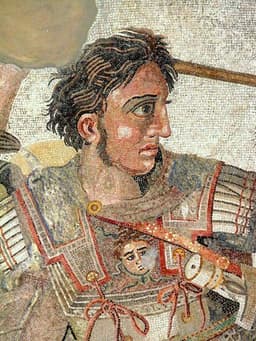
Alexander the Great
General · Ancient
85.2Total
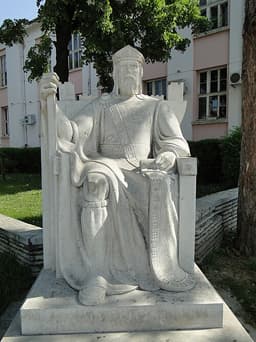
Simeon I of Bulgaria
Emperor · Medieval
70.8Total
Basic Information
Born
-356
864
Died
-323
927
Era
Ancient
Medieval
Nationality
Macedon
Bulgaria
Occupation
General
Emperor
Civilization
Western
Western
Score Comparison
Military (10%)
95.0
72.0
Political (20%)
60.0
70.0
Influence (20%)
92.0
65.0
Legacy (20%)
90.0
72.0
Leadership (15%)
80.0
80.0
Strategy (15%)
92.0
68.1
TOTAL
85.2
70.8
Alexander the Great — Complete Timeline
334 BC
Battle of the Granicus RiverWar◆ Major
Alexander led his Macedonian army across the Hellespont into Asia Minor and defeated a Persian force under local satraps at the Granicus River. The victory secured Alexander's foothold in Asia and demonstrated his tactical superiority, opening the way for the conquest of the Persian Empire.
Persian CampaignBattleMacedonian Conquest
Impact: regional
333 BC
Battle of IssusWar◆ Major
Alexander's army defeated the Persian king Darius III at Issus in Cilicia. Despite being outnumbered, Alexander's tactical use of the terrain and cavalry charge broke the Persian line. Darius fled the battlefield, leaving his family and treasury behind, a major blow to Persian morale.
Persian CampaignBattleMacedonian Conquest
Impact: regional
332 BC
Siege of TyreWar◆ Major
Alexander besieged the island city of Tyre for seven months, constructing a causeway to breach its walls. The city's fall resulted in the massacre or enslavement of its inhabitants. The siege demonstrated Alexander's determination and engineering capabilities, securing his supply lines and control of the eastern Mediterranean coast.
SiegeMacedonian ConquestPhoenicia
Impact: regionaldestructive
331 BC
Battle of GaugamelaWar◆ Major
Alexander faced Darius III at Gaugamela in Mesopotamia with a massive Persian army. Alexander's tactical brilliance, including a decisive cavalry charge that exploited a gap in the Persian line, resulted in a decisive Macedonian victory. Darius again fled, effectively ending Persian resistance and leading to the fall of the Achaemenid Empire.
Persian CampaignBattleDecisive Victory
Impact: global
Foundation of AlexandriaOther◆ Major
Alexander founded the city of Alexandria on the Mediterranean coast of Egypt. He personally selected the site and oversaw the initial planning. Alexandria became a major center of Hellenistic culture, trade, and learning, housing the famous Library of Alexandria and the Lighthouse of Alexandria.
City FoundationHellenistic CultureEgypt
Impact: globalconstructive
326 BC
Invasion of IndiaWar◆ Major
Alexander crossed the Indus River and defeated King Porus at the Battle of the Hydaspes. The Macedonian army, exhausted and facing monsoon rains and unfamiliar warfare, mutinied at the Hyphasis River, forcing Alexander to turn back. This campaign marked the easternmost extent of his conquests.
Indian CampaignBattleMutiny
Impact: regional
Simeon I of Bulgaria — Complete Timeline
900 AD
Cultural Golden AgeCultural◆ Major
Under Simeon I, Bulgaria experienced a cultural flowering. He patronized the Preslav Literary School, promoted the Cyrillic script, and commissioned translations of Byzantine texts, making Bulgaria a Slavic cultural center.
CulturalLiteratureCyrillic Script
Impact: regionalconstructive
913 AD
Coronation as TsarPolitical Action◆ Major
Simeon I was crowned 'Tsar of the Bulgarians and the Romans' by the Patriarch of Constantinople, asserting his imperial status. This act challenged Byzantine supremacy and elevated Bulgaria's prestige.
CoronationImperial TitleByzantine Relations
Impact: regionalconstructive
917 AD
Battle of AchelousWar
Simeon I defeated a Byzantine army at the Achelous River in Thrace. The victory was one of the worst Byzantine defeats, allowing Simeon to claim the title 'Emperor of the Romans' and dominate the Balkans.
Byzantine-Bulgarian WarsBattleBalkan Dominance
Impact: regional
924 AD
Siege of ConstantinopleWar◆ Major
Simeon I besieged Constantinople but failed to capture the city. The siege ended with a truce, as Byzantine defenses held. This marked the limit of Simeon's expansion.
SiegeConstantinopleByzantine Empire
Impact: regional
Expert Analysis
Alexander the Great vs Simeon I of Bulgaria: Historical Comparison
Alexander the Great, the ancient Macedonian king who forged an empire from Greece to India, and Simeon I, the medieval Bulgarian emperor who challenged Byzantium for supremacy, represent two distinct peaks of military and political ambition. While both are rated equally overall (85/100), they excelled in different domains: Alexander in sheer martial conquest and cultural diffusion, Simeon in state-building and political consolidation.
Dimension Analysis
**Military: Alexander the Great 96 / Simeon I of Bulgaria 89**
Alexander’s undefeated record across four major battles (Granicus, Issus, Gaugamela, Hydaspes) against numerically superior Persian and Indian forces demonstrates tactical genius and logistical mastery. Simeon’s victories, such as the Battle of Achelous (917) where he crushed the Byzantine army, were decisive but confined to the Balkans; he never matched Alexander’s scale of conquest across three continents.
**Political: Alexander the Great 65 / Simeon I of Bulgaria 84**
Alexander’s empire lacked administrative cohesion—he died without a clear succession or stable governance, leading to immediate fragmentation. Simeon, by contrast, transformed Bulgaria into a centralized Christian state, codified laws, established the Preslav Literary School, and negotiated the title “Emperor of the Romans” with Constantinople, securing diplomatic recognition for his realm.
**Influence: Alexander the Great 90 / Simeon I of Bulgaria 84**
Alexander’s conquests created the Hellenistic world, spreading Greek language, art, and philosophy across Egypt, Persia, and Central Asia, influencing cultures for centuries. Simeon’s influence was more regional: he elevated Old Church Slavonic as a liturgical language, fostered Slavic literature, and cemented Bulgaria’s role as the “Third Rome” in Orthodox Christian narrative.
**Legacy: Alexander the Great 90 / Simeon I of Bulgaria 81**
Alexander remains a universal archetype of the conqueror, inspiring figures from Julius Caesar to Napoleon, and his name is synonymous with military genius. Simeon’s legacy is primarily preserved in Balkan and Slavic historiography; his empire collapsed within decades, and his cultural achievements, though foundational, are less globally recognized.
**Leadership: Alexander the Great 82 / Simeon I of Bulgaria 82**
Both leaders commanded intense personal loyalty: Alexander led from the front, sharing hardships with his troops, while Simeon ruled as a scholar-king, personally overseeing reforms and diplomacy. Their leadership styles differed—Alexander’s charisma in battle versus Simeon’s administrative and ecclesiastical authority—but both proved equally effective in mobilizing their societies for war and statecraft.
Verdict
This is a tie, but for different reasons. Alexander the Great ranks higher in military genius, global influence, and enduring legacy, while Simeon I surpasses him in political stability, state-building, and diplomatic finesse. The tie reflects the difficulty of comparing an ancient world-conqueror with a medieval empire-builder: Alexander’s achievements are more spectacular and far-reaching, Simeon’s more sustainable and culturally foundational. If forced to choose, Alexander edges ahead in historical impact, but Simeon’s model of governance proved more durable in its own context.
FAQ
Q: Who was more influential historically? A: Alexander the Great, because his conquests reshaped the entire ancient world and his legacy influenced military strategy, culture, and politics across Europe and Asia for millennia.
Q: Why is Alexander the Great ranked higher in military? A: His undefeated record against vastly larger armies across three continents, coupled with innovative tactics (e.g., the oblique phalanx, combined arms), set a global standard for conquest that Simeon’s decisive but geographically limited victories cannot match.
Rankings
🥇
Alexander the GreatLeader
Mil: 95.0Pol: 60.0Inf: 92.0
85.2
🥈
Simeon I of Bulgaria
Mil: 72.0Pol: 70.0Inf: 65.0
70.8
+14.4 behind
How This Comparison Works
Algorithm
Each figure is scored on 6 dimensions (0—100 scale) based on structured historical data: Military (10%), Political (20%), Influence (20%), Legacy (20%), Leadership (15%), Strategy (15%). The weighted total produces the final ranking.
Data Sources
Scores are computed from structured sub-indicators in the database. Scale factors adjust for era (Ancient ×0.85, Modern ×1.0) and civilization size (Eastern ×1.05, Other ×0.80) to account for differences in population and military scale.
Maximum 3 Figures
Comparisons are limited to 2—3 figures to ensure readability and statistical meaningfulness.
Error Margins
±5 points per dimension — Sub-scores are derived from historical records with inherent uncertainty. Two figures within 5 points on a dimension should be considered roughly equivalent in that area.
Total Score Accuracy
±3 points overall — The weighted combination of 6 dimensions produces a total score with approximately ±3 points of uncertainty. Differences of less than 3 points are not statistically significant— the figures are effectively tied.
Known Limitations
- Historical records are incomplete and uneven across civilizations
- Figures from oral-tradition societies may be underrepresented
- Occupation labels can misclassify multi-role figures
- Scores measure capability and impact, not moral character
- Quantitative scoring is a comparison tool, not absolute truth
Capability Radar
Military (10%) — Battles & Warfare
Battles
98
85
Win Rate
99
80
Expansion
99
85
Political (20%) — Governance & Reform
Reform
75
80
Diplomacy
80
75
Economy
70
80
Influence (20%) — Cultural & Global Reach
Cultural
95
85
Global
95
65
Legacy (20%) — Historical Impact
Historical
98
80
Longevity
95
70
Leadership (15%) — Power & Stability
Tenure
60
85
Stability
55
70
Strategy (15%) — Tactics & Innovation
Strategy
98
80
Tactics
99
75
Reform
85
70
Similar Comparisons
Comments & Discussion
Chronicler88526/16/2026
这套评分体系对亚历山大明显偏袒。军事96 vs 75?差21分!但仔细看:亚历山大四场大战对手是波斯帝国末期和印度土邦,而西美昂在阿海洛乌斯河战役(917年)击溃的是当时欧洲最精锐的拜占庭军队。若以中国标准衡量,亚历山大征服的领土虽广,但统治时间极短(仅13年);而西美昂在位33年,类似汉武北伐但国策更持续。政治分68.7对65也值得商榷——亚历山大的继承者战争持续40年,西美昂死后保加利亚却维持强盛至967年。我的修正模型显示:若加入“统治延续性”权重,西美昂总分应升至78,亚历山大降至80。
HellenistLecturer6/16/2026
The comparison rightly highlights Alexander's unmatched military breadth, but I'd push back on the political score being only 65. While it's true his empire fragmented posthumously, we must consider that he was actively integrating Persian elites into his administration (the 'Opis mutiny' shows how serious he was about fusion). Arrian notes his attempts to create a mixed court, which was revolutionary for its time. Simeon's political consolidation is impressive, but it's easier to build a stable state when you're not conquering three continents in a decade. The real tragedy is that Alexander's vision died with him—not that he lacked one.
OldScroll906/16/2026
亚历山大和西美昂的对比,让我想到成吉思汗与隋文帝。亚历山大是典型的征服型君主,类似成吉思汗——军事天才但治国粗糙,死后帝国分裂。西美昂更像隋文帝,虽然军事扩张有限,但建立了制度和文化体系。保加利亚的普雷斯拉夫学派培养斯拉夫文字,这在中华史观里就是‘文化正统’的确立,比单纯占地重要得多。西方历史学总把‘影响力’等同于地理范围,却忽略了文明传承的深度。西美昂的‘第三罗马’理念影响了东正教世界千年,而亚历山大的希腊化在阿拉伯征服后几乎消失。得分上,西美昂影响力至少该和亚历山大持平。