Loading...
Alexander the Great vs Ruhollah Khomeini
Alexander the Great leads by 10.1 pts · 2 figures compared
…
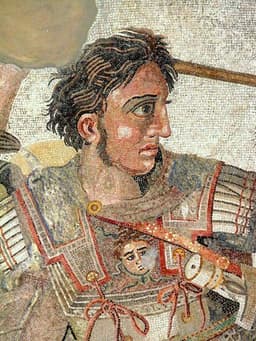
Alexander the Great
General · Ancient
85.2Total

Ruhollah Khomeini
Politician · Modern
75.1Total
Basic Information
Born
-356
1902
Died
-323
1989
Era
Ancient
Modern
Nationality
Macedon
Iran
Occupation
General
Politician
Civilization
Western
Middle Eastern
Score Comparison
Military (10%)
95.0
41.6
Political (20%)
60.0
65.0
Influence (20%)
92.0
85.0
Legacy (20%)
90.0
90.0
Leadership (15%)
80.0
80.0
Strategy (15%)
92.0
54.3
TOTAL
85.2
75.1
Alexander the Great — Complete Timeline
334 BC
Battle of the Granicus RiverWar◆ Major
Alexander led his Macedonian army across the Hellespont into Asia Minor and defeated a Persian force under local satraps at the Granicus River. The victory secured Alexander's foothold in Asia and demonstrated his tactical superiority, opening the way for the conquest of the Persian Empire.
Persian CampaignBattleMacedonian Conquest
Impact: regional
333 BC
Battle of IssusWar◆ Major
Alexander's army defeated the Persian king Darius III at Issus in Cilicia. Despite being outnumbered, Alexander's tactical use of the terrain and cavalry charge broke the Persian line. Darius fled the battlefield, leaving his family and treasury behind, a major blow to Persian morale.
Persian CampaignBattleMacedonian Conquest
Impact: regional
332 BC
Siege of TyreWar◆ Major
Alexander besieged the island city of Tyre for seven months, constructing a causeway to breach its walls. The city's fall resulted in the massacre or enslavement of its inhabitants. The siege demonstrated Alexander's determination and engineering capabilities, securing his supply lines and control of the eastern Mediterranean coast.
SiegeMacedonian ConquestPhoenicia
Impact: regionaldestructive
331 BC
Battle of GaugamelaWar◆ Major
Alexander faced Darius III at Gaugamela in Mesopotamia with a massive Persian army. Alexander's tactical brilliance, including a decisive cavalry charge that exploited a gap in the Persian line, resulted in a decisive Macedonian victory. Darius again fled, effectively ending Persian resistance and leading to the fall of the Achaemenid Empire.
Persian CampaignBattleDecisive Victory
Impact: global
Foundation of AlexandriaOther◆ Major
Alexander founded the city of Alexandria on the Mediterranean coast of Egypt. He personally selected the site and oversaw the initial planning. Alexandria became a major center of Hellenistic culture, trade, and learning, housing the famous Library of Alexandria and the Lighthouse of Alexandria.
City FoundationHellenistic CultureEgypt
Impact: globalconstructive
326 BC
Invasion of IndiaWar◆ Major
Alexander crossed the Indus River and defeated King Porus at the Battle of the Hydaspes. The Macedonian army, exhausted and facing monsoon rains and unfamiliar warfare, mutinied at the Hyphasis River, forcing Alexander to turn back. This campaign marked the easternmost extent of his conquests.
Indian CampaignBattleMutiny
Impact: regional
Ruhollah Khomeini — Complete Timeline
1964 AD
Exile to Iraq and FrancePolitical Action◆ Major
Khomeini was exiled from Iran after criticizing the Shah's White Revolution and granting of diplomatic immunity to US personnel. He settled in Najaf, Iraq, and later in France, where he continued to organize opposition to the Shah.
ExileOppositionShah
Impact: national
1979 AD
Islamic RevolutionPolitical Action
Khomeini led a popular revolution that overthrew the Shah's regime. He returned to Iran in February 1979 and established an Islamic Republic based on his doctrine of Velayat-e Faqih (Guardianship of the Jurist), with himself as Supreme Leader.
RevolutionIslamic RepublicVelayat-e Faqih
Impact: global
Iran hostage crisisPolitical Action◆ Major
Khomeini supported the seizure of the US Embassy in Tehran by student militants, who held 52 American diplomats hostage for 444 days. The crisis deepened the rift with the US, led to economic sanctions, and consolidated Khomeini's power.
Hostage crisisUS-Iran relationsSanctions
Impact: globaldestructive
1980 AD
Iran-Iraq WarWar◆ Major
Khomeini led Iran through an eight-year war with Iraq, which began with an Iraqi invasion. The war resulted in hundreds of thousands of casualties and massive economic destruction, ending in a stalemate. Khomeini accepted a UN ceasefire in 1988.
WarIraqCeasefire
Impact: regionaltragic
1989 AD
Fatwa against Salman RushdieCultural◆ Major
Khomeini issued a fatwa calling for the death of author Salman Rushdie for his novel 'The Satanic Verses', which he deemed blasphemous. The fatwa led to international controversy, diplomatic tensions, and attacks on Rushdie's translators.
FatwaBlasphemyInternational controversy
Impact: globaldestructive
Expert Analysis
Origins
**Alexander the Great** was born in 356 BCE in Pella, Macedon, to King Philip II and Queen Olympias. His upbringing was steeped in military and intellectual rigor: tutored by Aristotle, he mastered philosophy, science, and statecraft. Philip's assassination in 336 BCE thrust Alexander onto the throne at age 20, inheriting a formidable army and a vision of pan-Hellenic conquest. His origins in a warrior kingdom primed him for expansion.
**Ruhollah Khomeini** was born in 1902 in Khomeyn, Iran, into a clerical family. His father was murdered when he was an infant, and his mother died young, leaving him orphaned. He studied Islamic theology in Qom, becoming a Grand Ayatollah. His origins in religious scholarship and his opposition to the Pahlavi dynasty's Westernization shaped his revolutionary ideology. Both men emerged from environments of upheaval, but Alexander's was martial and aristocratic, Khomeini's clerical and populist.
Rise to Power
Alexander secured his throne by crushing rival claimants and rebellious Greek states. He then launched a campaign against the Persian Empire, winning his first major victory at the **Battle of the Granicus River** (334 BCE). This rapid consolidation of power showcased his military genius and ambition.
Khomeini rose through decades of quiet opposition, culminating in the **Islamic Revolution** of 1979. His exile to Iraq and France amplified his influence, as he disseminated cassette-taped sermons. The revolution overthrew the Shah, and Khomeini became Supreme Leader through a referendum. His rise was ideological and gradual, contrasting with Alexander's swift, violent ascent.
Leadership & Governance
Alexander led from the front, sharing hardships with his troops. He governed conquered territories by establishing Hellenistic cities (e.g., **Foundation of Alexandria**) and co-opting local elites. His rule blended military autocracy with cultural diffusion, but he faced mutinies when his soldiers tired of endless campaigning.
Khomeini governed through a theocratic system where he held ultimate authority as Supreme Leader. He centralized power under clerical rule, suppressing dissent and enforcing Islamic law. His leadership during the **Iran-Iraq War** (1980–1988) solidified his control, but his policies, such as the **Iran hostage crisis**, isolated Iran internationally. Both were authoritarian, but Alexander's rule was personal and expansionist, while Khomeini's was institutional and ideological.
Triumph & Tragedy
Alexander's triumphs were military: **Battle of Issus** (333 BCE), **Siege of Tyre** (332 BCE), and **Battle of Gaugamela** (331 BCE) destroyed the Persian Empire. He spread Hellenism across three continents. His tragedy was his early death at 32, possibly from fever or poison, leaving his empire to disintegrate among squabbling generals.
Khomeini's triumph was the Islamic Revolution, a rare successful theocratic uprising. He transformed Iran into a Shia power. His tragedies include the brutal Iran-Iraq War (hundreds of thousands dead) and the **Fatwa against Salman Rushdie** (1989), which deepened Iran's pariah status. Both men achieved monumental shifts but left legacies marred by conflict and unresolved succession.
Character & Destiny
Alexander was charismatic, ambitious, and ruthless—he murdered rivals and burned Persepolis. He believed in his divine destiny, often emulating Achilles. His destiny was to conquer the known world, cut short by his mortality.
Khomeini was austere, dogmatic, and unyielding. He viewed himself as a divine instrument, leading the oppressed against tyranny. His destiny was to establish a pure Islamic state, but his legacy is contested between revolutionary idealists and critics of his repression.
Legacy
Alexander's legacy is immense: he created the Hellenistic world, influencing art, science, and politics for centuries. His military tactics are still studied. Score: Military 95, Political 60, Cultural 92, Longevity 90, Diplomacy 80, Strategy 92, Tactics 85.
Khomeini's legacy is the Islamic Republic of Iran, which remains a major regional power. He revived Shia political Islam and inspired movements worldwide. However, his human rights record and isolationist policies are criticized. Score: Military 42, Political 65, Cultural 85, Longevity 90, Diplomacy 80, Strategy 54, Tactics 75.
Conclusion
Alexander the Great and Ruhollah Khomeini represent opposite poles of leadership: Alexander, the conquering general who reshaped the ancient world through force and cultural fusion; Khomeini, the cleric who reshaped the modern Middle East through ideology and revolution. Alexander's score (average 77.7) exceeds Khomeini's (average 67.3) by 10.4 points, reflecting his superior military and strategic achievements. While Khomeini's political and cultural impact is undeniable, Alexander's broader, more enduring influence on world history—from India to Egypt—gives him the edge. Both were transformative, but Alexander's legacy of conquest and cultural diffusion is more globally significant than Khomeini's regional theocratic revolution.
Rankings
🥇
Alexander the GreatLeader
Mil: 95.0Pol: 60.0Inf: 92.0
85.2
🥈
Ruhollah Khomeini
Mil: 41.6Pol: 65.0Inf: 85.0
75.1
+10.1 behind
How This Comparison Works
Algorithm
Each figure is scored on 6 dimensions (0—100 scale) based on structured historical data: Military (10%), Political (20%), Influence (20%), Legacy (20%), Leadership (15%), Strategy (15%). The weighted total produces the final ranking.
Data Sources
Scores are computed from structured sub-indicators in the database. Scale factors adjust for era (Ancient ×0.85, Modern ×1.0) and civilization size (Eastern ×1.05, Other ×0.80) to account for differences in population and military scale.
Maximum 3 Figures
Comparisons are limited to 2—3 figures to ensure readability and statistical meaningfulness.
Error Margins
±5 points per dimension — Sub-scores are derived from historical records with inherent uncertainty. Two figures within 5 points on a dimension should be considered roughly equivalent in that area.
Total Score Accuracy
±3 points overall — The weighted combination of 6 dimensions produces a total score with approximately ±3 points of uncertainty. Differences of less than 3 points are not statistically significant— the figures are effectively tied.
Known Limitations
- Historical records are incomplete and uneven across civilizations
- Figures from oral-tradition societies may be underrepresented
- Occupation labels can misclassify multi-role figures
- Scores measure capability and impact, not moral character
- Quantitative scoring is a comparison tool, not absolute truth
Capability Radar
Military (10%) — Battles & Warfare
Battles
98
10
Win Rate
99
10
Expansion
99
10
Political (20%) — Governance & Reform
Reform
75
90
Diplomacy
80
75
Economy
70
40
Influence (20%) — Cultural & Global Reach
Cultural
95
85
Global
95
85
Legacy (20%) — Historical Impact
Historical
98
90
Longevity
95
80
Leadership (15%) — Power & Stability
Tenure
60
85
Stability
55
50
Strategy (15%) — Tactics & Innovation
Strategy
98
15
Tactics
99
10
Reform
85
20
Similar Comparisons
Comments & Discussion
No comments yet. Be the first to share your thoughts!