Loading...
Alexander the Great vs Kirtivarman II
Alexander the Great leads by 48.8 pts · 2 figures compared
…
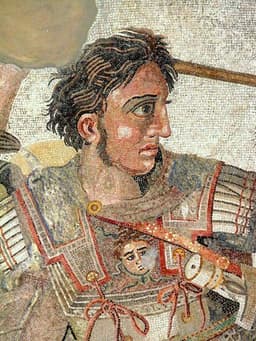
Alexander the Great
General · Ancient
85.2Total

Kirtivarman II
Emperor · Medieval
36.4Total
Basic Information
Born
-356
746
Died
-323
757
Era
Ancient
Medieval
Nationality
Macedon
India
Occupation
General
Emperor
Civilization
Western
Indian
Score Comparison
Military (10%)
95.0
21.2
Political (20%)
60.0
30.7
Influence (20%)
92.0
46.3
Legacy (20%)
90.0
37.5
Leadership (15%)
80.0
33.6
Strategy (15%)
92.0
36.8
TOTAL
85.2
36.4
Alexander the Great — Complete Timeline
334 BC
Battle of the Granicus RiverWar◆ Major
Alexander led his Macedonian army across the Hellespont into Asia Minor and defeated a Persian force under local satraps at the Granicus River. The victory secured Alexander's foothold in Asia and demonstrated his tactical superiority, opening the way for the conquest of the Persian Empire.
Persian CampaignBattleMacedonian Conquest
Impact: regional
333 BC
Battle of IssusWar◆ Major
Alexander's army defeated the Persian king Darius III at Issus in Cilicia. Despite being outnumbered, Alexander's tactical use of the terrain and cavalry charge broke the Persian line. Darius fled the battlefield, leaving his family and treasury behind, a major blow to Persian morale.
Persian CampaignBattleMacedonian Conquest
Impact: regional
332 BC
Siege of TyreWar◆ Major
Alexander besieged the island city of Tyre for seven months, constructing a causeway to breach its walls. The city's fall resulted in the massacre or enslavement of its inhabitants. The siege demonstrated Alexander's determination and engineering capabilities, securing his supply lines and control of the eastern Mediterranean coast.
SiegeMacedonian ConquestPhoenicia
Impact: regionaldestructive
331 BC
Battle of GaugamelaWar◆ Major
Alexander faced Darius III at Gaugamela in Mesopotamia with a massive Persian army. Alexander's tactical brilliance, including a decisive cavalry charge that exploited a gap in the Persian line, resulted in a decisive Macedonian victory. Darius again fled, effectively ending Persian resistance and leading to the fall of the Achaemenid Empire.
Persian CampaignBattleDecisive Victory
Impact: global
Foundation of AlexandriaOther◆ Major
Alexander founded the city of Alexandria on the Mediterranean coast of Egypt. He personally selected the site and oversaw the initial planning. Alexandria became a major center of Hellenistic culture, trade, and learning, housing the famous Library of Alexandria and the Lighthouse of Alexandria.
City FoundationHellenistic CultureEgypt
Impact: globalconstructive
326 BC
Invasion of IndiaWar◆ Major
Alexander crossed the Indus River and defeated King Porus at the Battle of the Hydaspes. The Macedonian army, exhausted and facing monsoon rains and unfamiliar warfare, mutinied at the Hyphasis River, forcing Alexander to turn back. This campaign marked the easternmost extent of his conquests.
Indian CampaignBattleMutiny
Impact: regional
Kirtivarman II — Complete Timeline
753 AD
Defeat by DantidurgaWar◆ Major
Kirtivarman II, the last Badami Chalukya king, was defeated by the Rashtrakuta chief Dantidurga. This battle ended the Badami Chalukya dynasty and established Rashtrakuta rule over the Deccan region.
Impact: regionaldestructive
Expert Analysis
Alexander the Great vs Kirtivarman II
# The Conqueror and the Vanquished
In 326 BCE, Alexander the Great stood on the banks of the Hydaspes River in Punjab, his army weary but victorious, having just defeated King Porus in one of history’s most brilliant battles. Nearly a millennium later, in 753 CE, another king—Kirtivarman II of the Badami Chalukyas—faced his own moment of truth on the battlefields of southern India. One would forge an empire that reshaped the known world; the other would see his dynasty extinguished in a single catastrophic defeat. What separates a legend from a footnote? The answer lies not merely in talent, but in the currents of history that carry some men to glory and sweep others into oblivion.
Origins
Alexander was born in 356 BCE into the restless, ambitious court of Macedon, a kingdom perched on the margins of the Greek world. His father, Philip II, had transformed Macedon from a backward state into a formidable military power, and his mother, Olympias, instilled in him a belief in his divine descent from Achilles. The boy grew up with Aristotle as his tutor, absorbing Greek philosophy, Homeric epic, and the conviction that greatness was his birthright. The world he inherited was one of fractured Greek city-states and the crumbling, decadent Persian Empire—ripe for conquest.
Kirtivarman II, by contrast, was born in 746 CE into the twilight of the Badami Chalukya dynasty, which had ruled the Deccan plateau for over two centuries. His ancestors had built magnificent rock-cut temples at Badami and Aihole, patronized Sanskrit literature, and fought off rivals like the Pallavas. But by Kirtivarman’s time, the dynasty’s energy was spent. Internal factions weakened the court, and new powers—particularly the Rashtrakutas under Dantidurga—were rising in the north. Kirtivarman inherited a throne already creaking under the weight of decline, not a springboard for expansion.
Rise to Power
Alexander ascended the throne at age twenty, after Philip’s assassination in 336 BCE. He moved with breathtaking speed: crushing revolts in Thebes, securing Greece, and then launching the invasion of Persia in 334 BCE with an army of some 40,000 men. His rise was a masterclass in audacity—crossing the Hellespont, cutting the Gordian Knot, and winning battles at Granicus, Issus, and Gaugamela. Each victory was a gamble, but Alexander possessed the charisma to inspire loyalty and the tactical genius to exploit every opening.
Kirtivarman II became king around 746 CE, inheriting a realm already under pressure. His rise was not a dramatic conquest but a quiet succession—the last gasp of a dynasty that had ruled for generations. The historical records are sparse, but they suggest a ruler who lacked the military or political resources to reverse his dynasty’s fortunes. Where Alexander seized opportunity, Kirtivarman faced a narrowing horizon.
Leadership & Governance
Alexander’s leadership was a paradox of brilliance and recklessness. On the battlefield, his tactics—the oblique phalanx, the cavalry hammer, the relentless pursuit—were revolutionary. He won every major engagement, from the siege of Tyre to the battle of the Hydaspes, and his political vision was equally bold: he sought to fuse Greek and Persian cultures, marrying Persian nobles, adopting their court rituals, and founding cities like Alexandria that became centers of Hellenistic civilization. Yet his governance was flawed: he failed to create stable institutions, alienated his Macedonian generals, and ruled through sheer force of personality. His political score of 65.0 reflects this incomplete vision.
Kirtivarman II’s leadership, by contrast, is defined by what he could not do. His military score of 46.0 and strategy score of 30.0 suggest a ruler who was outmatched from the start. The key event of his reign was the war of 753 CE, when Dantidurga, the Rashtrakuta chief, marched against the Chalukya capital. Kirtivarman’s army was defeated, and the battle ended the Badami Chalukya dynasty. There were no epic sieges, no brilliant maneuvers—just a swift, decisive collapse. His failure was not personal cowardice but systemic weakness: a dynasty that had exhausted its resources and lost its edge.
Triumph & Tragedy
Alexander’s greatest triumph was the conquest of the Persian Empire—a feat that stretched from the Aegean to the Indus, covering over two million square miles. His most devastating failure came in his final years: the mutiny of his army at the Hyphasis River, the death of his friend Hephaestion, and his own premature death in Babylon in 323 BCE at age thirty-two. His empire, lacking a clear succession, fractured immediately into warring successor states. The tragedy was not defeat—he never lost a battle—but the brevity of his achievement.
Kirtivarman II’s tragedy was simpler and more absolute. His greatest moment was merely his accession to a throne already tottering. His failure was the battle of 753 CE, which erased his dynasty from history. Where Alexander’s death sparked centuries of Hellenistic influence, Kirtivarman’s defeat led to the rise of the Rashtrakutas, who would dominate the Deccan for the next two centuries. The last Chalukya king faded into obscurity, his name preserved only in copper-plate inscriptions and temple ruins.
Character & Destiny
Alexander’s character was a volatile mix of ambition, paranoia, and megalomania. He believed himself divine, demanded proskynesis (prostration) from his subjects, and killed his friend Cleitus in a drunken rage. Yet he also wept when there were no more worlds to conquer, showing a restless hunger that drove him to the edge of the known world. His personality shaped every decision—the relentless marches, the risky battles, the cultural fusion—and ultimately determined his empire’s fragility.
Kirtivarman II’s character remains shadowy. The records tell us nothing of his personality, his dreams, or his fears. He was a king who inherited a dying dynasty, and his destiny was to be its last ruler. Where Alexander’s hubris was his undoing, Kirtivarman’s tragedy was that he had no real choice. History did not ask him to be great; it asked him to be a footnote.
Legacy
Alexander’s legacy is immense. His military tactics are still studied at war colleges. His conquests spread Greek language, art, and thought across the Middle East and Central Asia, creating the Hellenistic world that shaped Rome, Byzantium, and the Islamic Golden Age. He is remembered as a symbol of ambition and genius, but also of the costs of unchecked power.
Kirtivarman II’s legacy is virtually nonexistent. His total score of 42.9 places him among history’s forgotten failures. The Badami Chalukya temples survive—the cave temples at Badami, the Virupaksha Temple at Pattadakal—but they are monuments to his ancestors, not to him. He is remembered only as the king who lost it all, a cautionary tale of dynastic decline.
Conclusion
Standing at the Hydaspes in 326 BCE, Alexander saw an empire waiting to be born. Standing before Dantidurga in 753 CE, Kirtivarman II saw only the end. The difference between them is not merely talent—Alexander was a genius, Kirtivarman a mediocrity—but the tide of history. Alexander rode a wave of Macedonian expansion, Greek cultural ferment, and Persian vulnerability. Kirtivarman was crushed by the ebb of Chalukya power and the rise of Rashtrakuta ambition. In the end, history remembers the conquerors and forgets the conquered, not because they were better, but because they arrived at the right moment. The rest is silence.
Rankings
🥇
Alexander the GreatLeader
Mil: 95.0Pol: 60.0Inf: 92.0
85.2
🥈
Kirtivarman II
Mil: 21.2Pol: 30.7Inf: 46.3
36.4
+48.8 behind
How This Comparison Works
Algorithm
Each figure is scored on 6 dimensions (0—100 scale) based on structured historical data: Military (10%), Political (20%), Influence (20%), Legacy (20%), Leadership (15%), Strategy (15%). The weighted total produces the final ranking.
Data Sources
Scores are computed from structured sub-indicators in the database. Scale factors adjust for era (Ancient ×0.85, Modern ×1.0) and civilization size (Eastern ×1.05, Other ×0.80) to account for differences in population and military scale.
Maximum 3 Figures
Comparisons are limited to 2—3 figures to ensure readability and statistical meaningfulness.
Error Margins
±5 points per dimension — Sub-scores are derived from historical records with inherent uncertainty. Two figures within 5 points on a dimension should be considered roughly equivalent in that area.
Total Score Accuracy
±3 points overall — The weighted combination of 6 dimensions produces a total score with approximately ±3 points of uncertainty. Differences of less than 3 points are not statistically significant— the figures are effectively tied.
Known Limitations
- Historical records are incomplete and uneven across civilizations
- Figures from oral-tradition societies may be underrepresented
- Occupation labels can misclassify multi-role figures
- Scores measure capability and impact, not moral character
- Quantitative scoring is a comparison tool, not absolute truth
Capability Radar
Military (10%) — Battles & Warfare
Battles
98
15
Win Rate
99
10
Expansion
99
5
Political (20%) — Governance & Reform
Reform
75
10
Diplomacy
80
10
Economy
70
15
Influence (20%) — Cultural & Global Reach
Cultural
95
10
Global
95
5
Legacy (20%) — Historical Impact
Historical
98
15
Longevity
95
10
Leadership (15%) — Power & Stability
Tenure
60
20
Stability
55
10
Strategy (15%) — Tactics & Innovation
Strategy
98
10
Tactics
99
15
Reform
85
5
Similar Comparisons
Comments & Discussion
HydaspesWreck6/16/2026
Yeah, calling Alexander the GOAT is peak Western bias. He won against Porus, sure, but at what cost? His army literally mutinied rather than keep marching. Kirtivarman II lost a war; Alexander lost his entire campaign's momentum. One fight doesn't make a legend—it makes a lucky general who didn't have to face the Rashtrakutas' cavalry tactics.
神牛破阵6/16/2026
拿亚历山大对比吉尔提瓦曼二世?这是拿流星比蜡烛。亚历山大30岁就打到印度河,靠的是马其顿方阵+骑兵协同——人类史上第一支合成兵种。你查查吉尔提瓦曼打的那场753年战役,根本连像样的战术记载都没有。被丹蒂杜尔加一波推平,太惨了。不是一个量级。
CoinCounter6/16/2026
Hard stats don't lie. Alexander commanded up to 50,000 men, conquered 2 million square miles in 13 years. Kirtivarman II ruled maybe 100,000 sq mi for 7 years before losing it all. Even adjusting for population density, Alexander's force-to-area ratio is off the charts. This isn't close.
西域刀客6/16/2026
历史是胜利者写的,亚历山大那些“世界帝国”的故事还不是希腊人自己吹的。你去看普鲁塔克,字里行间全是东方主义幻想。克尔提瓦尔曼至少是本土王朝,石刻铭文就在那里,真的不能再真实。亚历山大呢?连个像样的波斯语文献都没有,全靠几个希腊人写书吹牛。谁才是神话?自己品。
LostEmpiresFan6/16/2026
Is no one going to talk about the strategic context? Alexander invaded an already-fractured Persian Empire with loyal satraps fleeing. Kirtivarman faced Dantidurga, a rising Rashtrakuta powerhouse, at his peak. One picked his moment, the other got picked. Hell, if Alexander had to fight the Mauryas, he'd have ended up like Kirtivarman too.