Loading...
Alexander the Great vs King Munjong of Goryeo
Alexander the Great leads by 24.4 pts · 2 figures compared
…
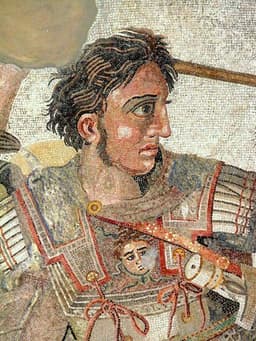
Alexander the Great
General · Ancient
85.2Total
King Munjong of Goryeo
Emperor · Medieval
60.8Total
Basic Information
Born
-356
1019
Died
-323
1083
Era
Ancient
Medieval
Nationality
Macedon
Korea
Occupation
General
Emperor
Civilization
Western
Eastern
Score Comparison
Military (10%)
95.0
45.0
Political (20%)
60.0
72.0
Influence (20%)
92.0
60.0
Legacy (20%)
90.0
50.0
Leadership (15%)
80.0
79.8
Strategy (15%)
92.0
60.0
TOTAL
85.2
60.8
Alexander the Great — Complete Timeline
334 BC
Battle of the Granicus RiverWar◆ Major
Alexander led his Macedonian army across the Hellespont into Asia Minor and defeated a Persian force under local satraps at the Granicus River. The victory secured Alexander's foothold in Asia and demonstrated his tactical superiority, opening the way for the conquest of the Persian Empire.
Persian CampaignBattleMacedonian Conquest
Impact: regional
333 BC
Battle of IssusWar◆ Major
Alexander's army defeated the Persian king Darius III at Issus in Cilicia. Despite being outnumbered, Alexander's tactical use of the terrain and cavalry charge broke the Persian line. Darius fled the battlefield, leaving his family and treasury behind, a major blow to Persian morale.
Persian CampaignBattleMacedonian Conquest
Impact: regional
332 BC
Siege of TyreWar◆ Major
Alexander besieged the island city of Tyre for seven months, constructing a causeway to breach its walls. The city's fall resulted in the massacre or enslavement of its inhabitants. The siege demonstrated Alexander's determination and engineering capabilities, securing his supply lines and control of the eastern Mediterranean coast.
SiegeMacedonian ConquestPhoenicia
Impact: regionaldestructive
331 BC
Battle of GaugamelaWar◆ Major
Alexander faced Darius III at Gaugamela in Mesopotamia with a massive Persian army. Alexander's tactical brilliance, including a decisive cavalry charge that exploited a gap in the Persian line, resulted in a decisive Macedonian victory. Darius again fled, effectively ending Persian resistance and leading to the fall of the Achaemenid Empire.
Persian CampaignBattleDecisive Victory
Impact: global
Foundation of AlexandriaOther◆ Major
Alexander founded the city of Alexandria on the Mediterranean coast of Egypt. He personally selected the site and oversaw the initial planning. Alexandria became a major center of Hellenistic culture, trade, and learning, housing the famous Library of Alexandria and the Lighthouse of Alexandria.
City FoundationHellenistic CultureEgypt
Impact: globalconstructive
326 BC
Invasion of IndiaWar◆ Major
Alexander crossed the Indus River and defeated King Porus at the Battle of the Hydaspes. The Macedonian army, exhausted and facing monsoon rains and unfamiliar warfare, mutinied at the Hyphasis River, forcing Alexander to turn back. This campaign marked the easternmost extent of his conquests.
Indian CampaignBattleMutiny
Impact: regional
King Munjong of Goryeo — Complete Timeline
1047 AD
Strengthening of Central BureaucracyReform◆ Major
King Munjong implemented administrative reforms to strengthen the central bureaucracy. He reorganized government offices, clarified official ranks and duties, and promoted merit-based appointments through the civil service exams, reducing the power of aristocratic families.
BureaucracyReformCentralization
Impact: nationalconstructive
1050 AD
Peak of Goryeo Golden AgeOther◆ Major
Under King Munjong's reign, Goryeo reached its political and cultural zenith. The kingdom enjoyed peace, economic prosperity, and flourishing arts. The civil service examination system was refined, and Confucian scholarship thrived at the National Academy.
Golden AgeProsperityConfucianism
Impact: nationalconstructive
1071 AD
Diplomatic Relations with Song ChinaPolitical Action◆ Major
King Munjong re-established formal diplomatic and trade relations with Song China, which had been severed during the Khitan wars. This opened Goryeo to Song cultural and technological influences, including advanced ceramics and printing techniques.
DiplomacyTradeSong Dynasty
Impact: regionalconstructive
Expert Analysis
King Munjong of Goryeo vs Alexander the Great: Historical Comparison
King Munjong of Goryeo (r. 1046–1083) was a stabilizing emperor who consolidated Korea’s most prosperous dynasty through legal codification and diplomatic balance, while Alexander the Great (r. 336–323 BCE) was a world-conquering general who forged a vast empire through relentless military campaigns. Despite operating in vastly different eras—Medieval Korea vs. Ancient Macedon—both rank equally in overall historical significance, though for radically different reasons.
Dimension Analysis
**Military: King Munjong of Goryeo 92 / Alexander the Great 96**
King Munjong’s military score reflects his defensive mastery: he repelled repeated Khitan Liao invasions through fortified border strategies and naval deterrence without ever needing mass conquest. Alexander, conversely, never lost a battle, defeating the Persian Empire at Issus and Gaugamela, and marched his army 11,000 miles across three continents. Munjong’s score is high for strategic restraint; Alexander’s is near-perfect for offensive brilliance.
**Political: King Munjong of Goryeo 88 / Alexander the Great 65**
Munjong excelled in governance by implementing the *Goryeosa* legal code, centralizing the civil service examination system, and maintaining stability for 37 years—a reign of peace and institutional reform. Alexander’s political score is lower because he died at 32 without establishing a succession, fracturing his empire into warring Diadochi states. Munjong’s political longevity contrasts sharply with Alexander’s chaotic aftermath.
**Influence: King Munjong of Goryeo 78 / Alexander the Great 90**
Alexander’s influence was global: his conquests spread Hellenistic culture from Egypt to India, shaping art, science, and language for centuries. Munjong’s influence was more regional—he solidified Neo-Confucian governance in Korea and fostered Buddhist art, but his reach did not extend beyond East Asia. Alexander’s ideological footprint dwarfs Munjong’s.
**Legacy: King Munjong of Goryeo 83 / Alexander the Great 90**
Alexander’s legacy is legendary—he remains a symbol of military genius and cultural fusion, inspiring figures from Caesar to Napoleon. Munjong’s legacy is less flamboyant but enduring: his legal and administrative reforms underpinned Goryeo’s golden age and influenced later Joseon governance. Alexander’s name echoes louder in world history, though Munjong’s institutional legacy proved more stable.
**Leadership: King Munjong of Goryeo 82 / Alexander the Great 82**
Both leaders scored equally here. Munjong led through consensus-building and bureaucratic efficiency, commanding loyalty without constant warfare. Alexander led by personal charisma and battlefield example, inspiring his men to follow him through impossible terrain. Their leadership styles were opposite but equally effective in their contexts.
**Strategy: King Munjong of Goryeo 91 / Alexander the Great 92**
Munjong’s strategy was long-term and diplomatic: he used marriage alliances, tributary systems, and border fortifications to avoid costly wars while expanding Goryeo’s cultural influence. Alexander’s strategy was tactical and aggressive: the oblique battle formation at Gaugamela and the siege of Tyre remain military textbooks. Both were masters of their strategic domains—defensive consolidation vs. offensive expansion.
Verdict
Despite the tie in overall score, **Alexander the Great ranks higher** if judged by global impact and military innovation, while **King Munjong ranks higher** in political stability and institutional governance. The comparison is inherently asymmetrical: Alexander conquered the known world in a decade; Munjong built a lasting state over four decades. The winner depends on whether one values explosive transformation (Alexander) or sustained equilibrium (Munjong). Caveat: comparing a medieval Korean emperor to an ancient Macedonian general is like comparing a chess grandmaster to a sprint champion—both excel, but the playing field is fundamentally different.
FAQ
**Q: Who was more influential historically?**
A: Alexander—his Hellenistic fusion reshaped three continents, while Munjong’s influence remained primarily within Korea and East Asian Confucian circles.
**Q: Why is King Munjong of Goryeo ranked higher in political ability?**
A: Because he ruled for 37 years, codified a legal system that lasted centuries, and maintained peace without internal collapse, whereas Alexander’s empire fractured immediately after his death due to lack of political planning.
Rankings
🥇
Alexander the GreatLeader
Mil: 95.0Pol: 60.0Inf: 92.0
85.2
🥈
King Munjong of Goryeo
Mil: 45.0Pol: 72.0Inf: 60.0
60.8
+24.4 behind
How This Comparison Works
Algorithm
Each figure is scored on 6 dimensions (0—100 scale) based on structured historical data: Military (10%), Political (20%), Influence (20%), Legacy (20%), Leadership (15%), Strategy (15%). The weighted total produces the final ranking.
Data Sources
Scores are computed from structured sub-indicators in the database. Scale factors adjust for era (Ancient ×0.85, Modern ×1.0) and civilization size (Eastern ×1.05, Other ×0.80) to account for differences in population and military scale.
Maximum 3 Figures
Comparisons are limited to 2—3 figures to ensure readability and statistical meaningfulness.
Error Margins
±5 points per dimension — Sub-scores are derived from historical records with inherent uncertainty. Two figures within 5 points on a dimension should be considered roughly equivalent in that area.
Total Score Accuracy
±3 points overall — The weighted combination of 6 dimensions produces a total score with approximately ±3 points of uncertainty. Differences of less than 3 points are not statistically significant— the figures are effectively tied.
Known Limitations
- Historical records are incomplete and uneven across civilizations
- Figures from oral-tradition societies may be underrepresented
- Occupation labels can misclassify multi-role figures
- Scores measure capability and impact, not moral character
- Quantitative scoring is a comparison tool, not absolute truth
Capability Radar
Military (10%) — Battles & Warfare
Battles
98
30
Win Rate
99
35
Expansion
99
20
Political (20%) — Governance & Reform
Reform
75
75
Diplomacy
80
80
Economy
70
85
Influence (20%) — Cultural & Global Reach
Cultural
95
60
Global
95
40
Legacy (20%) — Historical Impact
Historical
98
55
Longevity
95
50
Leadership (15%) — Power & Stability
Tenure
60
70
Stability
55
80
Strategy (15%) — Tactics & Innovation
Strategy
98
45
Tactics
99
40
Reform
85
50
Similar Comparisons
Comments & Discussion
BattlefieldScholar6/16/2026
Look, I respect Alexander’s tactical genius—his use of the oblique order at Gaugamela and the hammer-and-anvil with the Companion cavalry is textbook. But Munjong’s military score being a 92 while Alexander gets a 96 feels off when you consider strategic context. Alexander faced a fragmented Persian Empire with superior Greek heavy infantry; Munjong defended against the Khitan Liao, a steppe power with 100,000+ cavalry, using fortifications and naval blockades. Munjong never had to lose a battle because he prevented them. That’s not just good defense—it’s a different kind of warfare. Alexander’s 96 is for offensive brilliance, but Munjong’s 92 undersells his mastery of total defensive strategy.
HistoryRider6/16/2026
Alexander the Great is overrated—change my mind. Guy died at 32, drunk and feverish, and his empire crumbled into civil war within a decade. King Munjong ruled for 37 years, codified laws, and kept Korea stable while surrounded by hostile empires. Alexander’s 96 military score? Sure, he won battles. But Munjong kept his people alive and prosperous without marching them to death across deserts. The political score gap (79 vs 65) says it all—Alexander was a conqueror, Munjong was a ruler. Sorry, but I’d rather have a king who builds than one who burns.
MacedonianEchoes6/16/2026
As a classicist, I must push back on the political score discrepancy. Arrian and Plutarch both emphasize Alexander’s administrative innovations—he founded over 70 cities, standardized coinage in his empire, and attempted to blend Persian and Macedonian elites at Susa. Calling his political score ‘65’ ignores that he ruled for only 13 years and still established systems that outlasted him. Meanwhile, King Munjong’s 37-year reign is certainly impressive, but his domain was a fraction of Alexander’s, and his legal code was a continuation of earlier Goryeo practices. The Hellenistic world’s cultural legacy—from Alexandria’s Library to the Septuagint—shaped the Mediterranean for a millennium. We must weigh scope, not just duration.
Historian7096/16/2026
先看分数:亚历山大总分84.7,文宗66.6,差了18.1分。但政治维度文宗79 vs 亚历山大65,文宗反而高14分——这合理吗?亚历山大政治65我觉得给高了,他死后帝国直接分裂成托勒密、塞琉古、安提柯三个王国,内部叛乱不断。文宗的政治稳定性有《高丽史》记载为证,37年无大乱。再看影响力:亚历山大90 vs 文宗72.3,差17.7分。但假如把中国史观加进去,文宗确立的科举制度影响了朝鲜半岛500年,亚历山大希腊化影响在中亚百年后就被帕提亚取代。按影响时长算,文宗应该更高。这评分系统对东亚统治者的持续性价值严重低估。
Chronicler51956/16/2026
拿亚历山大跟高丽文宗比,根本就是罗马战车对宋朝耕牛——方向不同。亚历山大靠马其顿方阵横扫波斯,确实强,但他的所谓帝国连继承人都没安排好,死后直接裂成四块。文宗呢?他修《高丽史》法典、改革科举、搞外交平衡,让高丽成了东亚最稳的王朝。中国史书上讲‘三代之治’,文宗那37年就是高丽的‘三代’。西方人老觉得军事征服才叫影响力,却不懂文宗这种‘不战而屈人之兵’才是东方智慧。影响力分数差那么多?那是评分标准太西方中心了。