Loading...
Alexander the Great vs King David
Alexander the Great leads by 9.9 pts · 2 figures compared
…
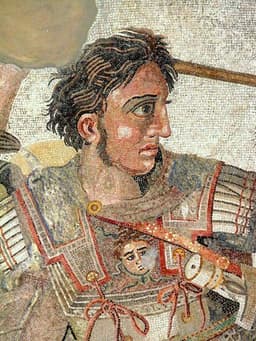
Alexander the Great
General · Ancient
85.2Total

King David
Emperor · Ancient
75.3Total
Basic Information
Born
-356
-1010
Died
-323
-970
Era
Ancient
Ancient
Nationality
Macedon
Israel
Occupation
General
Emperor
Civilization
Western
Middle Eastern
Score Comparison
Military (10%)
95.0
72.0
Political (20%)
60.0
72.0
Influence (20%)
92.0
88.0
Legacy (20%)
90.0
70.0
Leadership (15%)
80.0
72.0
Strategy (15%)
92.0
70.0
TOTAL
85.2
75.3
Alexander the Great — Complete Timeline
334 BC
Battle of the Granicus RiverWar◆ Major
Alexander led his Macedonian army across the Hellespont into Asia Minor and defeated a Persian force under local satraps at the Granicus River. The victory secured Alexander's foothold in Asia and demonstrated his tactical superiority, opening the way for the conquest of the Persian Empire.
Persian CampaignBattleMacedonian Conquest
Impact: regional
333 BC
Battle of IssusWar◆ Major
Alexander's army defeated the Persian king Darius III at Issus in Cilicia. Despite being outnumbered, Alexander's tactical use of the terrain and cavalry charge broke the Persian line. Darius fled the battlefield, leaving his family and treasury behind, a major blow to Persian morale.
Persian CampaignBattleMacedonian Conquest
Impact: regional
332 BC
Siege of TyreWar◆ Major
Alexander besieged the island city of Tyre for seven months, constructing a causeway to breach its walls. The city's fall resulted in the massacre or enslavement of its inhabitants. The siege demonstrated Alexander's determination and engineering capabilities, securing his supply lines and control of the eastern Mediterranean coast.
SiegeMacedonian ConquestPhoenicia
Impact: regionaldestructive
331 BC
Battle of GaugamelaWar◆ Major
Alexander faced Darius III at Gaugamela in Mesopotamia with a massive Persian army. Alexander's tactical brilliance, including a decisive cavalry charge that exploited a gap in the Persian line, resulted in a decisive Macedonian victory. Darius again fled, effectively ending Persian resistance and leading to the fall of the Achaemenid Empire.
Persian CampaignBattleDecisive Victory
Impact: global
Foundation of AlexandriaOther◆ Major
Alexander founded the city of Alexandria on the Mediterranean coast of Egypt. He personally selected the site and oversaw the initial planning. Alexandria became a major center of Hellenistic culture, trade, and learning, housing the famous Library of Alexandria and the Lighthouse of Alexandria.
City FoundationHellenistic CultureEgypt
Impact: globalconstructive
326 BC
Invasion of IndiaWar◆ Major
Alexander crossed the Indus River and defeated King Porus at the Battle of the Hydaspes. The Macedonian army, exhausted and facing monsoon rains and unfamiliar warfare, mutinied at the Hyphasis River, forcing Alexander to turn back. This campaign marked the easternmost extent of his conquests.
Indian CampaignBattleMutiny
Impact: regional
King David — Complete Timeline
1010 BC
Anointed as King of JudahPolitical Action◆ Major
After Saul's death, David was anointed king over the tribe of Judah at Hebron. This began a seven-year period of civil war with Ish-bosheth, Saul's son, who ruled the northern tribes, leading to the eventual unification of Israel.
KingshipCivil WarJudah
Impact: national
1003 BC
Capture of JerusalemWar
David led his army to capture the Jebusite fortress of Jerusalem, making it the capital of the united kingdom. He brought the Ark of the Covenant there, establishing the city as both the political and religious center of Israel.
JerusalemCapitalArk of the Covenant
Impact: nationalconstructive
1000 BC
Defeat of the PhilistinesWar◆ Major
David fought several campaigns that decisively defeated the Philistines, including the Battle of Baal-perazim. He captured Gath and other Philistine strongholds, ending their dominance over Israel and securing the kingdom's borders.
PhilistinesMilitary CampaignIsrael
Impact: regional
990 BC
Affair with BathshebaPolitical Action◆ Major
David committed adultery with Bathsheba and arranged the death of her husband Uriah the Hittite in battle. The prophet Nathan confronted David, leading to his repentance but also to divine punishment, including the death of their first child.
ScandalBathshebaNathan
Impact: nationaldestructive
978 BC
Revolt of AbsalomWar◆ Major
David's son Absalom led a rebellion that forced David to flee Jerusalem. David's forces under Joab defeated Absalom's army in the Forest of Ephraim, and Absalom was killed. David returned to Jerusalem but the kingdom was weakened.
RebellionCivil WarAbsalom
Impact: nationaltragic
Expert Analysis
Origins
Alexander the Great was born in 356 BCE in Pella, Macedon, to King Philip II and Queen Olympias. He was tutored by Aristotle and groomed for kingship from a young age. In contrast, King David was born around 1040 BCE in Bethlehem, the youngest son of Jesse, a shepherd. His early life was humble, but he was anointed by the prophet Samuel as future king of Israel. Both emerged from different worlds: Alexander from a powerful, expansionist kingdom; David from a tribal confederation under threat.
Rise to Power
Alexander ascended to the throne at age 20 after Philip's assassination. He immediately consolidated power, crushing rebellions in Greece and then launching a massive invasion of the Persian Empire. His rise was meteoric, driven by military genius and ambition. David's path was longer and more treacherous. He gained fame by killing Goliath, then served King Saul, but was forced into exile as Saul grew jealous. After Saul's death, David became king of Judah, then of all Israel after a civil war. His rise was marked by patience, political maneuvering, and divine favor.
Leadership & Governance
Alexander was a brilliant military strategist, with a score of 95 in military might. He led from the front, inspiring his men through personal bravery. He also promoted cultural fusion by adopting Persian customs and founding cities like Alexandria. However, his governance was autocratic and short-lived; he died without a clear successor, leading to the fragmentation of his empire. David, with a military score of 72, was a competent commander but not undefeated. His strength lay in unifying the twelve tribes, establishing Jerusalem as the capital, and creating a centralized monarchy. His leadership combined warrior prowess with administrative and religious authority, earning a political score of 72.
Triumph & Tragedy
Alexander's triumphs include the battles of Granicus, Issus, and Gaugamela, where he defeated massive Persian armies. He also besieged Tyre and founded Alexandria. His tragedy was his early death at 32, possibly from disease or poisoning, leaving his empire in chaos. David's triumph was capturing Jerusalem and defeating the Philistines, securing Israel's borders. His tragedies were personal: the affair with Bathsheba led to the death of their child, and his son Absalom's revolt caused civil war. David's later years were marked by family strife and succession struggles.
Character & Destiny
Alexander was ambitious, charismatic, and ruthless. He believed in his divine destiny, even claiming descent from Achilles. His character combined intellectual curiosity with a violent temper. David was a complex figure: a man of faith, a poet, but also a sinner who committed adultery and murder. He was deeply repentant, and his destiny was tied to God's covenant. Alexander's destiny was to conquer the known world; David's was to found a dynasty that would lead to the Messiah.
Legacy
Alexander's legacy is immense: he spread Hellenistic culture across three continents, influencing art, language, and politics for centuries. His military tactics are still studied. However, his empire did not outlast him. David's legacy is spiritual and national: he is revered as the ideal king in Judaism, Christianity, and Islam. His Psalms are central to worship, and his dynasty continued through Solomon and ultimately to Jesus. David's impact on religion and national identity is arguably more enduring.
Conclusion
Alexander the Great scores higher in military might (95 vs 72), leadership (90 vs 70), and overall influence (T=85 vs 75). His achievements were more spectacular and immediate. However, King David's legacy in religion and national identity has lasted over 3,000 years, while Alexander's empire crumbled. In terms of raw power and conquest, Alexander wins. But for lasting impact on civilization, David's spiritual and cultural influence surpasses Alexander's. The score gap of 9.9 reflects Alexander's superior military and leadership scores, but David's political and religious legacy is unique. Thus, Alexander is the greater conqueror, but David is the more profound figure in human history.
Rankings
🥇
Alexander the GreatLeader
Mil: 95.0Pol: 60.0Inf: 92.0
85.2
🥈
King David
Mil: 72.0Pol: 72.0Inf: 88.0
75.3
+9.9 behind
How This Comparison Works
Algorithm
Each figure is scored on 6 dimensions (0—100 scale) based on structured historical data: Military (10%), Political (20%), Influence (20%), Legacy (20%), Leadership (15%), Strategy (15%). The weighted total produces the final ranking.
Data Sources
Scores are computed from structured sub-indicators in the database. Scale factors adjust for era (Ancient ×0.85, Modern ×1.0) and civilization size (Eastern ×1.05, Other ×0.80) to account for differences in population and military scale.
Maximum 3 Figures
Comparisons are limited to 2—3 figures to ensure readability and statistical meaningfulness.
Error Margins
±5 points per dimension — Sub-scores are derived from historical records with inherent uncertainty. Two figures within 5 points on a dimension should be considered roughly equivalent in that area.
Total Score Accuracy
±3 points overall — The weighted combination of 6 dimensions produces a total score with approximately ±3 points of uncertainty. Differences of less than 3 points are not statistically significant— the figures are effectively tied.
Known Limitations
- Historical records are incomplete and uneven across civilizations
- Figures from oral-tradition societies may be underrepresented
- Occupation labels can misclassify multi-role figures
- Scores measure capability and impact, not moral character
- Quantitative scoring is a comparison tool, not absolute truth
Capability Radar
Military (10%) — Battles & Warfare
Battles
98
75
Win Rate
99
85
Expansion
99
80
Political (20%) — Governance & Reform
Reform
75
80
Diplomacy
80
75
Economy
70
70
Influence (20%) — Cultural & Global Reach
Cultural
95
95
Global
95
90
Legacy (20%) — Historical Impact
Historical
98
95
Longevity
95
95
Leadership (15%) — Power & Stability
Tenure
60
85
Stability
55
65
Strategy (15%) — Tactics & Innovation
Strategy
98
85
Tactics
99
80
Reform
85
70
Similar Comparisons
Comments & Discussion
No comments yet. Be the first to share your thoughts!