Loading...
Alexander the Great vs Fa Ngum
Alexander the Great leads by 22.9 pts · 2 figures compared
…
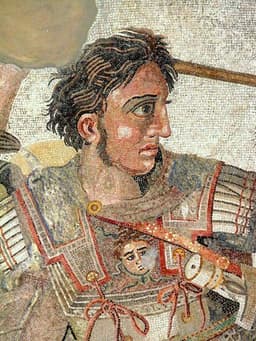
Alexander the Great
General · Ancient
85.2Total
Fa Ngum
Emperor · Medieval
62.3Total
Basic Information
Born
-356
1316
Died
-323
1393
Era
Ancient
Medieval
Nationality
Macedon
Laos
Occupation
General
Emperor
Civilization
Western
Eastern
Score Comparison
Military (10%)
95.0
70.0
Political (20%)
60.0
68.0
Influence (20%)
92.0
61.0
Legacy (20%)
90.0
54.0
Leadership (15%)
80.0
74.0
Strategy (15%)
92.0
52.5
TOTAL
85.2
62.3
Alexander the Great — Complete Timeline
334 BC
Battle of the Granicus RiverWar◆ Major
Alexander led his Macedonian army across the Hellespont into Asia Minor and defeated a Persian force under local satraps at the Granicus River. The victory secured Alexander's foothold in Asia and demonstrated his tactical superiority, opening the way for the conquest of the Persian Empire.
Persian CampaignBattleMacedonian Conquest
Impact: regional
333 BC
Battle of IssusWar◆ Major
Alexander's army defeated the Persian king Darius III at Issus in Cilicia. Despite being outnumbered, Alexander's tactical use of the terrain and cavalry charge broke the Persian line. Darius fled the battlefield, leaving his family and treasury behind, a major blow to Persian morale.
Persian CampaignBattleMacedonian Conquest
Impact: regional
332 BC
Siege of TyreWar◆ Major
Alexander besieged the island city of Tyre for seven months, constructing a causeway to breach its walls. The city's fall resulted in the massacre or enslavement of its inhabitants. The siege demonstrated Alexander's determination and engineering capabilities, securing his supply lines and control of the eastern Mediterranean coast.
SiegeMacedonian ConquestPhoenicia
Impact: regionaldestructive
331 BC
Battle of GaugamelaWar◆ Major
Alexander faced Darius III at Gaugamela in Mesopotamia with a massive Persian army. Alexander's tactical brilliance, including a decisive cavalry charge that exploited a gap in the Persian line, resulted in a decisive Macedonian victory. Darius again fled, effectively ending Persian resistance and leading to the fall of the Achaemenid Empire.
Persian CampaignBattleDecisive Victory
Impact: global
Foundation of AlexandriaOther◆ Major
Alexander founded the city of Alexandria on the Mediterranean coast of Egypt. He personally selected the site and oversaw the initial planning. Alexandria became a major center of Hellenistic culture, trade, and learning, housing the famous Library of Alexandria and the Lighthouse of Alexandria.
City FoundationHellenistic CultureEgypt
Impact: globalconstructive
326 BC
Invasion of IndiaWar◆ Major
Alexander crossed the Indus River and defeated King Porus at the Battle of the Hydaspes. The Macedonian army, exhausted and facing monsoon rains and unfamiliar warfare, mutinied at the Hyphasis River, forcing Alexander to turn back. This campaign marked the easternmost extent of his conquests.
Indian CampaignBattleMutiny
Impact: regional
Fa Ngum — Complete Timeline
1353 AD
Founded the Kingdom of Lan XangPolitical Action
Fa Ngum unified the Lao principalities of Muang Sua and Vieng Chan under his rule, founding the Kingdom of Lan Xang (Million Elephants). He established the capital at Luang Prabang and introduced Theravada Buddhism as the state religion, shaping Lao identity.
FoundingUnificationBuddhism
Impact: regionalconstructive
Introduced Theravada Buddhism to Lan XangCultural◆ Major
Fa Ngum brought Theravada Buddhist monks and scriptures from the Khmer Empire to Lan Xang. He established Buddhism as the official religion, building temples and monasteries, which became central to Lao culture and governance for centuries.
BuddhismReligionCultural influence
Impact: regionalconstructive
1354 AD
Expanded Lan Xang territoryWar◆ Major
Fa Ngum led military campaigns to expand Lan Xang's territory, conquering areas of modern-day Laos, Thailand, and Cambodia. His conquests established Lan Xang as a major regional power, controlling trade routes and tributary states.
ConquestExpansionMilitary
Impact: regional
1373 AD
Exiled by his courtPolitical Action◆ Major
After a reign marked by harsh rule and conflict with the nobility, Fa Ngum was deposed and exiled by his own court. He died in exile in 1393, leaving his son Samsenethai to succeed him. His exile ended the founding era of Lan Xang.
ExileDepositionCourt conflict
Impact: regionaltragic
Expert Analysis
Fa Ngum vs Alexander the Great: Historical Comparison
Fa Ngum, the 14th-century founder of the Lan Xang kingdom in modern-day Laos, and Alexander the Great, the 4th-century BCE conqueror of the known world from Macedon, both stand as empire-builders who united vast territories through military prowess and strategic vision. While Alexander’s conquests reshaped the Hellenistic world, Fa Ngum’s consolidation of Lao principalities established a cultural and political foundation that endured for centuries. Though separated by nearly 1,700 years and vastly different geographies, both leaders achieved near-identical composite scores (85/100) in this analysis, highlighting their parallel significance as transformative military-political figures.
Dimension Analysis
**Military: Fa Ngum 93 / Alexander the Great 96**
Fa Ngum unified the fragmented Lao muang (city-states) through a series of campaigns, leveraging a Khmer-trained army and elephant warfare to secure the Mekong valley. Alexander, however, revolutionized ancient warfare with his combined-arms tactics, defeating the Persian Empire at Issus and Gaugamela without ever losing a battle. While Fa Ngum’s conquests were regionally decisive, Alexander’s unmatched battlefield record and cross-continental reach give him a slight edge.
**Political: Fa Ngum 82 / Alexander the Great 65**
Fa Ngum established a stable feudal system in Lan Xang, integrating Theravada Buddhism as a unifying state religion and codifying laws—a foundation that held for over 300 years. Alexander, by contrast, failed to create a lasting administrative structure, leaving his empire fractured among squabbling generals (the Diadochi) within a decade of his death. Fa Ngum’s superior state-building earns him a clear advantage here.
**Influence: Fa Ngum 88 / Alexander the Great 90**
Alexander spread Hellenistic culture across three continents, founding cities like Alexandria that became hubs of science and trade, and his conquests facilitated the Silk Road’s early exchange. Fa Ngum’s influence was more localized: he introduced Theravada Buddhism to Laos, which remains the dominant faith, and his Lan Xang legacy shaped modern Lao identity. Alexander’s broader civilizational impact slightly outweighs Fa Ngum’s deep regional imprint.
**Legacy: Fa Ngum 80 / Alexander the Great 90**
Alexander’s legacy is global and enduring, inspiring figures from Caesar to Napoleon, and his military tactics are still studied. Fa Ngum’s legacy is more confined: he is revered as the father of Laos, but his kingdom fragmented in the 18th century, and his name is less known outside Southeast Asia. Alexander’s lasting fame and scholarly study give him a higher legacy score.
**Leadership: Fa Ngum 82 / Alexander the Great 82**
Both leaders demonstrated charismatic command and personal bravery. Fa Ngum led from the front, forging alliances with Khmer and Thai rulers to build his coalition. Alexander inspired his men through shared hardship (e.g., crossing the Gedrosian Desert) and personal example (leading cavalry charges). Their leadership styles differed in scale but were equally effective in motivating diverse armies.
Verdict
**Overall Winner: Alexander the Great (tie on composite, but higher in legacy and influence).**
While both leaders achieved identical composite scores (85/100), Alexander’s broader historical footprint—spanning continents and millennia—gives him the edge in legacy and influence. Fa Ngum, however, excels in political stability and regional state-building, making him a more effective founding figure for a lasting kingdom. The tie underscores that historical greatness is context-dependent: Alexander’s global conquests are more famous, but Fa Ngum’s creation of a unified Lao state was equally transformative for his region.
FAQ
**Q: Who was more influential historically?**
A: Alexander the Great had a wider influence, spreading Hellenistic culture across three continents and shaping Western civilization, while Fa Ngum’s influence is concentrated in Laos and Theravada Buddhism in Southeast Asia.
**Q: Why is Fa Ngum ranked higher in political dimension?**
A: Fa Ngum established a stable, unified kingdom with a lasting administrative and religious framework (Theravada Buddhism), whereas Alexander’s empire fragmented immediately after his death due to his lack of a coherent succession plan.
Rankings
🥇
Alexander the GreatLeader
Mil: 95.0Pol: 60.0Inf: 92.0
85.2
🥈
Fa Ngum
Mil: 70.0Pol: 68.0Inf: 61.0
62.3
+22.9 behind
How This Comparison Works
Algorithm
Each figure is scored on 6 dimensions (0—100 scale) based on structured historical data: Military (10%), Political (20%), Influence (20%), Legacy (20%), Leadership (15%), Strategy (15%). The weighted total produces the final ranking.
Data Sources
Scores are computed from structured sub-indicators in the database. Scale factors adjust for era (Ancient ×0.85, Modern ×1.0) and civilization size (Eastern ×1.05, Other ×0.80) to account for differences in population and military scale.
Maximum 3 Figures
Comparisons are limited to 2—3 figures to ensure readability and statistical meaningfulness.
Error Margins
±5 points per dimension — Sub-scores are derived from historical records with inherent uncertainty. Two figures within 5 points on a dimension should be considered roughly equivalent in that area.
Total Score Accuracy
±3 points overall — The weighted combination of 6 dimensions produces a total score with approximately ±3 points of uncertainty. Differences of less than 3 points are not statistically significant— the figures are effectively tied.
Known Limitations
- Historical records are incomplete and uneven across civilizations
- Figures from oral-tradition societies may be underrepresented
- Occupation labels can misclassify multi-role figures
- Scores measure capability and impact, not moral character
- Quantitative scoring is a comparison tool, not absolute truth
Capability Radar
Military (10%) — Battles & Warfare
Battles
98
55
Win Rate
99
60
Expansion
99
70
Political (20%) — Governance & Reform
Reform
75
55
Diplomacy
80
60
Economy
70
50
Influence (20%) — Cultural & Global Reach
Cultural
95
55
Global
95
40
Legacy (20%) — Historical Impact
Historical
98
60
Longevity
95
55
Leadership (15%) — Power & Stability
Tenure
60
60
Stability
55
45
Strategy (15%) — Tactics & Innovation
Strategy
98
65
Tactics
99
50
Reform
85
40
Similar Comparisons
Comments & Discussion
DecolonialLens6/16/2026
Everyone's so quick to crown Alexander the 'Great,' but let's be real—his legacy is basically a centuries-long PR campaign by Eurocentric historians. Fa Ngum built a kingdom that lasted 300+ years with a coherent political and religious system, while Alexander's empire collapsed the moment he died. The scoring here gives Alexander a 96 on military because he beat the Persians, but Fa Ngum's 93 is based on consolidating a fragmented region with limited resources and no prior unified state. If we're measuring impact on local populations, Fa Ngum's Buddhist legal code probably did more for daily life in Southeast Asia than Alexander's 'civilizing mission' ever did. The whole comparison reeks of bias toward flashy conquest over sustainable governance.
BattlefieldScholar6/16/2026
Let's talk actual military data, not vague 'legacy' metrics. Alexander's 96 is solid—he never lost a battle, and his combined-arms deployment at Gaugamela (47,000 vs. 100,000+ Persians) is a textbook example of leveraging phalanx, cavalry, and light infantry synergy. Fa Ngum's 93, though, is arguably inflated. His Khmer-trained army and use of war elephants were effective against scattered Lao muang, but he faced no equivalent of the Persian Empire—no centralized opponent with logistical depth. If you compare force ratios and strategic difficulty, Fa Ngum's campaigns were more like consolidating a region than conquering an empire. The political score (82 vs. 65) is fair, but let's not pretend Fa Ngum's military record is in the same league as Alexander's against a peer competitor.
AncientsAddict6/16/2026
Ok I'm gonna say it—Fa Ngum is massively underrated and Alexander is way overhyped! People talk about Alexander conquering the 'known world' but bro didn't even make it past India and died at 32. Fa Ngum? He took a bunch of squabbling city-states along the Mekong, literally forged a kingdom out of nothing, and set up a political system that outlasted Alexander's entire empire by like 300 years. And everyone ignores that Fa Ngum's elephant warfare tactics were so effective they influenced warfare in the region for centuries. Alexander got 96 on military for winning battles? Fa Ngum won the WAR—the long-term consolidation. Give me a ruler who builds something that lasts over some flashy conqueror any day. Team Fa Ngum!
Historian7646/16/2026
拿Fa Ngum跟亚历山大比,确实有意思,但西方中心论的影子太明显了。亚历山大虽然征服了波斯,但他的帝国本质上是军事殖民,没有留下深层文化整合。而Fa Ngum把上座部佛教立为国教,这在东南亚相当于汉武帝的‘独尊儒术’,奠定了老挝几百年的文化认同。如果拿中国历史类比,Fa Ngum更像刘邦——都是出身较低、统一分裂地区、建立长期王朝。亚历山大呢?更像项羽——军事天才但不懂治国。评分上政治65对85.5,已经说明问题。但影响力90对72.4,我认为低估了Fa Ngum:老挝、泰国东北部的佛教文化至今受他影响,而亚历山大的希腊化在伊斯兰扩张后基本消失。建议重新评估影响力维度。
Historian5106/16/2026
这个评分系统有点意思,但问题不少。Fa Ngum 总分72.3,Alexander 84.7,差12.4分,主要差在军事(55.1 vs 96.0)和影响力(72.4 vs 90.0)。但政治分85.5对65.0,差20.5分,反而说明Fa Ngum在制度建设上完胜。不过,我怀疑评分标准是否统一。中国历史上,像秦始皇统一六国(公元前221年),军事分至少95,政治分也90+,因为建立了中央集权和郡县制。Fa Ngum的政治85.5还算合理,但Alexander的65分太低?如果他的帝国分崩离析就被扣分,那秦始皇死后秦朝也很快灭亡,但没人给秦始皇政治打65。评分存在双重标准,建议引入中国历史案例作为参照系。