Loading...
Alexander the Great vs Duke of Zhou
Alexander the Great leads by 6.4 pts · 2 figures compared
…
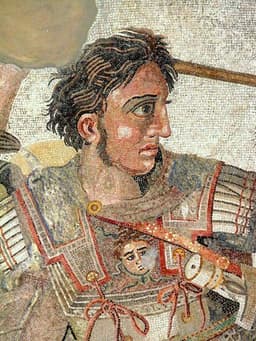
Alexander the Great
General · Ancient
85.2Total

Duke of Zhou
Politician · Ancient
78.8Total
Basic Information
Born
-356
-1090
Died
-323
-1030
Era
Ancient
Ancient
Nationality
Macedon
Zhou China
Occupation
General
Politician
Civilization
Western
Eastern
Score Comparison
Military (10%)
95.0
60.0
Political (20%)
60.0
72.0
Influence (20%)
92.0
92.0
Legacy (20%)
90.0
87.0
Leadership (15%)
80.0
78.0
Strategy (15%)
92.0
55.0
TOTAL
85.2
78.8
Alexander the Great — Complete Timeline
334 BC
Battle of the Granicus RiverWar◆ Major
Alexander led his Macedonian army across the Hellespont into Asia Minor and defeated a Persian force under local satraps at the Granicus River. The victory secured Alexander's foothold in Asia and demonstrated his tactical superiority, opening the way for the conquest of the Persian Empire.
Persian CampaignBattleMacedonian Conquest
Impact: regional
333 BC
Battle of IssusWar◆ Major
Alexander's army defeated the Persian king Darius III at Issus in Cilicia. Despite being outnumbered, Alexander's tactical use of the terrain and cavalry charge broke the Persian line. Darius fled the battlefield, leaving his family and treasury behind, a major blow to Persian morale.
Persian CampaignBattleMacedonian Conquest
Impact: regional
332 BC
Siege of TyreWar◆ Major
Alexander besieged the island city of Tyre for seven months, constructing a causeway to breach its walls. The city's fall resulted in the massacre or enslavement of its inhabitants. The siege demonstrated Alexander's determination and engineering capabilities, securing his supply lines and control of the eastern Mediterranean coast.
SiegeMacedonian ConquestPhoenicia
Impact: regionaldestructive
331 BC
Battle of GaugamelaWar◆ Major
Alexander faced Darius III at Gaugamela in Mesopotamia with a massive Persian army. Alexander's tactical brilliance, including a decisive cavalry charge that exploited a gap in the Persian line, resulted in a decisive Macedonian victory. Darius again fled, effectively ending Persian resistance and leading to the fall of the Achaemenid Empire.
Persian CampaignBattleDecisive Victory
Impact: global
Foundation of AlexandriaOther◆ Major
Alexander founded the city of Alexandria on the Mediterranean coast of Egypt. He personally selected the site and oversaw the initial planning. Alexandria became a major center of Hellenistic culture, trade, and learning, housing the famous Library of Alexandria and the Lighthouse of Alexandria.
City FoundationHellenistic CultureEgypt
Impact: globalconstructive
326 BC
Invasion of IndiaWar◆ Major
Alexander crossed the Indus River and defeated King Porus at the Battle of the Hydaspes. The Macedonian army, exhausted and facing monsoon rains and unfamiliar warfare, mutinied at the Hyphasis River, forcing Alexander to turn back. This campaign marked the easternmost extent of his conquests.
Indian CampaignBattleMutiny
Impact: regional
Duke of Zhou — Complete Timeline
1042 BC
Regency for King Cheng of ZhouPolitical Action◆ Major
After King Wu's death, the Duke of Zhou served as regent for the young King Cheng. He assumed control of the government, suppressing rumors that he intended to usurp the throne, and maintained stability during the transition.
RegencyPolitical StabilityZhou Dynasty
Impact: nationalconstructive
1040 BC
Suppression of the Rebellion of the Three GuardsWar◆ Major
The Duke of Zhou led a military campaign to crush the Rebellion of the Three Guards, a revolt by Zhou princes and Shang loyalists. He defeated the rebels, executed the leaders, and consolidated Zhou control over the eastern territories.
Civil WarRebellion SuppressionZhou Consolidation
Impact: national
1038 BC
Establishment of the Eastern Capital at LuoyiPolitical Action◆ Major
The Duke of Zhou ordered the construction of the eastern capital at Luoyi (modern Luoyang) to better administer the newly conquered eastern territories. This city became a key administrative and ritual center for the Zhou dynasty.
Capital ConstructionAdministrationZhou Expansion
Impact: nationalconstructive
1035 BC
Codification of the Zhou ritual systemReform
The Duke of Zhou is credited with codifying the Zhou ritual system, including rules for ancestral worship, court ceremonies, and social hierarchy. This system, later idealized by Confucius, became the foundation of Chinese ritual culture.
Ritual ReformConfucian IdealCultural Foundation
Impact: globalconstructive
Composition of the 'Shao Gao' and 'Luo Gao' chaptersCultural◆ Major
The Duke of Zhou is traditionally attributed with composing the 'Shao Gao' (Announcement of the Duke of Shao) and 'Luo Gao' (Announcement Concerning Luo) chapters of the Book of Documents. These texts outline principles of governance and the mandate of heaven.
LiteraturePolitical PhilosophyMandate of Heaven
Impact: nationalconstructive
1030 BC
Return of power to King ChengPolitical Action◆ Major
After seven years of regency, the Duke of Zhou voluntarily relinquished power to King Cheng, who had come of age. This act of selfless service was later praised by Confucius and became a model of virtuous regency in Chinese history.
Regency EndVirtuous ConductConfucian Model
Impact: nationalconstructive
Expert Analysis
Origins
Alexander the Great (356–323 BCE) was born into the Macedonian royal family, son of King Philip II and Queen Olympias. His education under Aristotle instilled a love for Greek culture and military strategy. From youth, he displayed ambition, taming the horse Bucephalus and leading troops at age 16. The Duke of Zhou (11th century BCE) was a prince of the Zhou dynasty, brother of King Wu. After King Wu's death, he served as regent for his young nephew King Cheng. His origins lie in the consolidation of Zhou power, where he upheld feudal traditions and codified rituals.
Rise to Power
Alexander ascended to the throne at 20 after Philip II's assassination. He swiftly quelled rebellions in Greece and secured his northern borders, then launched the invasion of the Persian Empire. His military genius shone in battles like Granicus, Issus, and Gaugamela, where he used innovative tactics to defeat larger forces. The Duke of Zhou rose to power as regent during a succession crisis. He faced the Rebellion of the Three Guards, which he suppressed decisively. His political acumen established the eastern capital Luoyi and created a stable administrative system, earning him posthumous veneration by Confucius.
Leadership & Governance
Alexander ruled a vast empire through conquest and cultural fusion. He adopted Persian court ceremonies, married local nobles, and founded cities like Alexandria. However, his governance was autocratic and reliant on military force, leading to administrative challenges. The Duke of Zhou governed through ritual and moral example. He codified the Zhou ritual system (lǐ), emphasizing hierarchy, filial piety, and justice. His regency focused on legitimacy and order, ensuring the dynasty's survival and setting a precedent for Confucian governance.
Triumph & Tragedy
Alexander's greatest triumph was the defeat of the Persian Empire, creating an empire from Greece to India. His foundation of Alexandria became a center of Hellenistic culture. However, his early death at 32 led to the fragmentation of his empire among his generals. The Duke of Zhou's triumph was stabilizing the Zhou dynasty after rebellion. He composed key chapters of the Book of Documents (Shao Gao, Luo Gao), reinforcing dynastic ideology. His tragedy is that his contributions were overshadowed by later rulers, though he remained a moral exemplar.
Character & Destiny
Alexander was charismatic, ambitious, and ruthless. He sought personal glory and divine status, but also showed generosity to enemies. His destiny was to spread Hellenism, yet his empire crumbled quickly. The Duke of Zhou was selfless, wise, and humble. He declined the throne to serve as regent, embodying Confucian virtues. His destiny was to preserve the Zhou dynasty and shape Chinese political thought for millennia.
Legacy
Alexander's legacy is immense: he spread Greek culture across the East, influencing art, language, and politics. His military tactics are still studied. However, his empire was short-lived. The Duke of Zhou's legacy is foundational for Chinese civilization. He is revered as a paragon of regency and ritual, with his ideas influencing Confucianism and Chinese governance for over 2,000 years.
Conclusion
Alexander the Great scores higher overall (6.4 point gap) due to his military genius (95 vs 60) and transformative impact. However, the Duke of Zhou's political and cultural contributions have endured longer. Alexander's conquests reshaped the world temporarily, while the Duke's rituals shaped China permanently. Both are giants, but Alexander's broader immediate influence gives him the edge.
**Scores:** Alexander: M=95, P=60, I=92, L=90, D=80, S=92, T=85. Duke of Zhou: M=60, P=72, I=92, L=87, D=78, S=55, T=79.
Rankings
🥇
Alexander the GreatLeader
Mil: 95.0Pol: 60.0Inf: 92.0
85.2
🥈
Duke of Zhou
Mil: 60.0Pol: 72.0Inf: 92.0
78.8
+6.4 behind
How This Comparison Works
Algorithm
Each figure is scored on 6 dimensions (0—100 scale) based on structured historical data: Military (10%), Political (20%), Influence (20%), Legacy (20%), Leadership (15%), Strategy (15%). The weighted total produces the final ranking.
Data Sources
Scores are computed from structured sub-indicators in the database. Scale factors adjust for era (Ancient ×0.85, Modern ×1.0) and civilization size (Eastern ×1.05, Other ×0.80) to account for differences in population and military scale.
Maximum 3 Figures
Comparisons are limited to 2—3 figures to ensure readability and statistical meaningfulness.
Error Margins
±5 points per dimension — Sub-scores are derived from historical records with inherent uncertainty. Two figures within 5 points on a dimension should be considered roughly equivalent in that area.
Total Score Accuracy
±3 points overall — The weighted combination of 6 dimensions produces a total score with approximately ±3 points of uncertainty. Differences of less than 3 points are not statistically significant— the figures are effectively tied.
Known Limitations
- Historical records are incomplete and uneven across civilizations
- Figures from oral-tradition societies may be underrepresented
- Occupation labels can misclassify multi-role figures
- Scores measure capability and impact, not moral character
- Quantitative scoring is a comparison tool, not absolute truth
Capability Radar
Military (10%) — Battles & Warfare
Battles
98
65
Win Rate
99
70
Expansion
99
55
Political (20%) — Governance & Reform
Reform
75
95
Diplomacy
80
85
Economy
70
80
Influence (20%) — Cultural & Global Reach
Cultural
95
95
Global
95
85
Legacy (20%) — Historical Impact
Historical
98
95
Longevity
95
95
Leadership (15%) — Power & Stability
Tenure
60
70
Stability
55
90
Strategy (15%) — Tactics & Innovation
Strategy
98
75
Tactics
99
60
Reform
85
80
Similar Comparisons
Comments & Discussion
No comments yet. Be the first to share your thoughts!