Loading...
Alexander the Great vs Dantidurga
Alexander the Great leads by 26.5 pts · 2 figures compared
…
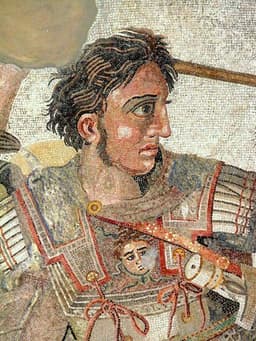
Alexander the Great
General · Ancient
85.2Total
Dantidurga
Emperor · Medieval
58.7Total
Basic Information
Born
-356
735
Died
-323
756
Era
Ancient
Medieval
Nationality
Macedon
India
Occupation
General
Emperor
Civilization
Western
Indian
Score Comparison
Military (10%)
95.0
67.5
Political (20%)
60.0
68.0
Influence (20%)
92.0
56.4
Legacy (20%)
90.0
50.0
Leadership (15%)
80.0
65.7
Strategy (15%)
92.0
52.5
TOTAL
85.2
58.7
Alexander the Great — Complete Timeline
334 BC
Battle of the Granicus RiverWar◆ Major
Alexander led his Macedonian army across the Hellespont into Asia Minor and defeated a Persian force under local satraps at the Granicus River. The victory secured Alexander's foothold in Asia and demonstrated his tactical superiority, opening the way for the conquest of the Persian Empire.
Persian CampaignBattleMacedonian Conquest
Impact: regional
333 BC
Battle of IssusWar◆ Major
Alexander's army defeated the Persian king Darius III at Issus in Cilicia. Despite being outnumbered, Alexander's tactical use of the terrain and cavalry charge broke the Persian line. Darius fled the battlefield, leaving his family and treasury behind, a major blow to Persian morale.
Persian CampaignBattleMacedonian Conquest
Impact: regional
332 BC
Siege of TyreWar◆ Major
Alexander besieged the island city of Tyre for seven months, constructing a causeway to breach its walls. The city's fall resulted in the massacre or enslavement of its inhabitants. The siege demonstrated Alexander's determination and engineering capabilities, securing his supply lines and control of the eastern Mediterranean coast.
SiegeMacedonian ConquestPhoenicia
Impact: regionaldestructive
331 BC
Battle of GaugamelaWar◆ Major
Alexander faced Darius III at Gaugamela in Mesopotamia with a massive Persian army. Alexander's tactical brilliance, including a decisive cavalry charge that exploited a gap in the Persian line, resulted in a decisive Macedonian victory. Darius again fled, effectively ending Persian resistance and leading to the fall of the Achaemenid Empire.
Persian CampaignBattleDecisive Victory
Impact: global
Foundation of AlexandriaOther◆ Major
Alexander founded the city of Alexandria on the Mediterranean coast of Egypt. He personally selected the site and oversaw the initial planning. Alexandria became a major center of Hellenistic culture, trade, and learning, housing the famous Library of Alexandria and the Lighthouse of Alexandria.
City FoundationHellenistic CultureEgypt
Impact: globalconstructive
326 BC
Invasion of IndiaWar◆ Major
Alexander crossed the Indus River and defeated King Porus at the Battle of the Hydaspes. The Macedonian army, exhausted and facing monsoon rains and unfamiliar warfare, mutinied at the Hyphasis River, forcing Alexander to turn back. This campaign marked the easternmost extent of his conquests.
Indian CampaignBattleMutiny
Impact: regional
Dantidurga — Complete Timeline
753 AD
Founding of the Rashtrakuta DynastyPolitical Action
Dantidurga overthrew his overlord, the Chalukya king Kirtivarman II, in a coup. He established the Rashtrakuta dynasty as the dominant power in the Deccan, with Manyakheta as his capital. This marked the beginning of a new imperial era.
Impact: regionalconstructive
754 AD
Performance of the Hiranyagarbha RitualCultural
Dantidurga performed the Hiranyagarbha (golden womb) ritual, a Vedic ceremony that symbolically rebirthed him as a Kshatriya. This legitimized his rule by claiming a higher caste status, as the Rashtrakutas were originally of humble origin.
Impact: nationalconstructive
755 AD
Conquest of MalwaWar◆ Major
Dantidurga led a military campaign into Malwa, defeating the Gurjara-Pratihara ruler Nagabhata I. He annexed the region, expanding Rashtrakuta territory northward. This victory established Rashtrakuta influence in central India.
Impact: regionaldestructive
Expert Analysis
Alexander the Great vs Dantidurga
# The Conqueror and the Founder: Why Alexander Built an Empire and Dantidurga Built a Dynasty
Two men, separated by a thousand years and half a world, each seized a moment in history with astonishing audacity. One was a Macedonian king who, by the age of thirty, had carved a path of conquest from the Aegean Sea to the Indus River, never losing a single battle. The other was a Deccan chieftain who, in a single generation, overthrew a centuries-old dynasty and laid the foundation for an empire that would dominate southern India for two centuries. Alexander the Great and Dantidurga both rose from relative obscurity to extraordinary power. Yet one died at thirty-two, his empire fragmented within a generation, while the other’s creation endured long after his own early death. The difference was not in ambition, but in what each man understood about the nature of power itself.
Origins
Alexander was born in 356 BCE into the glittering court of Macedon, a kingdom that his father, Philip II, had transformed from a barbarian backwater into the dominant power of Greece. From boyhood, Alexander was groomed for greatness. His tutor was Aristotle, who filled his mind with Homeric epics and the ideal of a unified world under Greek civilization. His mother, Olympias, whispered that he was descended from Achilles. Every lesson, every story, every expectation told him that he was destined to conquer the known world.
Dantidurga, born in 735 CE, emerged from a very different world. He was a chieftain of the Rashtrakuta clan, a family of uncertain origin that served as feudatories to the Chalukya kings of Badami—a dynasty that had ruled the Deccan for over two centuries. Unlike Alexander, Dantidurga had no Aristotle, no epic of world conquest. His world was one of ritual legitimacy and local power, where a king’s authority was measured by his ability to perform sacred ceremonies and protect his domain. Where Alexander saw a world to be remade, Dantidurga saw a throne to be claimed.
Rise to Power
Alexander’s path was swift and violent. When Philip was assassinated in 336 BCE, the twenty-year-old Alexander crushed rival claimants, suppressed rebellions in Greece, and then turned east. In 334 BCE, he crossed the Hellespont into Asia with an army of some forty thousand men. Within three years, he had defeated the Persian king Darius III at Issus and Gaugamela, conquered Egypt, and burned Persepolis. He pushed on into Central Asia, then descended into India, where he fought the epic battle against King Porus at the Hydaspes River in 326 BCE. Each victory was decisive, each campaign a masterpiece of speed and tactical brilliance.
Dantidurga’s rise was more subtle, more political. In 753 CE, he did not march across continents but performed a coup—overthrowing his own overlord, the Chalukya king Kirtivarman II. The Rashtrakuta chronicles describe this not as a conquest but as a ritual of rebirth. In 754 CE, Dantidurga performed the *Hiranyagarbha* ceremony, the “golden womb” ritual, in which he was symbolically reborn as a Kshatriya warrior. This was not mere superstition; it was a masterstroke of political theater. In a society where kingship required divine sanction, Dantidurga created his own legitimacy. The following year, he led a campaign into Malwa, defeating the Gurjara-Pratihara ruler Nagabhata I and annexing the region. But he did not destroy his enemies; he absorbed them.
Leadership & Governance
Alexander ruled by personal example and relentless momentum. He led from the front, sharing the hardships of his soldiers, wounded in battle again and again. His army was a finely tuned instrument of war, with the phalanx, the cavalry, and the siege engines all coordinated with precision. Yet his governance was improvisational. He appointed Persian satraps, married a Bactrian princess, encouraged his officers to take Persian wives, and tried to fuse Greek and Persian cultures into a new ruling class. This was visionary, but it was also fragile. He never built lasting institutions, never created a stable administrative system. His empire was held together by his own charisma and the fear his army inspired.
Dantidurga ruled by legitimacy and integration. The Rashtrakuta Empire, which he founded in 753 CE, would become known for its efficient administration, its patronage of Jainism and Hinduism, and its ability to incorporate local elites. Dantidurga did not impose a foreign culture; he performed local rituals, honored local gods, and presented himself as the rightful successor to the Chalukyas. His military campaigns were limited and strategic—defeating Nagabhata I to secure Malwa, but not pursuing total annihilation. He understood that an empire built on conquest alone would crumble; an empire built on consent would endure.
Triumph & Tragedy
Alexander’s greatest triumph was also his greatest tragedy. By 323 BCE, he had conquered the largest empire the world had ever seen, from Greece to India. He was undefeated in battle, a military genius whose tactics are still studied in war colleges today. But his soldiers, exhausted and homesick, mutinied at the Hyphasis River, refusing to march further east. Alexander wept—not from anger, but from the realization that his men would not follow him forever. He died in Babylon later that year, possibly from fever or poison, leaving a pregnant wife, a weak half-brother, and a power vacuum that his generals filled with civil war. His empire shattered within a decade.
Dantidurga’s triumph was the founding of a dynasty that would last for two centuries. His tragedy was his own early death—he died in 756 CE, just three years after his coup, at the age of twenty-one. He never saw the empire he founded reach its full glory under his uncle Krishna I, who expanded the Rashtrakuta domains into the greatest power in the Deccan. But Dantidurga’s work was done. He had established the pattern: legitimacy through ritual, power through integration, and a dynasty that would produce some of the most remarkable rulers of medieval India.
Character & Destiny
Alexander’s character was shaped by a relentless hunger for glory. He wanted to be remembered as a god, and he succeeded—but at the cost of lasting achievement. His personality was magnetic, his ambition boundless, but his vision was personal rather than institutional. He trusted his own genius above all else, and that trust was misplaced in the long run.
Dantidurga’s character was shaped by a different imperative: survival. He had no Homer to inspire him, no oracle to confirm his divinity. He had only the rituals of his ancestors and the sword of his clan. He understood that power in India was not about conquest alone; it was about legitimacy, about being seen as the rightful ruler. His decision to perform the *Hiranyagarbha* ritual was not a religious whim but a political necessity. He was reborn not as a god, but as a king.
Legacy
Alexander’s legacy is immortal. His name became a legend, his image a symbol of conquest. Hellenistic culture spread across the ancient world, blending Greek, Persian, Egyptian, and Indian influences. Cities named Alexandria dotted his empire. His military tactics are still taught. But the empire itself was ephemeral—a flash of lightning that illuminated the world for a moment and then vanished.
Dantidurga’s legacy is quieter but more enduring. The Rashtrakuta dynasty he founded reached its zenith under his successors, building the magnificent Kailasa temple at Ellora, patronizing poets and philosophers, and establishing a stable rule that outlasted Alexander’s empire many times over. Dantidurga is remembered not as a world conqueror, but as a founder—the man who, in a single decade, overthrew an old order and planted the seeds of a new one.
Conclusion
Standing on the banks of the Beas River, Alexander wept because he could go no further. Standing in a temple in Malwa, Dantidurga performed a ritual that made him a king. One man reached for the world and grasped only a memory; the other reached for a throne and built a dynasty. Both died young. But while Alexander’s empire dissolved into warring fragments, Dantidurga’s creation endured—because he understood that the most enduring power is not the power to conquer, but the power to be accepted. In the end, the conqueror and the founder both changed history. But only one of them built something that lasted.
Rankings
🥇
Alexander the GreatLeader
Mil: 95.0Pol: 60.0Inf: 92.0
85.2
🥈
Dantidurga
Mil: 67.5Pol: 68.0Inf: 56.4
58.7
+26.5 behind
How This Comparison Works
Algorithm
Each figure is scored on 6 dimensions (0—100 scale) based on structured historical data: Military (10%), Political (20%), Influence (20%), Legacy (20%), Leadership (15%), Strategy (15%). The weighted total produces the final ranking.
Data Sources
Scores are computed from structured sub-indicators in the database. Scale factors adjust for era (Ancient ×0.85, Modern ×1.0) and civilization size (Eastern ×1.05, Other ×0.80) to account for differences in population and military scale.
Maximum 3 Figures
Comparisons are limited to 2—3 figures to ensure readability and statistical meaningfulness.
Error Margins
±5 points per dimension — Sub-scores are derived from historical records with inherent uncertainty. Two figures within 5 points on a dimension should be considered roughly equivalent in that area.
Total Score Accuracy
±3 points overall — The weighted combination of 6 dimensions produces a total score with approximately ±3 points of uncertainty. Differences of less than 3 points are not statistically significant— the figures are effectively tied.
Known Limitations
- Historical records are incomplete and uneven across civilizations
- Figures from oral-tradition societies may be underrepresented
- Occupation labels can misclassify multi-role figures
- Scores measure capability and impact, not moral character
- Quantitative scoring is a comparison tool, not absolute truth
Capability Radar
Military (10%) — Battles & Warfare
Battles
98
60
Win Rate
99
65
Expansion
99
65
Political (20%) — Governance & Reform
Reform
75
45
Diplomacy
80
55
Economy
70
50
Influence (20%) — Cultural & Global Reach
Cultural
95
40
Global
95
30
Legacy (20%) — Historical Impact
Historical
98
55
Longevity
95
50
Leadership (15%) — Power & Stability
Tenure
60
40
Stability
55
45
Strategy (15%) — Tactics & Innovation
Strategy
98
60
Tactics
99
55
Reform
85
40
Similar Comparisons
Comments & Discussion
Rashtrakuta Realist6/16/2026
Let's stop romanticizing Alexander the "Great". His empire crumbled the moment he died because he conquered for personal glory, not governance. Dantidurga understood that lasting power requires building institutions, administering land, and co-opting local elites—not just winning battles. Alexander's so-called "fusion policy" was largely symbolic; Dantidurga actually integrated Chalukyan and Rashtrakuta governance structures. That's why the Rashtrakutas lasted centuries while Alexander's legacy
Macedonian Mythbuster6/16/2026
说亚历山大是“伟大”的征服者,不如说他是运气爆棚的赌徒。他赢的每一场战役,兵力都多于波斯守军——伊苏斯战役中波斯只有杂牌军,高加米拉战役大流士三世临阵脱逃。反观丹蒂杜尔加,他面对的遮娄其王朝可是统治了南印度两百年的成熟帝国。他靠的是政治手腕和战略耐心,不是靠吹嘘自己是阿喀琉斯后代。把亚历山大和真正的帝国奠基人放在一起比,本身就是对历史的不尊重。
Data Driven Dynast6/16/2026
Let's look at empirical metrics: Alexander's empire lasted roughly 13 years total before fracturing into warring successor states. Dantidurga's Rashtrakuta Empire endured for over 200 years, controlling most of the Deccan. Even during Alexander's lifetime, his "empire" was operationally fragile—he couldn't project power beyond his marching army. Dantidurga actually established a taxation system, coinage, and administrative districts that functioned without his personal presence. By any sustainab
Epic Echoes6/16/2026
问题是,亚历山大给我们留下了西方文明的神话,而丹蒂杜尔加连中文维基百科的词条都短得可怜。这不公平,但这就是历史书写的现实——胜者书写历史,而西方学者更偏爱金发碧眼的马其顿英雄。丹蒂杜尔加在埃洛拉石窟建造的凯拉萨神庙比亚历山大任何军事成就都更永恒,但哪个普通中文读者听说过他?历史比较从来不是客观的——它反映的是我们选择记住什么。