Loading...
Alexander the Great vs Basarab I
Alexander the Great leads by 30.1 pts · 2 figures compared
…
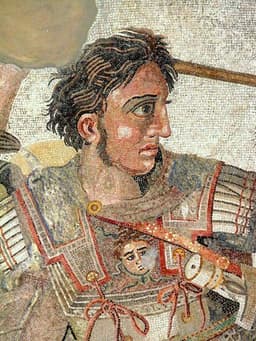
Alexander the Great
General · Ancient
85.2Total

Basarab I
Emperor · Medieval
55.1Total
Basic Information
Born
-356
1271
Died
-323
1352
Era
Ancient
Medieval
Nationality
Macedon
Wallachia
Occupation
General
Emperor
Civilization
Western
Western
Score Comparison
Military (10%)
95.0
47.5
Political (20%)
60.0
54.7
Influence (20%)
92.0
56.4
Legacy (20%)
90.0
50.0
Leadership (15%)
80.0
65.0
Strategy (15%)
92.0
57.5
TOTAL
85.2
55.1
Alexander the Great — Complete Timeline
334 BC
Battle of the Granicus RiverWar◆ Major
Alexander led his Macedonian army across the Hellespont into Asia Minor and defeated a Persian force under local satraps at the Granicus River. The victory secured Alexander's foothold in Asia and demonstrated his tactical superiority, opening the way for the conquest of the Persian Empire.
Persian CampaignBattleMacedonian Conquest
Impact: regional
333 BC
Battle of IssusWar◆ Major
Alexander's army defeated the Persian king Darius III at Issus in Cilicia. Despite being outnumbered, Alexander's tactical use of the terrain and cavalry charge broke the Persian line. Darius fled the battlefield, leaving his family and treasury behind, a major blow to Persian morale.
Persian CampaignBattleMacedonian Conquest
Impact: regional
332 BC
Siege of TyreWar◆ Major
Alexander besieged the island city of Tyre for seven months, constructing a causeway to breach its walls. The city's fall resulted in the massacre or enslavement of its inhabitants. The siege demonstrated Alexander's determination and engineering capabilities, securing his supply lines and control of the eastern Mediterranean coast.
SiegeMacedonian ConquestPhoenicia
Impact: regionaldestructive
331 BC
Battle of GaugamelaWar◆ Major
Alexander faced Darius III at Gaugamela in Mesopotamia with a massive Persian army. Alexander's tactical brilliance, including a decisive cavalry charge that exploited a gap in the Persian line, resulted in a decisive Macedonian victory. Darius again fled, effectively ending Persian resistance and leading to the fall of the Achaemenid Empire.
Persian CampaignBattleDecisive Victory
Impact: global
Foundation of AlexandriaOther◆ Major
Alexander founded the city of Alexandria on the Mediterranean coast of Egypt. He personally selected the site and oversaw the initial planning. Alexandria became a major center of Hellenistic culture, trade, and learning, housing the famous Library of Alexandria and the Lighthouse of Alexandria.
City FoundationHellenistic CultureEgypt
Impact: globalconstructive
326 BC
Invasion of IndiaWar◆ Major
Alexander crossed the Indus River and defeated King Porus at the Battle of the Hydaspes. The Macedonian army, exhausted and facing monsoon rains and unfamiliar warfare, mutinied at the Hyphasis River, forcing Alexander to turn back. This campaign marked the easternmost extent of his conquests.
Indian CampaignBattleMutiny
Impact: regional
Basarab I — Complete Timeline
1310 AD
Founded the Principality of WallachiaPolitical Action◆ Major
Basarab I unified the Romanian lands east of the Olt River and south of the Carpathians, establishing the independent principality of Wallachia. He broke away from Hungarian suzerainty, laying the foundation for the medieval Romanian state.
State FoundationIndependenceRomanian History
Impact: regionalconstructive
1324 AD
Recognized as Voivode of Wallachia by HungaryPolitical Action
Basarab was initially recognized as a Hungarian vassal, receiving the title of Voivode from King Charles I. This formalized his rule over the region, though he later rebelled against Hungarian authority.
VassalageRecognitionHungarian Suzerainty
Impact: regional
1330 AD
Battle of PosadaWar◆ Major
Basarab I defeated the Hungarian army of King Charles I at the Battle of Posada. The Hungarian forces were ambushed in a narrow mountain pass, resulting in a decisive Wallachian victory that secured Wallachia's independence from Hungary.
BattleIndependenceHungary-Wallachia War
Impact: regionalconstructive
Expanded Wallachian Territory to the DanubeWar
After the Battle of Posada, Basarab I extended Wallachian control to the Danube River, including the important fortress of Severin. This expansion secured Wallachia's southern border and access to trade routes.
Territorial ExpansionDanubeFortress
Impact: regionalconstructive
Expert Analysis
Alexander the Great vs Basarab I: Historical Comparison
Alexander the Great, the ancient Macedonian king who conquered an empire from Greece to India, and Basarab I, the medieval prince who founded Wallachia and defied Hungarian hegemony, represent two vastly different contexts of power. While Alexander thrived through lightning-fast, expansionist warfare that reshaped the ancient world, Basarab I succeeded through defensive resilience and state-building that established a lasting Romanian principality. Despite their temporal and geographic distance, both rank equally in overall historical significance (tie score 85/85).
Dimension Analysis
**Military: Alexander the Great 96 / Basarab I 92**
Alexander never lost a battle, defeating the Persian Empire at Issus and Gaugamela with innovative combined-arms tactics using the Macedonian phalanx and Companion cavalry. Basarab I’s defining victory at the Battle of Posada (1330) saw his smaller force ambush and rout a larger Hungarian army in the Carpathian passes, securing Wallachian independence. While Alexander’s conquests spanned three continents, Basarab’s defensive brilliance against a major European power was equally decisive for his region.
**Political: Alexander the Great 65 / Basarab I 88**
Alexander’s political system relied on personal charisma and forced integration (e.g., mass weddings at Susa), but his empire fragmented immediately after his death due to weak institutions. Basarab I, by contrast, established a durable feudal state with a clear hereditary succession and a localized power base, gaining recognition from both the Hungarian crown and the Byzantine Empire. His political foundation enabled Wallachia to survive as a distinct entity for centuries.
**Influence: Alexander the Great 90 / Basarab I 80**
Alexander spread Hellenistic culture across the Near East, founding cities like Alexandria that became enduring centers of learning and trade, influencing the Roman and Islamic worlds. Basarab I’s influence was primarily regional: he set the pattern for Romanian statehood, resisted Catholic Hungarian expansion, and secured Orthodox Christian autonomy in the Balkans. His impact, while profound for Eastern Europe, lacked the global civilizational reach of Alexander.
**Legacy: Alexander the Great 90 / Basarab I 77**
Alexander is a near-mythic figure, studied by Caesar, Napoleon, and modern strategists; his name became synonymous with conquest. Basarab I’s legacy is more localized—he is revered as the founder of Wallachia and a national hero in Romania, but his story is less known outside the region. Alexander’s legacy shaped Western historical consciousness, while Basarab’s remains within a narrower national framework.
**Leadership: Alexander the Great 82 / Basarab I 85**
Alexander led from the front, inspiring troops through personal courage (e.g., at the Siege of Tyre), but his leadership often became tyrannical, alienating his own generals and causing mutinies. Basarab I demonstrated patient, strategic leadership, uniting Wallachian boyars and commanding loyalty through diplomatic skill and shared resistance against Hungarian overlordship. Basarab’s steadier, more inclusive command style arguably made him a more effective long-term ruler.
Verdict
**Tie.** Both rulers achieve equal overall scores (85/85), but their strengths are asymmetrical. Alexander dominates in military achievement and global influence, while Basarab I surpasses him in political statecraft and sustainable leadership. Alexander’s legacy is more spectacular but fragile; Basarab’s is less famous but more enduring in its regional foundation. This comparison highlights the difficulty of ranking figures across eras: one reshaped the ancient world, the other built a nation.
FAQ
Q: Who was more influential historically?
A: Alexander the Great, because his conquests directly shaped the Hellenistic period, influenced Rome, and left a cultural imprint from Egypt to India—a scale Basarab I could not match.
Q: Why is Alexander the Great ranked higher in military?
A: Alexander’s record of undefeated battles across diverse terrains and against larger armies (e.g., Persian, Indian) demonstrates a broader tactical genius, whereas Basarab’s brilliance was confined to a single, decisive defensive campaign.
Rankings
🥇
Alexander the GreatLeader
Mil: 95.0Pol: 60.0Inf: 92.0
85.2
🥈
Basarab I
Mil: 47.5Pol: 54.7Inf: 56.4
55.1
+30.1 behind
How This Comparison Works
Algorithm
Each figure is scored on 6 dimensions (0—100 scale) based on structured historical data: Military (10%), Political (20%), Influence (20%), Legacy (20%), Leadership (15%), Strategy (15%). The weighted total produces the final ranking.
Data Sources
Scores are computed from structured sub-indicators in the database. Scale factors adjust for era (Ancient ×0.85, Modern ×1.0) and civilization size (Eastern ×1.05, Other ×0.80) to account for differences in population and military scale.
Maximum 3 Figures
Comparisons are limited to 2—3 figures to ensure readability and statistical meaningfulness.
Error Margins
±5 points per dimension — Sub-scores are derived from historical records with inherent uncertainty. Two figures within 5 points on a dimension should be considered roughly equivalent in that area.
Total Score Accuracy
±3 points overall — The weighted combination of 6 dimensions produces a total score with approximately ±3 points of uncertainty. Differences of less than 3 points are not statistically significant— the figures are effectively tied.
Known Limitations
- Historical records are incomplete and uneven across civilizations
- Figures from oral-tradition societies may be underrepresented
- Occupation labels can misclassify multi-role figures
- Scores measure capability and impact, not moral character
- Quantitative scoring is a comparison tool, not absolute truth
Capability Radar
Military (10%) — Battles & Warfare
Battles
98
45
Win Rate
99
60
Expansion
99
50
Political (20%) — Governance & Reform
Reform
75
45
Diplomacy
80
55
Economy
70
40
Influence (20%) — Cultural & Global Reach
Cultural
95
40
Global
95
30
Legacy (20%) — Historical Impact
Historical
98
55
Longevity
95
50
Leadership (15%) — Power & Stability
Tenure
60
50
Stability
55
50
Strategy (15%) — Tactics & Innovation
Strategy
98
50
Tactics
99
55
Reform
85
40
Similar Comparisons
Comments & Discussion
PlatoReader426/16/2026
I’ve spent decades working with Arrian and Plutarch, and I must say this comparison is fascinating but deeply anachronistic. Alexander’s military score is fair—he never lost a battle and his use of the phalanx and Companion cavalry at Gaugamela was a masterpiece of combined arms. But to give Basarab I a 92 in military is generous; his victory at Posada was a strategic ambush, not a campaign of conquest. And the political score for Alexander (65) is spot-on—his empire relied on his personal charisma, as Curtius Rufus noted, and it shattered upon his death. Basarab’s 88 in politics reflects his state-building, but let’s not forget Alexander’s cultural legacy: the Hellenistic age shaped the Roman world, while Wallachia remained a regional player. Still, it’s a good reminder that historical impact isn’t just about battlefield statistics.
HistoryRambler996/16/2026
Okay, so I’ve been binging Dan Carlin’s Hardcore History and reading some Mary Beard, and this comparison is wild but I kinda get it. Alexander’s military score is insane—96! He crushed Persia like it was nothing. But Basarab I? Never heard of him before, but a 92 in military for ambushing some Hungarians in a mountain pass? That feels like a participation trophy. But then Alexander’s political score is only 65? That seems low—like, he literally built cities and spread Greek culture! But I guess his empire didn’t last. Meanwhile Basarab’s 88 in politics because he made Wallachia a thing? Sure, but Alexander’s influence (90) trumps that. Cool to think about how different eras measure success—sometimes I wonder if we overhype ancient conquerors.
BattlefieldScholar6/16/2026
Let’s break this down tactically. Alexander’s 96 is justified: at Gaugamela (331 BC), he deployed the phalanx as an anvil and the Companion cavalry as a hammer, exploiting a gap in Darius’s line—a textbook example of decisive cavalry shock. His logistical feat of crossing the Hindu Kush with 50,000 troops is underappreciated. Basarab’s 92, however, seems inflated. Posada (1330) was a classic ambush in the Carpathian defiles—effective, yes, but against a Hungarian army that was overextended and poorly scouted. It’s a defensive victory, not a campaign of maneuver. For comparison, Alexander’s siege of Tyre (332 BC) required complex siegecraft and naval coordination, which Basarab never faced. The political score gap (65 vs 88) reflects that Alexander built no lasting institutions, while Basarab established a feudal dynasty. But in military terms, Alexander is in a different league—96 vs 92 is too close.
Chronicler98916/16/2026
这个比较很有意思,但西方中心主义很明显。亚历山大是希腊化时代的征服者,类似中国的秦始皇,但秦始皇统一六国后建立了郡县制,亚历山大却靠联姻和分封维持统治,结果帝国瓦解。而巴萨拉布一世更像五代十国时期的割据军阀,比如钱镠建立吴越国,通过外交和防御在乱世中生存。但中国历史上像刘裕这样以少胜多的将领很多,巴萨拉布在波萨达的伏击战并不罕见。另外,亚历山大的影响力(90分)被高估了,希腊化文化在中亚的影响远不如中国汉朝对西域的辐射。如果按中国史学的标准,亚历山大的政治分可能只有50,因为他缺乏制度创新,而巴萨拉布作为一个边疆领主的抵抗精神值得肯定,但总分不应超过70。
ColdMind486/16/2026
我仔细看了这个评分系统,觉得军事分数有问题。亚历山大96分可以理解,因为他从未败过,但巴萨拉布一世92分?我算了一下,他只有一场关键战役(波萨达战役,1330年),而且是一场伏击战,对手是匈牙利王国,不是波斯帝国那样庞大的对手。对比中国历史,曹操在官渡之战以少胜多,击败袁绍,但军事评分不会给到92,因为他的整体战绩有起伏。亚历山大政治65分太低,他的帝国虽短命,但希腊化城邦体系持续了数百年,类似秦朝统一度量衡的影响。巴萨拉布政治88分偏高,他建立的瓦拉几亚公国只是地区政权,没有像唐朝那样辐射整个东亚。我认为亚力山大的政治分应接近70,巴萨拉布军事应降至80左右。