Loading...
Alexander the Great vs Babur
Alexander the Great leads by 7.1 pts · 2 figures compared
…
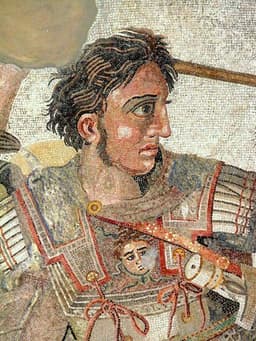
Alexander the Great
General · Ancient
85.2Total

Babur
Emperor · Medieval
78.1Total
Basic Information
Born
-356
1483
Died
-323
1530
Era
Ancient
Medieval
Nationality
Macedon
Mughal Empire
Occupation
General
Emperor
Civilization
Western
Indian
Score Comparison
Military (10%)
95.0
74.0
Political (20%)
60.0
72.0
Influence (20%)
92.0
88.0
Legacy (20%)
90.0
80.0
Leadership (15%)
80.0
74.0
Strategy (15%)
92.0
67.6
TOTAL
85.2
78.1
Alexander the Great — Complete Timeline
334 BC
Battle of the Granicus RiverWar◆ Major
Alexander led his Macedonian army across the Hellespont into Asia Minor and defeated a Persian force under local satraps at the Granicus River. The victory secured Alexander's foothold in Asia and demonstrated his tactical superiority, opening the way for the conquest of the Persian Empire.
Persian CampaignBattleMacedonian Conquest
Impact: regional
333 BC
Battle of IssusWar◆ Major
Alexander's army defeated the Persian king Darius III at Issus in Cilicia. Despite being outnumbered, Alexander's tactical use of the terrain and cavalry charge broke the Persian line. Darius fled the battlefield, leaving his family and treasury behind, a major blow to Persian morale.
Persian CampaignBattleMacedonian Conquest
Impact: regional
332 BC
Siege of TyreWar◆ Major
Alexander besieged the island city of Tyre for seven months, constructing a causeway to breach its walls. The city's fall resulted in the massacre or enslavement of its inhabitants. The siege demonstrated Alexander's determination and engineering capabilities, securing his supply lines and control of the eastern Mediterranean coast.
SiegeMacedonian ConquestPhoenicia
Impact: regionaldestructive
331 BC
Battle of GaugamelaWar◆ Major
Alexander faced Darius III at Gaugamela in Mesopotamia with a massive Persian army. Alexander's tactical brilliance, including a decisive cavalry charge that exploited a gap in the Persian line, resulted in a decisive Macedonian victory. Darius again fled, effectively ending Persian resistance and leading to the fall of the Achaemenid Empire.
Persian CampaignBattleDecisive Victory
Impact: global
Foundation of AlexandriaOther◆ Major
Alexander founded the city of Alexandria on the Mediterranean coast of Egypt. He personally selected the site and oversaw the initial planning. Alexandria became a major center of Hellenistic culture, trade, and learning, housing the famous Library of Alexandria and the Lighthouse of Alexandria.
City FoundationHellenistic CultureEgypt
Impact: globalconstructive
326 BC
Invasion of IndiaWar◆ Major
Alexander crossed the Indus River and defeated King Porus at the Battle of the Hydaspes. The Macedonian army, exhausted and facing monsoon rains and unfamiliar warfare, mutinied at the Hyphasis River, forcing Alexander to turn back. This campaign marked the easternmost extent of his conquests.
Indian CampaignBattleMutiny
Impact: regional
Babur — Complete Timeline
1526 AD
Battle of Panipat (1526)War
Babur led his army of about 12,000 men against the Delhi Sultanate army of Ibrahim Lodi, which numbered around 100,000. Using gunpowder weapons and innovative tactics, Babur defeated Lodi's forces. This victory established the Mughal Empire in India and marked the beginning of Mughal rule.
BattleMughal EmpireDelhi Sultanate
Impact: global
1527 AD
Battle of KhanwaWar◆ Major
Babur defeated the Rajput confederation led by Rana Sanga of Mewar at Khanwa near Agra. The Rajput army was larger and included cavalry and war elephants. Babur's use of artillery and defensive tactics secured the victory. This battle consolidated Mughal control over northern India.
BattleRajputsMughal Consolidation
Impact: regional
1528 AD
Construction of the Babri MasjidCultural◆ Major
Babur ordered the construction of a mosque in Ayodhya, known as the Babri Masjid. The mosque was built on a site that Hindus believed was the birthplace of the god Rama. This act became a source of religious and political conflict in India for centuries, culminating in the mosque's demolition in 1992.
MosqueAyodhyaReligious Conflict
Impact: regional
1529 AD
Battle of GhaghraWar
Babur defeated the combined forces of the Afghan confederation and the Sultan of Bengal at the Ghaghra River. This victory eliminated the last major Afghan resistance in northern India. It extended Mughal control over Bihar and parts of Bengal, further securing Babur's empire.
BattleAfghansBengal
Impact: regional
Expert Analysis
Origins
Alexander the Great (356–323 BCE) was born to King Philip II of Macedon and Queen Olympias. Tutored by Aristotle, he inherited a strong, unified kingdom with a professional army. Babur (1483–1530 CE), born Zahir-ud-din Muhammad, was a descendant of Timur on his father's side and Genghis Khan on his mother's. He inherited the fragmented principality of Fergana in Central Asia. Both men were thrust into leadership at young ages—Alexander at 20, Babur at 11—but Alexander's foundation was far more stable.
Rise to Power
Alexander quickly consolidated power by crushing rebellions in Thebes and Athens, then launched his invasion of the Persian Empire in 334 BCE. His early victories at Granicus, Issus, and Gaugamela showcased his tactical brilliance. Babur, by contrast, struggled for decades to hold Samarkand, losing and regaining it multiple times. After being driven out of Central Asia by the Uzbeks, he turned his attention to India, where he defeated the Delhi Sultanate at Panipat in 1526. Alexander's rise was meteoric and linear; Babur's was fraught with setbacks.
Leadership & Governance
Alexander was a charismatic leader who led from the front, inspiring his troops with personal bravery. He implemented Hellenistic governance by founding cities and installing Greek administrators, but his rule was often autocratic and his adoption of Persian customs alienated his Macedonian officers. Babur was more pragmatic and culturally adaptable. He established the Mughal Empire by winning over local Rajput chiefs and employing a meritocratic administration. Babur's memoirs, the Baburnama, reveal a reflective, strategic mind. However, his empire was smaller and less enduring than Alexander's immediate conquests.
Triumph & Tragedy
Alexander's greatest triumphs—the defeat of Darius III at Gaugamela, the capture of Persepolis, and his advance to the Indus—were followed by tragedy: his army mutinied at the Hyphasis River, forcing a retreat. He died in Babylon at 32, possibly from poisoning or disease, leaving no clear successor. Babur's triumph at Panipat and later victories at Khanwa and Ghaghra secured northern India. His tragedy was his early death at 47 from natural causes, but he left a stable foundation for his son Humayun and grandson Akbar. Alexander's empire fragmented immediately; Babur's dynasty lasted centuries.
Character & Destiny
Alexander was driven by a near-mythical ambition to conquer the known world, often reckless and prone to bouts of paranoia (executing his friend Parmenion). He saw himself as a divine figure. Babur was more grounded—a poet, memoirist, and strategist who accepted his fate with stoicism. Both were brilliant on the battlefield, but Alexander's hubris and lack of succession planning were fatal flaws. Babur's modesty and adaptability ensured his legacy endured.
Legacy
Alexander's legacy is immense: he spread Hellenistic culture across three continents, founded over 20 cities, and influenced military tactics for millennia. His scores: M=95, P=60, I=92, L=90, D=80, S=92, T=85. Babur's legacy is the Mughal Empire, which shaped Indian art, architecture, and governance for 300 years. His scores: M=74, P=72, I=88, L=80, D=74, S=68, T=78. While Babur's empire was more durable, Alexander's conquests were more extensive and transformative.
Conclusion
Alexander the Great surpasses Babur in military genius, scale of conquest, and cultural impact. His undefeated record and rapid expansion outshine Babur's slower, more practical rise. However, Babur's superior governance and lasting dynasty give him a edge in statesmanship. Overall, Alexander's score gap of 7.1 reflects his greater historical significance. **Winner: Alexander the Great.**
Rankings
🥇
Alexander the GreatLeader
Mil: 95.0Pol: 60.0Inf: 92.0
85.2
🥈
Babur
Mil: 74.0Pol: 72.0Inf: 88.0
78.1
+7.1 behind
How This Comparison Works
Algorithm
Each figure is scored on 6 dimensions (0—100 scale) based on structured historical data: Military (10%), Political (20%), Influence (20%), Legacy (20%), Leadership (15%), Strategy (15%). The weighted total produces the final ranking.
Data Sources
Scores are computed from structured sub-indicators in the database. Scale factors adjust for era (Ancient ×0.85, Modern ×1.0) and civilization size (Eastern ×1.05, Other ×0.80) to account for differences in population and military scale.
Maximum 3 Figures
Comparisons are limited to 2—3 figures to ensure readability and statistical meaningfulness.
Error Margins
±5 points per dimension — Sub-scores are derived from historical records with inherent uncertainty. Two figures within 5 points on a dimension should be considered roughly equivalent in that area.
Total Score Accuracy
±3 points overall — The weighted combination of 6 dimensions produces a total score with approximately ±3 points of uncertainty. Differences of less than 3 points are not statistically significant— the figures are effectively tied.
Known Limitations
- Historical records are incomplete and uneven across civilizations
- Figures from oral-tradition societies may be underrepresented
- Occupation labels can misclassify multi-role figures
- Scores measure capability and impact, not moral character
- Quantitative scoring is a comparison tool, not absolute truth
Capability Radar
Military (10%) — Battles & Warfare
Battles
98
75
Win Rate
99
85
Expansion
99
85
Political (20%) — Governance & Reform
Reform
75
55
Diplomacy
80
70
Economy
70
50
Influence (20%) — Cultural & Global Reach
Cultural
95
70
Global
95
75
Legacy (20%) — Historical Impact
Historical
98
85
Longevity
95
80
Leadership (15%) — Power & Stability
Tenure
60
40
Stability
55
45
Strategy (15%) — Tactics & Innovation
Strategy
98
82
Tactics
99
80
Reform
85
60
Similar Comparisons
Comments & Discussion
No comments yet. Be the first to share your thoughts!