Loading...
Alexander the Great vs Ashoka the Great
Alexander the Great leads by 8.9 pts · 2 figures compared
…
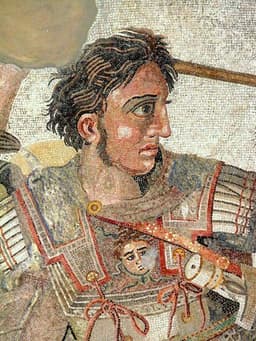
Alexander the Great
General · Ancient
85.2Total

Ashoka the Great
Emperor · Ancient
76.3Total
Basic Information
Born
-356
-304
Died
-323
-232
Era
Ancient
Ancient
Nationality
Macedon
India
Occupation
General
Emperor
Civilization
Western
Indian
Score Comparison
Military (10%)
95.0
72.0
Political (20%)
60.0
82.0
Influence (20%)
92.0
71.0
Legacy (20%)
90.0
90.0
Leadership (15%)
80.0
72.0
Strategy (15%)
92.0
58.0
TOTAL
85.2
76.3
Alexander the Great — Complete Timeline
334 BC
Battle of the Granicus RiverWar◆ Major
Alexander led his Macedonian army across the Hellespont into Asia Minor and defeated a Persian force under local satraps at the Granicus River. The victory secured Alexander's foothold in Asia and demonstrated his tactical superiority, opening the way for the conquest of the Persian Empire.
Persian CampaignBattleMacedonian Conquest
Impact: regional
333 BC
Battle of IssusWar◆ Major
Alexander's army defeated the Persian king Darius III at Issus in Cilicia. Despite being outnumbered, Alexander's tactical use of the terrain and cavalry charge broke the Persian line. Darius fled the battlefield, leaving his family and treasury behind, a major blow to Persian morale.
Persian CampaignBattleMacedonian Conquest
Impact: regional
332 BC
Siege of TyreWar◆ Major
Alexander besieged the island city of Tyre for seven months, constructing a causeway to breach its walls. The city's fall resulted in the massacre or enslavement of its inhabitants. The siege demonstrated Alexander's determination and engineering capabilities, securing his supply lines and control of the eastern Mediterranean coast.
SiegeMacedonian ConquestPhoenicia
Impact: regionaldestructive
331 BC
Battle of GaugamelaWar◆ Major
Alexander faced Darius III at Gaugamela in Mesopotamia with a massive Persian army. Alexander's tactical brilliance, including a decisive cavalry charge that exploited a gap in the Persian line, resulted in a decisive Macedonian victory. Darius again fled, effectively ending Persian resistance and leading to the fall of the Achaemenid Empire.
Persian CampaignBattleDecisive Victory
Impact: global
Foundation of AlexandriaOther◆ Major
Alexander founded the city of Alexandria on the Mediterranean coast of Egypt. He personally selected the site and oversaw the initial planning. Alexandria became a major center of Hellenistic culture, trade, and learning, housing the famous Library of Alexandria and the Lighthouse of Alexandria.
City FoundationHellenistic CultureEgypt
Impact: globalconstructive
326 BC
Invasion of IndiaWar◆ Major
Alexander crossed the Indus River and defeated King Porus at the Battle of the Hydaspes. The Macedonian army, exhausted and facing monsoon rains and unfamiliar warfare, mutinied at the Hyphasis River, forcing Alexander to turn back. This campaign marked the easternmost extent of his conquests.
Indian CampaignBattleMutiny
Impact: regional
Ashoka the Great — Complete Timeline
261 BC
Kalinga WarWar
Ashoka launched a brutal conquest of the Kalinga region (modern Odisha). The war caused massive casualties, with over 100,000 killed and 150,000 deported. The suffering witnessed during this campaign led Ashoka to renounce military conquest and embrace Buddhism.
ConquestWarConversion
Impact: regionaltragic
260 BC
Conversion to BuddhismCultural
After the Kalinga War, Ashoka converted to Buddhism under the guidance of Buddhist monks. He adopted the principle of Dhamma (righteous law) and began promoting non-violence, vegetarianism, and religious tolerance throughout his empire.
ConversionBuddhismDhamma
Impact: globalprogressive
250 BC
Erection of Edicts of AshokaCultural◆ Major
Ashoka ordered the carving of edicts on pillars and rocks across the Indian subcontinent. These inscriptions, written in Prakrit and other languages, proclaimed his policies of non-violence, social welfare, and religious harmony. They are the earliest deciphered written records from ancient India.
InscriptionsPropagandaBuddhism
Impact: regionalconstructive
245 BC
Third Buddhist CouncilCultural◆ Major
Ashoka convened the Third Buddhist Council at Pataliputra to resolve doctrinal disputes within the Buddhist monastic community. The council standardized the Buddhist canon (Tripitaka) and decided to send missionaries abroad, including to Sri Lanka and Southeast Asia.
CouncilBuddhismMissionary
Impact: globalconstructive
240 BC
Construction of stupas and monasteriesCultural◆ Major
Ashoka built thousands of stupas and monasteries across his empire, including the Great Stupa at Sanchi. These structures became centers of Buddhist worship and pilgrimage, spreading Buddhist art and architecture throughout Asia.
ArchitectureBuddhismPatronage
Impact: regionalconstructive
Expert Analysis
Origins
Alexander the Great (356–323 BCE) was born in Pella, Macedon, to King Philip II and Queen Olympias. He was tutored by Aristotle and groomed for conquest from a young age. In contrast, Ashoka (304–232 BCE) was born in Pataliputra, India, to Emperor Bindusara and a lesser queen. He was one of many princes in the Mauryan dynasty, rising through political maneuvering. Alexander's origins in a frontier kingdom gave him a drive to prove Macedon's worth, while Ashoka's imperial background prepared him for governance but not for the moral crisis that defined him.
Rise to Power
Alexander ascended the throne at age 20 after Philip's assassination, immediately consolidating power by crushing revolts in Greece. He then launched a campaign against the Persian Empire, winning major battles at Granicus, Issus, and Gaugamela, eventually toppling Darius III and conquering Egypt and Central Asia. Ashoka's rise was more brutal: he reportedly killed 99 brothers to secure the throne, then expanded the Mauryan Empire through ruthless wars, notably the Kalinga War. Both were ambitious, but Alexander's rise was meteoric and outward, while Ashoka's was internal and ruthless.
Leadership & Governance
Alexander was a hands-on military leader who fought alongside his men, inspiring loyalty through personal bravery. He founded over 20 cities, spread Hellenistic culture, and attempted to fuse Greek and Persian elites. However, his governance was often autocratic and unstable, leading to revolts and mutinies. Ashoka, after his conversion, ruled through a centralized bureaucracy based on Dhamma (righteousness). He erected edicts promoting non-violence, religious tolerance, and social welfare, creating a more stable and just empire. Alexander's governance was innovative but fragile; Ashoka's was transformative and enduring.
Triumph & Tragedy
Alexander's greatest triumph was the conquest of the Persian Empire in just over a decade, creating a vast multicultural empire. His tragedy was his early death at 32, without a clear heir, leading to the rapid fragmentation of his empire. Ashoka's triumph was the Kalinga War, which, despite its brutality, led to his spiritual awakening and the adoption of Buddhism. His tragedy was the immense suffering of that war, which haunted him and reshaped his policies. Alexander's triumph was external; Ashoka's was internal.
Character & Destiny
Alexander was charismatic, ambitious, and ruthless, driven by a desire for glory and immortality. He was also prone to paranoia and excess, killing friends in fits of rage. His destiny was to be remembered as the greatest conqueror of the ancient world. Ashoka started as a ruthless conqueror but transformed into a benevolent ruler, guided by Buddhist principles. His destiny was to be remembered as a model of enlightened governance and peace. Alexander's character was static; Ashoka's was dynamic.
Legacy
Alexander's legacy is immense: he spread Hellenistic culture from the Mediterranean to India, influencing art, architecture, and politics for centuries. His military tactics are still studied. However, his empire did not outlast him. Ashoka's legacy is equally profound: he spread Buddhism across Asia, promoted non-violence and religious tolerance, and established a moral framework for governance. His edicts are a testament to his ideals. While Alexander's impact was immediate and widespread, Ashoka's was deeper and more lasting.
Conclusion
Both rulers were extraordinary, but they represent different paths to greatness. Alexander excelled in military conquest and cultural diffusion, achieving a score of 84.6 in military might and influence. Ashoka, with a score of 75.7, transformed from a conqueror to a reformer, leaving a moral legacy that resonated for millennia. Alexander's achievements were spectacular but ephemeral; Ashoka's were quieter but more enduring. In the battle of conqueror vs. reformer, Ashoka's legacy of peace may ultimately hold more value for humanity. However, if greatness is measured by immediate impact and tactical genius, Alexander prevails. HistoryVersus.com gives the edge to Alexander for his sheer scale of conquest and undefeated record, but Ashoka's moral evolution makes him a close second.
Rankings
🥇
Alexander the GreatLeader
Mil: 95.0Pol: 60.0Inf: 92.0
85.2
🥈
Ashoka the Great
Mil: 72.0Pol: 82.0Inf: 71.0
76.3
+8.9 behind
How This Comparison Works
Algorithm
Each figure is scored on 6 dimensions (0—100 scale) based on structured historical data: Military (10%), Political (20%), Influence (20%), Legacy (20%), Leadership (15%), Strategy (15%). The weighted total produces the final ranking.
Data Sources
Scores are computed from structured sub-indicators in the database. Scale factors adjust for era (Ancient ×0.85, Modern ×1.0) and civilization size (Eastern ×1.05, Other ×0.80) to account for differences in population and military scale.
Maximum 3 Figures
Comparisons are limited to 2—3 figures to ensure readability and statistical meaningfulness.
Error Margins
±5 points per dimension — Sub-scores are derived from historical records with inherent uncertainty. Two figures within 5 points on a dimension should be considered roughly equivalent in that area.
Total Score Accuracy
±3 points overall — The weighted combination of 6 dimensions produces a total score with approximately ±3 points of uncertainty. Differences of less than 3 points are not statistically significant— the figures are effectively tied.
Known Limitations
- Historical records are incomplete and uneven across civilizations
- Figures from oral-tradition societies may be underrepresented
- Occupation labels can misclassify multi-role figures
- Scores measure capability and impact, not moral character
- Quantitative scoring is a comparison tool, not absolute truth
Capability Radar
Military (10%) — Battles & Warfare
Battles
98
85
Win Rate
99
90
Expansion
99
95
Political (20%) — Governance & Reform
Reform
75
95
Diplomacy
80
90
Economy
70
85
Influence (20%) — Cultural & Global Reach
Cultural
95
95
Global
95
90
Legacy (20%) — Historical Impact
Historical
98
95
Longevity
95
95
Leadership (15%) — Power & Stability
Tenure
60
90
Stability
55
90
Strategy (15%) — Tactics & Innovation
Strategy
98
80
Tactics
99
75
Reform
85
70
Similar Comparisons
Comments & Discussion
No comments yet. Be the first to share your thoughts!