Loading...
Alcuin of York vs Wang Zhen
Alcuin of York leads by 12.5 pts · 2 figures compared
…
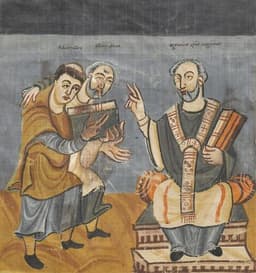
Alcuin of York
Politician · Medieval
53.2Total

Wang Zhen
Politician · Medieval
40.7Total
Basic Information
Born
735
1390
Died
804
1449
Era
Medieval
Medieval
Nationality
Frankish Empire
China
Occupation
Politician
Politician
Civilization
Western
Eastern
Score Comparison
Military (10%)
28.8
21.4
Political (20%)
62.7
26.4
Influence (20%)
65.0
47.1
Legacy (20%)
40.0
40.0
Leadership (15%)
72.0
51.9
Strategy (15%)
38.5
50.4
TOTAL
53.2
40.7
Alcuin of York — Complete Timeline
782 AD
Appointment as Head of the Palace School at AachenCultural◆ Major
Alcuin of York was invited by Charlemagne to lead the Palace School at Aachen. He established a curriculum based on the seven liberal arts, including grammar, rhetoric, and logic. This school became a center of learning and a model for education in the Carolingian Empire.
EducationCarolingian RenaissanceScholarship
Impact: regionalconstructive
789 AD
Compilation of the 'Admonitio Generalis'Cultural
Alcuin contributed to the 'Admonitio Generalis', a set of reforms issued by Charlemagne. The document promoted education, the correction of texts, and the standardization of religious practices. It was a key text of the Carolingian Renaissance, emphasizing the importance of learning.
ReformEducationCarolingian Renaissance
Impact: regionalconstructive
790 AD
Development of the Carolingian Minuscule ScriptCultural◆ Major
Alcuin oversaw the development of the Carolingian minuscule script at the Palace School. This clear, standardized script improved readability and facilitated the copying of manuscripts. It became the standard script in medieval Europe and influenced later handwriting styles.
ScriptManuscriptCarolingian Renaissance
Impact: globalconstructive
800 AD
Correspondence with Charlemagne on Theological MattersCultural
Alcuin engaged in extensive correspondence with Charlemagne on theological and philosophical issues. His letters advised the emperor on matters of doctrine, liturgy, and education. This correspondence helped shape the intellectual climate of the Carolingian court.
CorrespondenceTheologyCarolingian Renaissance
Impact: regionalconstructive
Wang Zhen — Complete Timeline
1442 AD
Rise to Power as Chief EunuchPolitical Action◆ Major
Wang Zhen became the chief eunuch of the Directorate of Ceremonial, gaining the trust of the young Zhengtong Emperor. He used his position to dominate the court, sidelining scholar-officials and accumulating immense personal power.
Eunuch PowerMing CourtCorruption
Impact: nationaldestructive
1445 AD
Suppression of Scholar-OfficialsPolitical Action◆ Major
Wang Zhen orchestrated the purge of several high-ranking officials who opposed his influence, including the Grand Secretary Yang Shiqi's faction. He replaced them with loyalists, weakening the civil service and concentrating power in the eunuch bureaucracy.
PurgePolitical RepressionMing Court
Impact: nationaldestructive
1449 AD
Death at the Battle of TumuWar◆ Major
During the Battle of Tumu Fortress, Wang Zhen was killed by his own officers who blamed him for the impending disaster. His death did not prevent the emperor's capture, and he was posthumously blamed for the crisis.
DeathTumu CrisisScapegoat
Impact: nationaltragic
Advocacy for the Tumu CampaignPolitical Action
Wang Zhen persuaded the Zhengtong Emperor to personally lead a military campaign against the Oirat Mongols, despite opposition from experienced generals. His arrogance and lack of military planning led to the disastrous Tumu Crisis.
Tumu CrisisMilitary DecisionMing Dynasty
Impact: nationaldestructive
1450 AD
Posthumous CondemnationPolitical Action
After the Tumu Crisis, the new Jingtai Emperor posthumously stripped Wang Zhen of all titles and confiscated his property. His family was executed, and he was vilified in official histories as a corrupt eunuch who caused the dynasty's near-collapse.
CondemnationHistorical JudgmentMing Dynasty
Impact: nationaldestructive
Expert Analysis
Origins
Alcuin of York was born around 735 AD into a noble Northumbrian family. He was educated at the cathedral school of York, which had a renowned library. He became a deacon and master of the school, gaining a deep knowledge of classical texts and theology. His background was firmly rooted in the intellectual traditions of the Anglo-Saxon church, which preserved Roman learning.
Wang Zhen was born in the early 15th century in China, likely into a humble family. He became a eunuch to enter the Ming imperial court, a common path for the poor. He received training in the Directorate of Ceremonial, learning court protocols and gaining literacy. His rise was based on personal ambition and manipulation rather than scholarly achievement.
Rise to Power
Alcuin's rise came through his reputation as a scholar. In 781, while returning from Rome, he met Charlemagne in Parma and was invited to lead the Palace School at Aachen. He accepted in 782 and quickly became Charlemagne's chief advisor on educational and religious matters. He used his position to reform the curriculum, emphasizing the seven liberal arts (trivium and quadrivium). His influence grew through extensive correspondence with the emperor and other scholars across Europe.
Wang Zhen's rise began when he was assigned to serve the young Zhu Qizhen, the future Zhengtong Emperor. He gained the emperor's trust through flattery and shared interests. In 1435, when the emperor ascended the throne at age eight, Wang became chief eunuch. He controlled access to the emperor and purged rival officials, such as Grand Secretary Yang Shiqi. By 1449, he dominated the court, ignoring the advice of military leaders.
Leadership & Governance
Alcuin's leadership was intellectual and reformist. He did not hold formal political office but shaped policy through Charlemagne's ear. He advocated for standardized education, the copying of manuscripts, and the correction of liturgical texts. His governance was indirect, relying on persuasion and the emperor's authority. He scored 72.0 in leadership, reflecting his ability to influence without formal power.
Wang Zhen's leadership was autocratic and corrupt. He used his position to enrich himself and his family, selling offices and accepting bribes. He suppressed scholar-officials who opposed him, weakening the civil service. His governance led to factionalism and military neglect. He scored 51.9 in leadership, but his political score was only 26.4, indicating his incompetence in managing the state.
Triumph & Tragedy
Alcuin's greatest triumph was the Carolingian Renaissance, a revival of learning that preserved classical texts. He oversaw the development of Carolingian minuscule script, which improved readability and became the basis for modern lowercase letters. He also compiled the 'Admonitio Generalis' (789), which mandated education for clergy. His tragedy was that his reforms were limited to the elite; after Charlemagne's death, the empire fragmented, and much progress was lost.
Wang Zhen's triumph was his rise from poverty to power, but his tragedy was the Tumu Crisis. In 1449, he persuaded the emperor to lead a campaign against the Oirat Mongols. The poorly planned expedition ended in disaster at Tumu Fortress, where the emperor was captured and Wang was killed by his own officers. The Ming dynasty was severely weakened, and Wang was posthumously condemned, his family executed.
Character & Destiny
Alcuin was pious, scholarly, and diplomatic. He sought to harmonize classical learning with Christian doctrine. His character led him to be a bridge between cultures, but his lack of political ambition meant his influence waned after Charlemagne. He scored 65.0 in influence, reflecting his intellectual reach.
Wang Zhen was ambitious, cunning, and arrogant. He overestimated his military abilities and ignored warnings. His character led directly to his downfall and the humiliation of the Ming court. He scored 47.1 in influence, but his legacy is purely negative.
Legacy
Alcuin's legacy is the preservation of classical texts and the educational framework of medieval Europe. Carolingian minuscule became the standard script, and his curriculum influenced universities. He is remembered as a key figure in the transmission of knowledge. His total score of 53.2 reflects his moderate but lasting impact.
Wang Zhen's legacy is a cautionary tale of eunuch power. The Tumu Crisis led to a shift in Ming military policy and increased distrust of eunuchs. His name is synonymous with arrogance and incompetence. His total score of 40.7 is lower, reflecting his destructive impact.
Conclusion
Alcuin of York had greater impact than Wang Zhen. Alcuin's intellectual contributions shaped Western education and literacy, with scores of 65.0 in influence and 40.0 in legacy. Wang Zhen's influence was high (47.1) but negative, and his legacy is also 40.0 but as a warning. Alcuin's total score of 53.2 exceeds Wang's 40.7 by 12.5 points. While Wang's actions had immediate consequences, Alcuin's work endured for centuries. Therefore, Alcuin is the more significant historical figure.
Rankings
🥇
Alcuin of YorkLeader
Mil: 28.8Pol: 62.7Inf: 65.0
53.2
🥈
Wang Zhen
Mil: 21.4Pol: 26.4Inf: 47.1
40.7
+12.5 behind
How This Comparison Works
Algorithm
Each figure is scored on 6 dimensions (0—100 scale) based on structured historical data: Military (10%), Political (20%), Influence (20%), Legacy (20%), Leadership (15%), Strategy (15%). The weighted total produces the final ranking.
Data Sources
Scores are computed from structured sub-indicators in the database. Scale factors adjust for era (Ancient ×0.85, Modern ×1.0) and civilization size (Eastern ×1.05, Other ×0.80) to account for differences in population and military scale.
Maximum 3 Figures
Comparisons are limited to 2—3 figures to ensure readability and statistical meaningfulness.
Error Margins
±5 points per dimension — Sub-scores are derived from historical records with inherent uncertainty. Two figures within 5 points on a dimension should be considered roughly equivalent in that area.
Total Score Accuracy
±3 points overall — The weighted combination of 6 dimensions produces a total score with approximately ±3 points of uncertainty. Differences of less than 3 points are not statistically significant— the figures are effectively tied.
Known Limitations
- Historical records are incomplete and uneven across civilizations
- Figures from oral-tradition societies may be underrepresented
- Occupation labels can misclassify multi-role figures
- Scores measure capability and impact, not moral character
- Quantitative scoring is a comparison tool, not absolute truth
Capability Radar
Military (10%) — Battles & Warfare
Battles
36
10
Win Rate
42
5
Expansion
43
5
Political (20%) — Governance & Reform
Reform
85
10
Diplomacy
75
10
Economy
60
10
Influence (20%) — Cultural & Global Reach
Cultural
85
10
Global
65
10
Legacy (20%) — Historical Impact
Historical
80
30
Longevity
75
20
Leadership (15%) — Power & Stability
Tenure
40
40
Stability
70
5
Strategy (15%) — Tactics & Innovation
Strategy
47
5
Tactics
51
5
Reform
53
5
Similar Comparisons
Comments & Discussion
No comments yet. Be the first to share your thoughts!