Loading...
This comparison has not been analyzed yet.
One-time AI generation (~1 minute). Scores and timeline are already available below.
Alcuin of York vs Li Jifu
Li Jifu leads by 0.2 pts · 2 figures compared
…
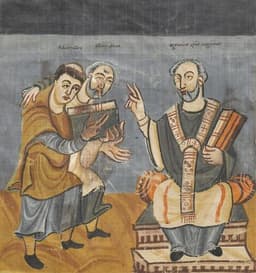
Alcuin of York
Politician · Medieval
53.2Total

Li Jifu
Politician · Medieval
53.4Total
Basic Information
Born
735
758
Died
804
814
Era
Medieval
Medieval
Nationality
Frankish Empire
China
Occupation
Politician
Politician
Civilization
Western
Eastern
Score Comparison
Military (10%)
28.8
25.4
Political (20%)
62.7
72.0
Influence (20%)
65.0
55.7
Legacy (20%)
40.0
46.7
Leadership (15%)
72.0
72.0
Strategy (15%)
38.5
36.9
TOTAL
53.2
53.4
Alcuin of York — Complete Timeline
782 AD
Appointment as Head of the Palace School at AachenCultural◆ Major
Alcuin of York was invited by Charlemagne to lead the Palace School at Aachen. He established a curriculum based on the seven liberal arts, including grammar, rhetoric, and logic. This school became a center of learning and a model for education in the Carolingian Empire.
EducationCarolingian RenaissanceScholarship
Impact: regionalconstructive
789 AD
Compilation of the 'Admonitio Generalis'Cultural
Alcuin contributed to the 'Admonitio Generalis', a set of reforms issued by Charlemagne. The document promoted education, the correction of texts, and the standardization of religious practices. It was a key text of the Carolingian Renaissance, emphasizing the importance of learning.
ReformEducationCarolingian Renaissance
Impact: regionalconstructive
790 AD
Development of the Carolingian Minuscule ScriptCultural◆ Major
Alcuin oversaw the development of the Carolingian minuscule script at the Palace School. This clear, standardized script improved readability and facilitated the copying of manuscripts. It became the standard script in medieval Europe and influenced later handwriting styles.
ScriptManuscriptCarolingian Renaissance
Impact: globalconstructive
800 AD
Correspondence with Charlemagne on Theological MattersCultural
Alcuin engaged in extensive correspondence with Charlemagne on theological and philosophical issues. His letters advised the emperor on matters of doctrine, liturgy, and education. This correspondence helped shape the intellectual climate of the Carolingian court.
CorrespondenceTheologyCarolingian Renaissance
Impact: regionalconstructive
Li Jifu — Complete Timeline
808 AD
Appointed ChancellorPolitical Action◆ Major
Li Jifu was appointed as chancellor (zaixiang) under Emperor Xianzong. As chancellor, he played a key role in centralizing Tang authority and implementing policies to reduce the power of provincial military governors.
Tang DynastyChancellorshipCentralization
Impact: nationalconstructive
810 AD
Implemented Fiscal ReformsReform◆ Major
Li Jifu implemented fiscal reforms aimed at strengthening the central treasury. These reforms included measures to improve tax collection and reduce the financial power of regional governors, supporting Emperor Xianzong's centralization efforts.
Fiscal ReformTang DynastyCentralization
Impact: nationalconstructive
813 AD
Compiled Yuanhe Maps and RecordsCultural◆ Major
Li Jifu compiled the 'Yuanhe Maps and Records of Prefectures and Counties', a comprehensive geographical and administrative survey of the Tang Empire. This work documented the empire's administrative divisions, population, and resources during the Yuanhe era.
GeographyAdministrationTang DynastyYuanhe Era
Impact: nationalconstructive
This comparison has not been analyzed yet.
One-time AI generation (~1 minute). Scores and timeline are already available below.
Rankings
🥇
Li JifuLeader
Mil: 25.4Pol: 72.0Inf: 55.7
53.4
🥈
Alcuin of York
Mil: 28.8Pol: 62.7Inf: 65.0
53.2
+0.2 behind
How This Comparison Works
Algorithm
Each figure is scored on 6 dimensions (0—100 scale) based on structured historical data: Military (10%), Political (20%), Influence (20%), Legacy (20%), Leadership (15%), Strategy (15%). The weighted total produces the final ranking.
Data Sources
Scores are computed from structured sub-indicators in the database. Scale factors adjust for era (Ancient ×0.85, Modern ×1.0) and civilization size (Eastern ×1.05, Other ×0.80) to account for differences in population and military scale.
Maximum 3 Figures
Comparisons are limited to 2—3 figures to ensure readability and statistical meaningfulness.
Error Margins
±5 points per dimension — Sub-scores are derived from historical records with inherent uncertainty. Two figures within 5 points on a dimension should be considered roughly equivalent in that area.
Total Score Accuracy
±3 points overall — The weighted combination of 6 dimensions produces a total score with approximately ±3 points of uncertainty. Differences of less than 3 points are not statistically significant— the figures are effectively tied.
Known Limitations
- Historical records are incomplete and uneven across civilizations
- Figures from oral-tradition societies may be underrepresented
- Occupation labels can misclassify multi-role figures
- Scores measure capability and impact, not moral character
- Quantitative scoring is a comparison tool, not absolute truth
Capability Radar
Military (10%) — Battles & Warfare
Battles
36
36
Win Rate
42
40
Expansion
43
44
Political (20%) — Governance & Reform
Reform
85
60
Diplomacy
75
55
Economy
60
60
Influence (20%) — Cultural & Global Reach
Cultural
85
45
Global
65
30
Legacy (20%) — Historical Impact
Historical
80
50
Longevity
75
40
Leadership (15%) — Power & Stability
Tenure
40
65
Stability
70
55
Strategy (15%) — Tactics & Innovation
Strategy
47
46
Tactics
51
51
Reform
53
55
Similar Comparisons
Comments & Discussion
No comments yet. Be the first to share your thoughts!