Loading...
Alcibiades vs Napoleon Bonaparte
Napoleon Bonaparte leads by 15.0 pts · 2 figures compared
…
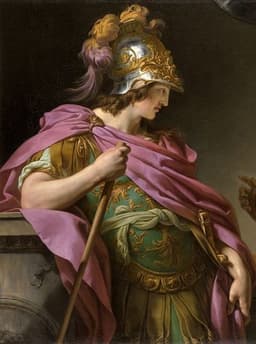
Alcibiades
General · Ancient
55.9Total

Napoleon Bonaparte
General · Modern
70.9Total
Basic Information
Born
-450
1769
Died
-404
1821
Era
Ancient
Modern
Nationality
Greece
France
Occupation
General
General
Civilization
Western
Western
Score Comparison
Military (10%)
60.0
94.0
Political (20%)
45.1
72.0
Influence (20%)
61.0
40.0
Legacy (20%)
58.0
80.0
Leadership (15%)
43.8
78.0
Strategy (15%)
68.1
90.0
TOTAL
55.9
70.9
Alcibiades — Complete Timeline
415 BC
Sicilian ExpeditionWar
Alcibiades persuaded Athens to launch a massive expedition against Syracuse in Sicily. He was appointed as one of the commanders but was recalled to face charges of sacrilege. He defected to Sparta instead, providing them with strategic advice that contributed to Athens' defeat.
Peloponnesian WarSicilyDefection
Impact: regionaldestructive
Defection to SpartaPolitical Action◆ Major
After being recalled from the Sicilian Expedition, Alcibiades fled to Sparta. He advised the Spartans to fortify Decelea in Attica and to send aid to Syracuse, actions that severely weakened Athens. His defection was a major blow to Athenian strategy.
Peloponnesian WarSpartaTreason
Impact: regionaldestructive
411 BC
Return to Athens and Naval VictoriesWar◆ Major
Alcibiades returned to Athens after being recalled by the democratic faction. He led the Athenian navy to several victories over the Spartans, including at Cyzicus and Abydos, restoring Athenian morale and temporarily reversing the tide of the war.
Peloponnesian WarNaval BattleAthens
Impact: regionalconstructive
404 BC
Second Exile and AssassinationPolitical Action◆ Major
After a naval defeat at Notium, Alcibiades was again exiled from Athens. He fled to Phrygia in Persia, where he was assassinated by Persian agents, likely at the instigation of the Spartan general Lysander. His death ended his turbulent political career.
ExileAssassinationPersia
Impact: regionaltragic
Napoleon Bonaparte — Complete Timeline
1799 AD
Coup of 18 BrumaireOther◆ Major
Napoleon Bonaparte, with support from his brother Lucien and key political figures, overthrew the Directory in a bloodless coup. He established the Consulate with himself as First Consul, effectively becoming the ruler of France. This event ended the French Revolution's most unstable period.
French RevolutionCoupRise to Power
Impact: regional
1804 AD
Promulgation of the Napoleonic CodeOther◆ Major
Napoleon enacted the Civil Code of the French, known as the Napoleonic Code, a comprehensive set of laws that replaced the fragmented feudal legal systems. The code established legal equality, protected property rights, and secularized law. It became the basis for legal systems in many European and world countries.
Legal ReformNapoleonic CodeCivil Law
Impact: globalconstructive
1805 AD
Battle of AusterlitzWar◆ Major
Napoleon's Grande Arm
Napoleonic WarsBattleDecisive Victory
Impact: global
1812 AD
Invasion of RussiaWar◆ Major
Napoleon led the Grande Arm
Napoleonic WarsInvasionDisaster
Impact: globaldestructive
1815 AD
Battle of WaterlooWar◆ Major
Napoleon's French army was defeated by the combined forces of the Duke of Wellington's Anglo-Allied army and Gebhard Leberecht von Bl
Napoleonic WarsBattleFinal Defeat
Impact: globaldestructive
Expert Analysis
alcibiades-vs-napoleon-bonaparte
# The Two Faces of Ambition: Napoleon and Alcibiades
On a June evening in 1815, Napoleon Bonaparte stood on a ridge near Waterloo, watching his Imperial Guard march into the maw of British cannon. Two thousand miles away and two thousand years earlier, another brilliant commander, Alcibiades of Athens, was fleeing through the night toward Persian territory, his life measured in hours. Both men shaped their worlds with extraordinary talent. Both fell from dizzying heights. But where Napoleon built an empire that reshaped Europe for a century, Alcibiades left behind a legacy of brilliant fragments—a mosaic of what might have been.
Origins
Napoleon was born in 1769 on Corsica, an island that had become French only the year before. His family were minor nobility, speaking Italian and nursing resentments against their new overlords. This outsider status forged something crucial in the young Bonaparte: he would have to prove himself ten times over to be accepted. When he entered the military academy at Brienne, his classmates mocked his accent and his poverty. He responded by devouring books on military history and artillery mathematics.
Alcibiades, born in 450 BC, was the opposite: an insider’s insider. His father had died in battle, but his guardian was Pericles, the greatest statesman of Athens. He was rich, beautiful, and connected to the city’s most powerful families. Where Napoleon had to climb, Alcibiades was born at the summit. This difference would define everything. Napoleon learned patience, calculation, and the art of building loyalty from nothing. Alcibiades learned that the world existed to serve his desires.
Rise to Power
Napoleon’s ascent was a masterpiece of timing and talent. In 1793, at just twenty-four, he drove the British out of Toulon with an artillery barrage that stunned his superiors. By 1796, he was commanding the Army of Italy, and within a year he had crushed the Austrians, created the Cisalpine Republic, and sent wagonloads of looted art back to Paris. Each victory was a step up a ladder he could see clearly.
Alcibiades rose differently—through charm, rhetoric, and sheer audacity. In 415 BC, at the height of the Peloponnesian War, he persuaded the Athenian assembly to launch the Sicilian Expedition, the most ambitious military campaign in Greek history. He was thirty-five, magnetic, and utterly convinced of his own genius. The assembly voted for war, and Alcibiades was appointed one of three commanders. But before the fleet could sail, his enemies accused him of mutilating the sacred herm statues of Athens. Rather than face trial, he defected to Sparta—the enemy he had been sent to fight.
Leadership & Governance
Napoleon governed as he commanded: with systematic brilliance. His Napoleonic Code swept away feudal privileges and established legal equality, property rights, and secular administration. He centralized the French state, created the Bank of France, and built roads and canals that connected his empire. On the battlefield, he was ruthless and innovative—using massed artillery, rapid marches, and the corps system to crush opponents at Austerlitz in 1805 and Jena in 1806. His soldiers adored him because he shared their hardships and remembered their names.
Alcibiades led differently. In Sparta, he advised the Spartans to fortify Decelea, a permanent fort in Athenian territory that crippled Athens’ silver mines and food supply. Then, when the Spartans grew suspicious, he fled to Persia and advised the Persian satrap Tissaphernes. In 411 BC, Athens recalled him, and he delivered a string of naval victories at Abydos, Cyzicus, and Byzantium. He was brilliant—but he governed through personal magnetism, not institutions. When he was present, his men fought with ferocious loyalty. When he was absent, they fell apart.
Triumph & Tragedy
Napoleon’s greatest moment came on December 2, 1805, when the sun rose over the frozen battlefield of Austerlitz and he destroyed the combined armies of Russia and Austria. It was a perfect battle, the culmination of years of study and instinct. His tragedy was the invasion of Russia in 1812—a campaign that began with 600,000 men and ended with fewer than 30,000. He could not stop, could not consolidate, could not admit that his system had limits.
Alcibiades’ triumph was the naval victory at Cyzicus in 410 BC, where he trapped the Spartan fleet and restored Athenian dominance in the Aegean. His tragedy was the defeat at Notium in 406 BC, when he left his subordinate in command and the subordinate lost. The Athenians, never forgiving, exiled him again. He fled to Phrygia, where Persian assassins surrounded his house and set it on fire. He died, according to Plutarch, charging out with a sword in each hand—fighting to the last.
Character & Destiny
Napoleon’s character was a paradox: a romantic who thought in systems, a man of immense discipline who could not control his own ambition. “Power is my mistress,” he once said. He believed that history was made by will, and he willed himself to the top of the world. But his greatness was also his flaw—he could not share power, could not delegate, could not imagine an end to his conquests.
Alcibiades had no such discipline. He was brilliant and shallow, capable of extraordinary insight and catastrophic selfishness. “He was a man of many changes,” wrote Thucydides, “and in the course of the war, he did more than anyone to ruin Athens.” He could have been Pericles. Instead, he became a ghost—a figure who haunted his city’s imagination, always promising greatness, always delivering betrayal.
Legacy
Napoleon’s legacy is carved into the stone of Europe. The Napoleonic Code governs legal systems from France to Louisiana. His military innovations are studied at every war college. His name is synonymous with ambition, genius, and the terrible cost of both. He scored a total of 82.4 across all metrics—a military genius at 94, a political operator at 75, a leader at 80.
Alcibiades scored 63.1 total, with military at 63.9 and leadership at a devastating 38.4. He is remembered not as a builder but as a tempter—a warning about what happens when talent outruns character. His name survives in philosophy seminars and history courses, a cautionary tale about the limits of charm.
Conclusion
Standing at Waterloo, Napoleon must have felt something like Alcibiades felt in that Phrygian house: the terrible clarity of a life that could have been different. Both men were given extraordinary gifts. Both threw them away—Napoleon through overreach, Alcibiades through betrayal. In the end, the difference between them is simple: Napoleon built something that outlasted him. Alcibiades built only his own legend. One changed the world. The other changed how we think about the world—and about ourselves.
Rankings
🥇
Napoleon BonaparteLeader
Mil: 94.0Pol: 72.0Inf: 40.0
70.9
🥈
Alcibiades
Mil: 60.0Pol: 45.1Inf: 61.0
55.9
+15.0 behind
How This Comparison Works
Algorithm
Each figure is scored on 6 dimensions (0—100 scale) based on structured historical data: Military (10%), Political (20%), Influence (20%), Legacy (20%), Leadership (15%), Strategy (15%). The weighted total produces the final ranking.
Data Sources
Scores are computed from structured sub-indicators in the database. Scale factors adjust for era (Ancient ×0.85, Modern ×1.0) and civilization size (Eastern ×1.05, Other ×0.80) to account for differences in population and military scale.
Maximum 3 Figures
Comparisons are limited to 2—3 figures to ensure readability and statistical meaningfulness.
Error Margins
±5 points per dimension — Sub-scores are derived from historical records with inherent uncertainty. Two figures within 5 points on a dimension should be considered roughly equivalent in that area.
Total Score Accuracy
±3 points overall — The weighted combination of 6 dimensions produces a total score with approximately ±3 points of uncertainty. Differences of less than 3 points are not statistically significant— the figures are effectively tied.
Known Limitations
- Historical records are incomplete and uneven across civilizations
- Figures from oral-tradition societies may be underrepresented
- Occupation labels can misclassify multi-role figures
- Scores measure capability and impact, not moral character
- Quantitative scoring is a comparison tool, not absolute truth
Capability Radar
Military (10%) — Battles & Warfare
Battles
65
95
Win Rate
55
90
Expansion
40
95
Political (20%) — Governance & Reform
Reform
45
95
Diplomacy
85
80
Economy
40
85
Influence (20%) — Cultural & Global Reach
Cultural
60
85
Global
55
90
Legacy (20%) — Historical Impact
Historical
70
95
Longevity
65
90
Leadership (15%) — Power & Stability
Tenure
60
85
Stability
20
70
Strategy (15%) — Tactics & Innovation
Strategy
70
95
Tactics
80
98
Reform
30
92
Similar Comparisons
Comments & Discussion
No comments yet. Be the first to share your thoughts!