Loading...
Albrecht von Roon vs He Yingqin
Albrecht von Roon leads by 5.5 pts · 2 figures compared
…
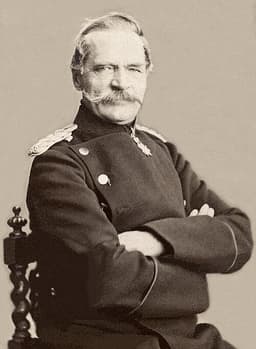
Albrecht von Roon
General · Modern
60.3Total

He Yingqin
General · Modern
54.8Total
Basic Information
Born
1803
1890
Died
1879
1987
Era
Modern
Modern
Nationality
Prussia
China
Occupation
General
General
Civilization
Western
Eastern
Score Comparison
Military (10%)
10.0
25.0
Political (20%)
78.0
48.0
Influence (20%)
62.0
59.0
Legacy (20%)
55.0
49.2
Leadership (15%)
78.0
80.0
Strategy (15%)
66.3
60.0
TOTAL
60.3
54.8
Albrecht von Roon — Complete Timeline
1859 AD
Prussian Army ReorganizationReform
Roon, as Prussian War Minister, implemented a major reorganization of the Prussian Army. He increased the size of the standing army, extended conscription, and reformed the officer corps. These reforms created the military force that would later win the wars of German unification.
PrussiaMilitary ReformGerman Unification
Impact: nationalconstructive
1862 AD
Constitutional CrisisPolitical Action◆ Major
Roon's army reforms led to a constitutional crisis in Prussia when the Landtag refused to approve the budget. Roon advised King Wilhelm I to appoint Otto von Bismarck as Minister President. Bismarck then governed without a legal budget, implementing the reforms anyway.
PrussiaPoliticsBismarck
Impact: national
1866 AD
Austro-Prussian WarWar◆ Major
Roon's reformed Prussian Army fought the Austro-Prussian War. The army's superior organization, training, and equipment led to a decisive Prussian victory at the Battle of K
German UnificationWarPrussia
Impact: regionalconstructive
He Yingqin — Complete Timeline
1930 AD
Chief of the General Staff of the Nationalist GovernmentPolitical Action◆ Major
He Yingqin was appointed Chief of the General Staff, making him the highest-ranking military officer in the Nationalist government. He played a key role in planning campaigns against the Chinese Communist Party and Japanese forces.
Military CommandNationalist Government
Impact: national
1933 AD
Negotiated the Tanggu TrucePolitical Action◆ Major
He Yingqin, as the Nationalist government's representative, signed the Tanggu Truce with Japan. The agreement ended hostilities in Rehe Province and created a demilitarized zone, effectively ceding control of northeastern China to Japan.
DiplomacyTerritorial ConcessionSino-Japanese Conflict
Impact: regionaldestructive
1944 AD
Commander-in-Chief of the National Revolutionary ArmyPolitical Action◆ Major
He Yingqin was appointed Commander-in-Chief of the National Revolutionary Army by Chiang Kai-shek. He oversaw Chinese military operations during the final years of the war against Japan, coordinating with Allied forces.
Military CommandWorld War II
Impact: national
1945 AD
Accepted Japanese Surrender in NanjingPolitical Action◆ Major
On September 9, 1945, He Yingqin, as the representative of the Chinese government, formally accepted the surrender of Japanese forces in China from General Yasuji Okamura in Nanjing. This ceremony marked the end of the Second Sino-Japanese War.
World War IISurrenderDiplomacy
Impact: nationalconstructive
Expert Analysis
Origins
Albrecht von Roon was born on April 30, 1803, in Pleushagen, Prussia, into a military family. His father was a Prussian officer, and Roon entered the Prussian cadet corps at age 13. He attended the Prussian Staff College, where he studied military science under Carl von Clausewitz. His early career included service on the General Staff and as a military instructor.
He Yingqin was born on April 2, 1890, in Xingyi, Guizhou, China, into a scholarly family. He studied at the Guizhou Military Academy and later at the Imperial Japanese Army Academy, graduating in 1910. His early career saw him join the Kuomintang (KMT) and participate in the Xinhai Revolution that overthrew the Qing dynasty.
Rise to Power
Roon's rise came through administrative and organizational roles. He served as a military attaché, then as a professor at the Prussian Staff College. In 1859, he was appointed Prussian War Minister, a position he held until 1873. His key turning point came during the constitutional crisis of 1862-1866, when he advocated for army reforms despite parliamentary opposition. He advised King Wilhelm I to appoint Otto von Bismarck as Minister President, forming a powerful alliance.
He Yingqin rose through the KMT military hierarchy. He became a close ally of Chiang Kai-shek, serving as Chief of the General Staff of the Nationalist Government from 1928 to 1931. In 1937, he was appointed Commander-in-Chief of the National Revolutionary Army, overseeing Chinese forces during the Second Sino-Japanese War. His acceptance of the Japanese surrender in Nanjing on September 9, 1945, marked his peak prominence.
Leadership & Governance
Roon's leadership was methodical and reform-oriented. He restructured the Prussian Army by increasing the standing army size, extending conscription to three years, and modernizing equipment and training. His reforms faced political opposition, but he maintained focus on military efficiency. He scored 78.0 in political acumen, reflecting his ability to navigate the constitutional crisis and secure funding for his reforms.
He Yingqin's leadership was characterized by loyalty to Chiang Kai-shek and bureaucratic management. He scored 80.0 in leadership, but his strategic decisions were often criticized. He negotiated the Tanggu Truce in 1933, which ceded territory to Japan, a move seen as appeasement. During the war, he focused on preserving the KMT army rather than aggressive offensives.
Triumph & Tragedy
Roon's greatest triumph was the Prussian Army Reorganization, which led to decisive victories in the Austro-Prussian War (1866) and the Franco-Prussian War (1870-1871). His reforms created a model for modern armies. However, he faced tragedy in the form of the constitutional crisis, where his reforms nearly caused a political breakdown. He also suffered from poor health in his later years.
He Yingqin's triumph was accepting the Japanese surrender, symbolizing China's victory. He also maintained the KMT military structure during the war. His tragedy was the Tanggu Truce, which damaged his reputation, and his inability to prevent the Communist victory in the Chinese Civil War. He scored 49.2 in legacy, reflecting mixed historical assessments.
Character & Destiny
Roon was meticulous, persistent, and politically savvy. He understood the need for military modernization and allied with Bismarck to achieve it. His character shaped Prussia's rise as a military power. He scored 66.3 in strategy, reflecting his organizational rather than tactical brilliance.
He Yingqin was cautious, loyal, and bureaucratic. His adherence to Chiang's policies limited his strategic independence. He scored 60.0 in strategy, but his lack of aggressive action during the war contributed to the KMT's eventual defeat.
Legacy
Roon's legacy is the modern Prussian Army, which became the foundation of the German Empire. His reforms influenced military organizations worldwide. He scored 55.0 in legacy, but his impact on military structure was profound.
He Yingqin's legacy is mixed. He is remembered for accepting the Japanese surrender but criticized for his role in the Tanggu Truce and the KMT's military failures. His legacy score of 49.2 reflects this ambivalence.
Conclusion
Albrecht von Roon had a greater overall impact due to his foundational role in creating the army that unified Germany. His political score of 78.0 and total score of 60.3 exceed He Yingqin's 48.0 political and 54.8 total. While He Yingqin led during a critical period, his decisions were less transformative. Roon's reforms shaped the course of European history, whereas He Yingqin's actions were largely reactive within a losing cause.
Rankings
🥇
Albrecht von RoonLeader
Mil: 10.0Pol: 78.0Inf: 62.0
60.3
🥈
He Yingqin
Mil: 25.0Pol: 48.0Inf: 59.0
54.8
+5.5 behind
How This Comparison Works
Algorithm
Each figure is scored on 6 dimensions (0—100 scale) based on structured historical data: Military (10%), Political (20%), Influence (20%), Legacy (20%), Leadership (15%), Strategy (15%). The weighted total produces the final ranking.
Data Sources
Scores are computed from structured sub-indicators in the database. Scale factors adjust for era (Ancient ×0.85, Modern ×1.0) and civilization size (Eastern ×1.05, Other ×0.80) to account for differences in population and military scale.
Maximum 3 Figures
Comparisons are limited to 2—3 figures to ensure readability and statistical meaningfulness.
Error Margins
±5 points per dimension — Sub-scores are derived from historical records with inherent uncertainty. Two figures within 5 points on a dimension should be considered roughly equivalent in that area.
Total Score Accuracy
±3 points overall — The weighted combination of 6 dimensions produces a total score with approximately ±3 points of uncertainty. Differences of less than 3 points are not statistically significant— the figures are effectively tied.
Known Limitations
- Historical records are incomplete and uneven across civilizations
- Figures from oral-tradition societies may be underrepresented
- Occupation labels can misclassify multi-role figures
- Scores measure capability and impact, not moral character
- Quantitative scoring is a comparison tool, not absolute truth
Capability Radar
Military (10%) — Battles & Warfare
Battles
20
45
Win Rate
20
40
Expansion
70
20
Political (20%) — Governance & Reform
Reform
85
25
Diplomacy
70
50
Economy
60
30
Influence (20%) — Cultural & Global Reach
Cultural
40
30
Global
60
35
Legacy (20%) — Historical Impact
Historical
70
45
Longevity
60
40
Leadership (15%) — Power & Stability
Tenure
70
60
Stability
75
35
Strategy (15%) — Tactics & Innovation
Strategy
60
55
Tactics
30
50
Reform
85
30
Similar Comparisons
Comments & Discussion
No comments yet. Be the first to share your thoughts!