Loading...
Albert I vs Rupert of the Palatinate
Albert I leads by 4.6 pts · 2 figures compared
…

Albert I
Emperor · Medieval
44.4Total
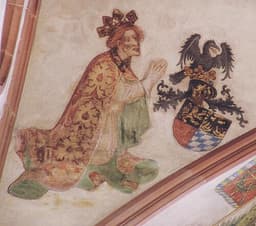
Rupert of the Palatinate
Emperor · Medieval
39.8Total
Basic Information
Born
1255
1352
Died
1308
1410
Era
Medieval
Medieval
Nationality
Holy Roman Empire
Holy Roman Empire
Occupation
Emperor
Emperor
Civilization
Western
Western
Score Comparison
Military (10%)
47.5
50.0
Political (20%)
36.5
26.4
Influence (20%)
49.4
47.9
Legacy (20%)
40.8
38.3
Leadership (15%)
48.4
38.1
Strategy (15%)
43.7
35.7
TOTAL
44.4
39.8
Albert I — Complete Timeline
1298 AD
Defeated Adolf of Nassau at the Battle of GöllheimWar◆ Major
Albert I of Habsburg defeated and killed Adolf of Nassau at the Battle of G
BattleHabsburgVictory
Impact: regional
Elected King of GermanyPolitical Action◆ Major
Albert I of Habsburg was elected King of Germany after deposing Adolf of Nassau. His election was supported by the prince-electors and marked the return of Habsburg rule to the German throne.
ElectionHabsburgGerman Kingdom
Impact: regional
Crowned Holy Roman EmperorPolitical Action◆ Major
Albert I of Habsburg was crowned Holy Roman Emperor in Aachen. His coronation reaffirmed Habsburg authority in the empire, though his reign was marked by conflicts with the Papacy and the prince-electors.
CoronationHoly Roman EmpireHabsburg
Impact: regional
1308 AD
Assassinated by His Nephew John ParricidaOther◆ Major
Albert I of Habsburg was assassinated by his nephew John Parricida near Windisch, Switzerland. His death ended his reign and led to a period of instability, with the throne passing to Henry VII of Luxembourg.
AssassinationHabsburgDeath
Impact: regionaltragic
Rupert of the Palatinate — Complete Timeline
1400 AD
Election as King of the RomansPolitical Action◆ Major
The four Rhenish electors deposed Wenceslaus IV and elected Rupert of the Palatinate as King of the Romans. Rupert's election was contested by Wenceslaus and his supporters, leading to a divided empire. Rupert was never crowned Holy Roman Emperor by the Pope.
ElectionImperial PoliticsSchism
Impact: regional
1401 AD
Italian CampaignWar◆ Major
Rupert led an expedition to Italy to secure his coronation as Holy Roman Emperor and to support Pope Boniface IX against his rivals. The campaign was a failure; Rupert's army was defeated by the forces of Gian Galeazzo Visconti of Milan near Brescia. Rupert retreated to Germany without achieving his goals.
Italian CampaignMilitary DefeatCoronation
Impact: regionaltragic
1405 AD
Conflict with the Archbishop of MainzPolitical Action
Rupert became embroiled in a conflict with Archbishop Johann II of Mainz over the election of a new bishop in the diocese of Paderborn. The dispute escalated into a military confrontation, with Rupert besieging the archbishop's castle. The conflict was eventually resolved through mediation, but it weakened Rupert's authority.
Ecclesiastical ConflictSiegeImperial Authority
destructive
Expert Analysis
Origins
Albert I of Habsburg (born 1255) was the eldest son of King Rudolf I of Germany, founder of the Habsburg dynasty. Growing up in the shadow of his father's rise, Albert inherited the Habsburg lands in Swabia and was trained in governance from a young age. His family background was one of ambitious territorial expansion, and he was deeply involved in his father's campaigns. In contrast, Rupert of the Palatinate (born 1352) came from the Wittelsbach dynasty, which ruled the Electoral Palatinate. He was the son of Elector Palatine Rupert II and was educated in courtly and administrative matters. His early years were spent consolidating Wittelsbach power in the Rhineland, but he lacked the direct royal lineage of Albert.
Rise to Power
Albert's rise came after the deposition of King Adolf of Nassau in 1298. With support from several prince-electors, Albert was elected King of Germany on July 27, 1298, and immediately defeated Adolf at the Battle of Göllheim on July 2, 1298, killing him in combat. This decisive victory secured his throne, and he was crowned Holy Roman Emperor in Aachen on August 24, 1298. Rupert's path was more contested. In 1400, four Rhenish electors deposed King Wenceslaus IV of Luxembourg, citing incompetence, and elected Rupert as King of the Romans on August 21, 1400. However, his election was not universally recognized, and Wenceslaus retained support in Bohemia and elsewhere. Rupert's political score of 26.4 reflects this weak mandate, while Albert's 36.5 indicates a stronger, though still challenged, position.
Leadership & Governance
Albert I governed with a focus on consolidating Habsburg power. He pursued territorial acquisitions in Switzerland and Thuringia, often through forceful means, and sought to strengthen royal authority against the princes. His leadership style was autocratic and militaristic, but he also engaged in diplomacy to secure alliances. For instance, he arranged marriages for his children to bind other noble houses. Rupert, by contrast, was more focused on ecclesiastical and imperial reform. He attempted to mediate conflicts within the Church and supported Pope Boniface IX against rivals. However, his Italian campaign in 1401-1402 to secure imperial coronation failed militarily, scoring only 50.0 in military compared to Albert's 47.5, but his political missteps led to a low leadership score of 38.1. Albert's leadership score of 48.4 shows a more effective, albeit ruthless, ruler.
Triumph & Tragedy
Albert's greatest triumph was his victory at Göllheim, which solidified his rule and restored Habsburg influence after a brief interruption. He also successfully expanded Habsburg territories, notably acquiring the Duchy of Austria for his son. However, his tragedy was his assassination on May 1, 1308, by his nephew John Parricida, allegedly over a dispute about inheritance. This sudden death plunged the empire into succession conflicts. Rupert's triumph was his election itself, as it demonstrated the electors' desire to replace the Luxembourg dynasty. Yet his tragedy was his failed Italian expedition, which drained resources and damaged his prestige. He never became emperor, dying in 1410 as a king without coronation. His legacy score of 38.3 and influence of 47.9 reflect these mixed outcomes.
Character & Destiny
Albert I was known for his ambition, ruthlessness, and strategic acumen. He was willing to use force to achieve his goals, as seen in his swift attack on Adolf. His character, however, also bred resentment, leading to his assassination. Historians note his administrative skills but criticize his harshness. Rupert, in contrast, was more pious and idealistic, but lacked the political savvy to navigate the complex imperial politics. His character led him to overestimate his support, resulting in his failed Italian campaign. Both men's destinies were shaped by their inability to secure lasting stability: Albert through violent death, Rupert through political failure.
Legacy
Albert I's legacy is mixed. He strengthened the Habsburg dynasty's hold on the German throne, but his assassination prevented long-term achievements. The Habsburgs would later become a dominant force in Europe, but Albert's direct impact was limited. Rupert's legacy is even more obscure. He is remembered as a transitional figure who failed to revive the monarchy. The Wittelsbachs continued to rule the Palatinate, but Rupert's reign did not alter the empire's trajectory. In terms of historical scores, Albert's total of 44.4 surpasses Rupert's 39.8, indicating a marginally greater impact, though both are considered minor figures.
Conclusion
While neither Albert I nor Rupert of the Palatinate ranks among the great Holy Roman Emperors, Albert clearly had a greater impact. His military victory at Göllheim and his role in re-establishing Habsburg power after a period of instability give him an edge. Rupert's failed coronation and lack of significant achievements place him lower. Albert's scores in political (36.5 vs 26.4), leadership (48.4 vs 38.1), and strategy (43.7 vs 35.7) all surpass Rupert's. The 4.6-point gap in total score reflects this difference. Thus, Albert I stands as the more consequential figure, despite his tragic end.
Rankings
🥇
Albert ILeader
Mil: 47.5Pol: 36.5Inf: 49.4
44.4
🥈
Rupert of the Palatinate
Mil: 50.0Pol: 26.4Inf: 47.9
39.8
+4.6 behind
How This Comparison Works
Algorithm
Each figure is scored on 6 dimensions (0—100 scale) based on structured historical data: Military (10%), Political (20%), Influence (20%), Legacy (20%), Leadership (15%), Strategy (15%). The weighted total produces the final ranking.
Data Sources
Scores are computed from structured sub-indicators in the database. Scale factors adjust for era (Ancient ×0.85, Modern ×1.0) and civilization size (Eastern ×1.05, Other ×0.80) to account for differences in population and military scale.
Maximum 3 Figures
Comparisons are limited to 2—3 figures to ensure readability and statistical meaningfulness.
Error Margins
±5 points per dimension — Sub-scores are derived from historical records with inherent uncertainty. Two figures within 5 points on a dimension should be considered roughly equivalent in that area.
Total Score Accuracy
±3 points overall — The weighted combination of 6 dimensions produces a total score with approximately ±3 points of uncertainty. Differences of less than 3 points are not statistically significant— the figures are effectively tied.
Known Limitations
- Historical records are incomplete and uneven across civilizations
- Figures from oral-tradition societies may be underrepresented
- Occupation labels can misclassify multi-role figures
- Scores measure capability and impact, not moral character
- Quantitative scoring is a comparison tool, not absolute truth
Capability Radar
Military (10%) — Battles & Warfare
Battles
20
20
Win Rate
25
25
Expansion
25
10
Political (20%) — Governance & Reform
Reform
30
15
Diplomacy
35
25
Economy
30
20
Influence (20%) — Cultural & Global Reach
Cultural
20
15
Global
15
10
Legacy (20%) — Historical Impact
Historical
25
20
Longevity
20
10
Leadership (15%) — Power & Stability
Tenure
40
30
Stability
20
15
Strategy (15%) — Tactics & Innovation
Strategy
20
15
Tactics
20
20
Reform
15
10
Similar Comparisons
Comments & Discussion
No comments yet. Be the first to share your thoughts!