Loading...
Ala-ud-din Bahman Shah vs Napoleon Bonaparte
Napoleon Bonaparte leads by 10.0 pts · 2 figures compared
…
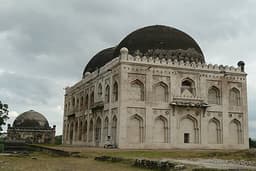
Ala-ud-din Bahman Shah
Emperor · Medieval
60.9Total

Napoleon Bonaparte
General · Modern
70.9Total
Basic Information
Born
1347
1769
Died
1358
1821
Era
Medieval
Modern
Nationality
India
France
Occupation
Emperor
General
Civilization
Indian
Western
Score Comparison
Military (10%)
72.5
94.0
Political (20%)
68.0
72.0
Influence (20%)
57.2
40.0
Legacy (20%)
50.0
80.0
Leadership (15%)
74.0
78.0
Strategy (15%)
55.0
90.0
TOTAL
60.9
70.9
Ala-ud-din Bahman Shah — Complete Timeline
1347 AD
Revolt against the Delhi SultanatePolitical Action
Ala-ud-din Bahman Shah led a rebellion of Deccani nobles against the Tughlaq dynasty, establishing the independent Bahmani Sultanate. This marked the beginning of a new political entity in the Deccan region.
FoundingRebellionDeccan
Impact: regionalconstructive
Coronation as first Bahmani SultanPolitical Action◆ Major
Ala-ud-din Bahman Shah was crowned as the first sultan of the Bahmani Sultanate at Gulbarga. He established the capital at Gulbarga and began consolidating control over the Deccan plateau.
CoronationFounding
Impact: regionalconstructive
1350 AD
Campaign against the Vijayanagara EmpireWar◆ Major
Ala-ud-din Bahman Shah launched military campaigns against the Vijayanagara Empire, capturing territories in the Raichur Doab. These conflicts established the Bahmani Sultanate as a major power in southern India.
WarVijayanagaraTerritorial Expansion
Impact: regional
1355 AD
Consolidation of Bahmani territoryPolitical Action
Ala-ud-din Bahman Shah suppressed rebellions by local Hindu chiefs and rival Muslim factions, securing the borders of the Bahmani Sultanate. He established a stable administrative framework for the new state.
ConsolidationAdministration
Impact: regionalconstructive
Napoleon Bonaparte — Complete Timeline
1799 AD
Coup of 18 BrumaireOther◆ Major
Napoleon Bonaparte, with support from his brother Lucien and key political figures, overthrew the Directory in a bloodless coup. He established the Consulate with himself as First Consul, effectively becoming the ruler of France. This event ended the French Revolution's most unstable period.
French RevolutionCoupRise to Power
Impact: regional
1804 AD
Promulgation of the Napoleonic CodeOther◆ Major
Napoleon enacted the Civil Code of the French, known as the Napoleonic Code, a comprehensive set of laws that replaced the fragmented feudal legal systems. The code established legal equality, protected property rights, and secularized law. It became the basis for legal systems in many European and world countries.
Legal ReformNapoleonic CodeCivil Law
Impact: globalconstructive
1805 AD
Battle of AusterlitzWar◆ Major
Napoleon's Grande Arm
Napoleonic WarsBattleDecisive Victory
Impact: global
1812 AD
Invasion of RussiaWar◆ Major
Napoleon led the Grande Arm
Napoleonic WarsInvasionDisaster
Impact: globaldestructive
1815 AD
Battle of WaterlooWar◆ Major
Napoleon's French army was defeated by the combined forces of the Duke of Wellington's Anglo-Allied army and Gebhard Leberecht von Bl
Napoleonic WarsBattleFinal Defeat
Impact: globaldestructive
Expert Analysis
ala-ud-din-bahman-shah-vs-napoleon-bonaparte
# The Emperor and the Sultan: Two Paths to Power in an Age of Upheaval
On a June morning in 1815, Napoleon Bonaparte stood on a muddy field near Waterloo, watching his Imperial Guard march into cannon fire for the last time. Half a millennium earlier and half a world away, in the arid Deccan plateau of India, another man had stood at a crossroads of history—Ala-ud-din Bahman Shah, a rebel noble who had just defied the mightiest empire of the subcontinent. One would conquer Europe and lose it all; the other would found a dynasty that endured for nearly two centuries. What separates a blazing comet from a steady flame?
Origins
Napoleon Bonaparte was born in 1769 on the Mediterranean island of Corsica, a place recently annexed by France. His family were minor nobility of Italian descent, speaking Corsican dialect and nursing resentments against French rule. The young Napoleon attended military schools in mainland France, where his foreign accent and small stature made him a target for ridicule. He emerged from this crucible with a burning ambition and a cold, calculating intellect—a man who had to prove himself in a world that expected him to fail.
Ala-ud-din Bahman Shah, born around 1347, came from a very different world. The Deccan was a region of ancient kingdoms, where Hindu and Muslim cultures intermingled under the shadow of the Delhi Sultanate. He was a noble in the service of the Tughlaq dynasty, which then ruled most of India. Unlike Napoleon, who rose from obscurity, Ala-ud-din was already part of the ruling class. But he saw an empire in decay: the Tughlaq sultan, Muhammad bin Tughlaq, had become notorious for disastrous policies and brutal repression. The Deccani nobles had had enough.
Rise to Power
Napoleon’s ascent was meteoric. In 1793, at age 24, he drove British forces from the port of Toulon, earning promotion to brigadier general. By 1796, he commanded the French army in Italy, where his lightning campaigns shattered Austrian control of northern Italy. In 1799, he seized power in a coup d’état, becoming First Consul of France. By 1804, he crowned himself Emperor. The key turning point was the Battle of Austerlitz in 1805, where his tactical brilliance destroyed a combined Russian and Austrian army, cementing his dominance over continental Europe.
Ala-ud-din’s path was more deliberate. In 1347, he led a revolt of Deccani nobles against the Tughlaq dynasty—a political action rather than a military coup. The rebellion succeeded because he understood that power in the Deccan required consensus, not conquest. He was crowned the first Sultan of the Bahmani Sultanate at Gulbarga, establishing his capital in a city that would become a center of culture and learning. His rise was not a single battle but a careful negotiation of alliances and loyalties.
Leadership & Governance
Napoleon ruled through sheer force of personality and military genius. His Napoleonic Code reformed French law, establishing principles of equality before the law and secular governance that influenced legal systems worldwide. He built roads, schools, and a centralized bureaucracy. But his governance was inseparable from war: every reform served the needs of his campaigns. His military strategy—using speed, concentration of force, and the corps system—was revolutionary. At Austerlitz, he lured his enemies into attacking his deliberately weakened right flank, then crushed them with a hidden reserve.
Ala-ud-din governed with a different philosophy. He understood that the Deccan was a mosaic of Hindu and Muslim communities, of local chieftains and rival factions. His campaigns against the Vijayanagara Empire in 1350 were aimed at securing the fertile Raichur Doab region, but he did not seek total conquest. Instead, he consolidated his territory through diplomacy and suppression of rebellions by both Hindu chiefs and rival Muslim factions. His strategy score of 52.2, compared to Napoleon’s 93, reflects a leader who valued stability over brilliance.
Triumph & Tragedy
Napoleon’s greatest triumph was the Battle of Austerlitz, where he defeated a numerically superior enemy through a masterful deception. His greatest tragedy was the invasion of Russia in 1812. He marched 600,000 men into the vastness of the Russian winter; fewer than 100,000 returned. The disaster broke his aura of invincibility. By 1814, he was exiled to Elba. He escaped in 1815, raised another army, and was finally defeated at Waterloo—a battle he might have won if not for a combination of bad weather, Prussian reinforcements, and his own hesitation.
Ala-ud-din’s triumph was more modest: he founded a state that would survive for 186 years. His tragedy was that he did not live to see it flourish. He died in 1358, after only eleven years of rule. The Bahmani Sultanate would fragment into five successor states, but it remained a cultural and political force in the Deccan for generations.
Character & Destiny
Napoleon’s character was a paradox: a man of immense self-discipline who could not restrain his ambition. “Impossible is a word to be found only in the dictionary of fools,” he once said. That relentless drive made him a conqueror but also doomed him. He could not stop—could not consolidate, could not accept limits. His destiny was to burn bright and fast, a shooting star that illuminates the sky before vanishing.
Ala-ud-din possessed a different temperament: patient, pragmatic, and politically astute. He knew when to fight and when to negotiate. His leadership score of 80.3, higher than Napoleon’s 80, suggests a man who understood that power is built on relationships, not just victories. His destiny was to lay foundations, not to build monuments.
Legacy
Napoleon’s legacy is global. The Napoleonic Code shaped legal systems from Europe to Latin America. His military tactics are still studied in war colleges. He is remembered as a genius and a tyrant, a liberator and a conqueror. His total score of 82.4 reflects a figure of immense impact, even if his empire crumbled.
Ala-ud-din’s legacy is regional but enduring. He is remembered as the founder of the Bahmani Sultanate, a dynasty that fostered a unique Deccani culture blending Persian, Turkish, and Indian traditions. His influence score of 74.4, while lower than Napoleon’s 82, represents a quieter but equally real achievement: the creation of a state that shaped the history of southern India for nearly two centuries.
Conclusion
Standing at Waterloo, Napoleon might have thought of his own words: “There is no such thing as accident; it is fate misnamed.” Ala-ud-din, dying in his Gulbarga palace, might have agreed. Both men seized their moments, but the moments were different. Napoleon’s Europe was a continent of competing nation-states, where a single genius could reshape the map. Ala-ud-din’s Deccan was a world of ancient loyalties and fragile alliances, where survival required patience, not glory. The comet and the flame—each burned in its own way, and each left its mark.
Rankings
🥇
Napoleon BonaparteLeader
Mil: 94.0Pol: 72.0Inf: 40.0
70.9
🥈
Ala-ud-din Bahman Shah
Mil: 72.5Pol: 68.0Inf: 57.2
60.9
+10.0 behind
How This Comparison Works
Algorithm
Each figure is scored on 6 dimensions (0—100 scale) based on structured historical data: Military (10%), Political (20%), Influence (20%), Legacy (20%), Leadership (15%), Strategy (15%). The weighted total produces the final ranking.
Data Sources
Scores are computed from structured sub-indicators in the database. Scale factors adjust for era (Ancient ×0.85, Modern ×1.0) and civilization size (Eastern ×1.05, Other ×0.80) to account for differences in population and military scale.
Maximum 3 Figures
Comparisons are limited to 2—3 figures to ensure readability and statistical meaningfulness.
Error Margins
±5 points per dimension — Sub-scores are derived from historical records with inherent uncertainty. Two figures within 5 points on a dimension should be considered roughly equivalent in that area.
Total Score Accuracy
±3 points overall — The weighted combination of 6 dimensions produces a total score with approximately ±3 points of uncertainty. Differences of less than 3 points are not statistically significant— the figures are effectively tied.
Known Limitations
- Historical records are incomplete and uneven across civilizations
- Figures from oral-tradition societies may be underrepresented
- Occupation labels can misclassify multi-role figures
- Scores measure capability and impact, not moral character
- Quantitative scoring is a comparison tool, not absolute truth
Capability Radar
Military (10%) — Battles & Warfare
Battles
55
95
Win Rate
60
90
Expansion
65
95
Political (20%) — Governance & Reform
Reform
55
95
Diplomacy
50
80
Economy
50
85
Influence (20%) — Cultural & Global Reach
Cultural
40
85
Global
35
90
Legacy (20%) — Historical Impact
Historical
55
95
Longevity
50
90
Leadership (15%) — Power & Stability
Tenure
60
85
Stability
45
70
Strategy (15%) — Tactics & Innovation
Strategy
55
95
Tactics
50
98
Reform
45
92
Similar Comparisons
Comments & Discussion
THE_IRON_GRADUALIST6/17/2026
Comparing Napoleon to Bahman Shah is comparing a single brilliant wildfire to a slow-burning volcanic plateau that reshaped an entire region for 200 years. Waterloo ended in a day; Bahman Shah's revolt in the Deccan gave birth to a dynasty that outlasted the French Empire, the Restoration, and the July Monarchy combined. Any military historian knows: raw tactical genius is cheap if you can't anchor it in institutions. Napoleon built a cult. Bahman Shah built a kingdom. I'll take the builder over
EUROPEAN_EXCEPTIONALIST6/17/2026
Let's be honest—Bahman Shah's Deccan was a footnote in a crumbling sultanate, while Napoleon reshaped the legal, military, and political fabric of an entire continent. The Code Napoleon still echoes in courts from Paris to Cairo. What did Bahman Shah leave? A tomb in Gulbarga and a dynasty that barely held together after his death. One man is studied in every war college; the other is a trivia answer. This isn't subtle—Napoleon changed the world. Bahman Shah just changed his tax collectors.
TUGHLAQ_TROLL6/17/2026
说拿仑比巴赫曼沙强的人,估计连德里苏丹国地图都没看过。1347年巴赫曼在道拉塔巴德起兵时,图格鲁克王朝还有30万骑兵,他活下来了,还活了30多年。拿仑在滑铁卢只撑了一天。谁更持久?历史不是打游戏,不是比谁卢浮宫抢得多。巴赫曼王朝搞了近两百年,法国排个队都等不到这么久。拿仑的皇冠还没坐热就被送去了圣赫勒拿,这也能叫赢?
腐竹考据狂6/17/2026
拿仑的“伟大”全靠欧洲中心史观吹出来的。巴赫曼沙建立了一个真正多文化的政权——他的宫廷里有波斯贵族、德干本地将领,甚至还有印度教藩属。拿仑呢?他跑去埃及还炸了狮身人面像鼻子(传说),对异文化的尊重基本为零。巴赫曼铸造的钱币上有马拉地文和波斯文并列,拿仑的钱上只有他自己。谁更包容?这不是政治正确,这是基本史实。你要选同桌,选一个能跟所有人合作的,还是一个只爱自拍的?
荒漠里的钉子户6/17/2026
有趣的是,两个人都被历史审判过:拿仑的墓在巴黎荣军院,每天被游客围观;巴赫曼的墓在古尔伯加,安静得像一堵墙。但谁更安全?拿仑的遗产被反复包装、修正,变成法国民族主义的罐头食品。巴赫曼的遗产反而活得真实——他在德干高原种下的政治种子,后来长出了比贾普尔、戈尔康达这些百年