Loading...
This comparison has not been analyzed yet.
One-time AI generation (~1 minute). Scores and timeline are already available below.
Al-Mustain of Cairo vs Theophilos
Theophilos leads by 8.3 pts · 2 figures compared
…

Al-Mustain of Cairo
Emperor · Medieval
39.6Total
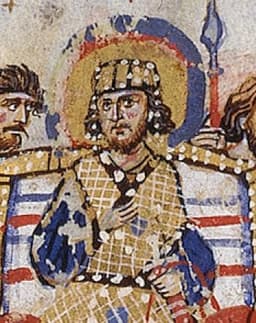
Theophilos
Emperor · Medieval
47.9Total
Basic Information
Born
1390
813
Died
1430
842
Era
Medieval
Medieval
Nationality
Abbasid Caliphate
Byzantine Empire
Occupation
Emperor
Emperor
Civilization
Middle Eastern
Western
Score Comparison
Military (10%)
20.0
38.3
Political (20%)
35.0
42.3
Influence (20%)
45.5
51.8
Legacy (20%)
35.8
42.5
Leadership (15%)
49.9
65.7
Strategy (15%)
45.0
43.3
TOTAL
39.6
47.9
Al-Mustain of Cairo — Complete Timeline
1406 AD
Accession as CaliphPolitical Action
Al-Mustain became caliph after the death of Al-Mutawakkil I. His reign was initially ceremonial, but he later became involved in Mamluk politics.
Caliphal Succession
1412 AD
Brief Rule as Mamluk SultanPolitical Action
During a succession crisis, Al-Mustain was proclaimed Mamluk Sultan by the emirs after the death of Sultan Faraj. He ruled for only a few months before being deposed by Emir Al-Mu'ayyad Shaykh. This was the only time a Cairene Abbasid caliph held temporal power.
SultanateMamluk PoliticsUnique Event
Impact: regional
Deposition and ExilePolitical Action◆ Major
After being deposed as sultan, Al-Mustain was forced to abdicate the caliphate and was exiled to Alexandria. He died there in 1430, ending his unique dual role.
DepositionExileEnd of Reign
tragic
Theophilos — Complete Timeline
829 AD
Accession as Emperor (829)Political Action◆ Major
Theophilos succeeded his father Michael II as Byzantine emperor. He was the last emperor to actively support iconoclasm. His reign was marked by military campaigns against the Arabs and cultural patronage.
Accession
Impact: regional
Iconoclast Persecutions (829-842)Political Action◆ Major
Theophilos continued the iconoclast policies of his predecessors, persecuting icon venerators. He ordered the execution of the painter Lazarus and the exile of the monk Theodore the Studite. His death in 842 ended the iconoclast period.
IconoclasmPersecution
Impact: regionaldestructive
830 AD
Campaigns against the Arabs (830s-840s)War◆ Major
Theophilos led several campaigns against the Abbasid Caliphate, including a major expedition in 838 that resulted in the sack of the Byzantine city of Amorium. The loss of Amorium was a significant blow to Byzantine prestige.
Byzantine-Arab WarsMilitary Campaign
Impact: regionaltragic
Construction of the Bryas Palace (c. 830s)Cultural
Theophilos built the Bryas Palace near Constantinople, modeled after Arab palaces he admired. The palace featured elaborate gardens, fountains, and mosaics. It reflected his interest in Islamic culture and architecture.
ArchitectureCultural Exchange
constructive
This comparison has not been analyzed yet.
One-time AI generation (~1 minute). Scores and timeline are already available below.
Rankings
🥇
TheophilosLeader
Mil: 38.3Pol: 42.3Inf: 51.8
47.9
🥈
Al-Mustain of Cairo
Mil: 20.0Pol: 35.0Inf: 45.5
39.6
+8.3 behind
How This Comparison Works
Algorithm
Each figure is scored on 6 dimensions (0—100 scale) based on structured historical data: Military (10%), Political (20%), Influence (20%), Legacy (20%), Leadership (15%), Strategy (15%). The weighted total produces the final ranking.
Data Sources
Scores are computed from structured sub-indicators in the database. Scale factors adjust for era (Ancient ×0.85, Modern ×1.0) and civilization size (Eastern ×1.05, Other ×0.80) to account for differences in population and military scale.
Maximum 3 Figures
Comparisons are limited to 2—3 figures to ensure readability and statistical meaningfulness.
Error Margins
±5 points per dimension — Sub-scores are derived from historical records with inherent uncertainty. Two figures within 5 points on a dimension should be considered roughly equivalent in that area.
Total Score Accuracy
±3 points overall — The weighted combination of 6 dimensions produces a total score with approximately ±3 points of uncertainty. Differences of less than 3 points are not statistically significant— the figures are effectively tied.
Known Limitations
- Historical records are incomplete and uneven across civilizations
- Figures from oral-tradition societies may be underrepresented
- Occupation labels can misclassify multi-role figures
- Scores measure capability and impact, not moral character
- Quantitative scoring is a comparison tool, not absolute truth
Capability Radar
Military (10%) — Battles & Warfare
Battles
5
40
Win Rate
5
35
Expansion
5
25
Political (20%) — Governance & Reform
Reform
5
40
Diplomacy
10
35
Economy
5
40
Influence (20%) — Cultural & Global Reach
Cultural
5
30
Global
5
20
Legacy (20%) — Historical Impact
Historical
10
35
Longevity
5
20
Leadership (15%) — Power & Stability
Tenure
10
55
Stability
5
30
Strategy (15%) — Tactics & Innovation
Strategy
5
30
Tactics
5
30
Reform
5
20
Similar Comparisons
Comments & Discussion
No comments yet. Be the first to share your thoughts!