Loading...
This comparison has not been analyzed yet.
One-time AI generation (~1 minute). Scores and timeline are already available below.
Ajit Singh of Marwar vs Sekgoma I
Ajit Singh of Marwar leads by 5.3 pts · 2 figures compared
…
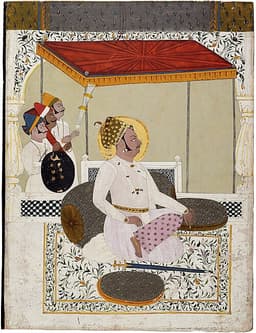
Ajit Singh of Marwar
Emperor · Modern
51.0Total

Sekgoma I
Emperor · Modern
45.7Total
Basic Information
Born
1679
1815
Died
1724
1883
Era
Modern
Modern
Nationality
India
Botswana
Occupation
Emperor
Emperor
Civilization
Indian
Other
Score Comparison
Military (10%)
40.0
50.0
Political (20%)
54.7
33.6
Influence (20%)
51.0
50.2
Legacy (20%)
41.7
40.8
Leadership (15%)
74.0
65.7
Strategy (15%)
45.0
30.3
TOTAL
51.0
45.7
Ajit Singh of Marwar — Complete Timeline
1707 AD
Restored to the Throne of JodhpurPolitical Action◆ Major
After Aurangzeb's death, Ajit Singh was restored to the throne of Jodhpur by the Rathore nobles. He had been exiled as a child after his father Jaswant Singh's death and the Mughal annexation of Marwar.
RestorationMarwarRathore
Impact: regionalconstructive
1708 AD
Conflict with the MughalsWar◆ Major
Ajit Singh led a rebellion against the Mughals under Bahadur Shah I. He recaptured Jodhpur and other territories, asserting Marwar's independence after decades of Mughal control.
RebellionMughal EmpireMarwar
Impact: regional
Alliance with the Rajput ConfederacyPolitical Action◆ Major
Ajit Singh joined a confederation of Rajput states, including Mewar and Amber, to resist Mughal expansion. This alliance temporarily weakened Mughal authority in Rajasthan.
AllianceRajputMughal Empire
Impact: regionalconstructive
1724 AD
AssassinationPolitical Action◆ Major
Ajit Singh was assassinated by his own son, Bakht Singh, in a power struggle. This event plunged Marwar into a succession war and weakened the Rathore dynasty.
AssassinationSuccession CrisisMarwar
Impact: regionaltragic
Sekgoma I — Complete Timeline
1862 AD
Resistance to Christian MissionariesCultural
Sekgoma I expelled European Christian missionaries from his territory, rejecting their influence and the conversion of his subjects. This action preserved traditional Tswana religion but isolated the Bangwato from external alliances.
MissionariesReligionCultural Resistance
1872 AD
Exile and Return to PowerPolitical Action◆ Major
Sekgoma I was forced into exile by his son Khama III and British allies. He later returned and briefly regained control of part of the Bangwato territory before being defeated again, ending his effective rule.
ExilePower StruggleDefeat
Impact: regionaltragic
1875 AD
Conflict with Khama III over SuccessionPolitical Action◆ Major
Sekgoma I opposed the succession of his son Khama III, favoring another son instead. This led to a prolonged power struggle within the Bangwato tribe, resulting in Khama III eventually seizing power with British support.
Succession DisputeCivil ConflictBangwato
Impact: regionaldestructive
This comparison has not been analyzed yet.
One-time AI generation (~1 minute). Scores and timeline are already available below.
Rankings
🥇
Ajit Singh of MarwarLeader
Mil: 40.0Pol: 54.7Inf: 51.0
51.0
🥈
Sekgoma I
Mil: 50.0Pol: 33.6Inf: 50.2
45.7
+5.3 behind
How This Comparison Works
Algorithm
Each figure is scored on 6 dimensions (0—100 scale) based on structured historical data: Military (10%), Political (20%), Influence (20%), Legacy (20%), Leadership (15%), Strategy (15%). The weighted total produces the final ranking.
Data Sources
Scores are computed from structured sub-indicators in the database. Scale factors adjust for era (Ancient ×0.85, Modern ×1.0) and civilization size (Eastern ×1.05, Other ×0.80) to account for differences in population and military scale.
Maximum 3 Figures
Comparisons are limited to 2—3 figures to ensure readability and statistical meaningfulness.
Error Margins
±5 points per dimension — Sub-scores are derived from historical records with inherent uncertainty. Two figures within 5 points on a dimension should be considered roughly equivalent in that area.
Total Score Accuracy
±3 points overall — The weighted combination of 6 dimensions produces a total score with approximately ±3 points of uncertainty. Differences of less than 3 points are not statistically significant— the figures are effectively tied.
Known Limitations
- Historical records are incomplete and uneven across civilizations
- Figures from oral-tradition societies may be underrepresented
- Occupation labels can misclassify multi-role figures
- Scores measure capability and impact, not moral character
- Quantitative scoring is a comparison tool, not absolute truth
Capability Radar
Military (10%) — Battles & Warfare
Battles
45
20
Win Rate
40
25
Expansion
25
25
Political (20%) — Governance & Reform
Reform
30
20
Diplomacy
45
30
Economy
35
20
Influence (20%) — Cultural & Global Reach
Cultural
30
20
Global
15
10
Legacy (20%) — Historical Impact
Historical
35
25
Longevity
25
20
Leadership (15%) — Power & Stability
Tenure
50
40
Stability
40
25
Strategy (15%) — Tactics & Innovation
Strategy
30
20
Tactics
35
20
Reform
20
15
Similar Comparisons
Comments & Discussion
No comments yet. Be the first to share your thoughts!