Loading...
This comparison has not been analyzed yet.
One-time AI generation (~1 minute). Scores and timeline are already available below.
Ajit Singh of Marwar vs Franz Joseph I of Austria
Ajit Singh of Marwar leads by 0.7 pts · 2 figures compared
…
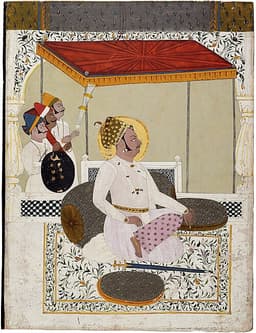
Ajit Singh of Marwar
Emperor · Modern
51.0Total

Franz Joseph I of Austria
Emperor · Modern
50.3Total
Basic Information
Born
1679
1830
Died
1724
1916
Era
Modern
Modern
Nationality
India
Austria
Occupation
Emperor
Emperor
Civilization
Indian
Western
Score Comparison
Military (10%)
40.0
25.9
Political (20%)
54.7
39.4
Influence (20%)
51.0
58.0
Legacy (20%)
41.7
56.0
Leadership (15%)
74.0
72.0
Strategy (15%)
45.0
25.0
TOTAL
51.0
50.3
Ajit Singh of Marwar — Complete Timeline
1707 AD
Restored to the Throne of JodhpurPolitical Action◆ Major
After Aurangzeb's death, Ajit Singh was restored to the throne of Jodhpur by the Rathore nobles. He had been exiled as a child after his father Jaswant Singh's death and the Mughal annexation of Marwar.
RestorationMarwarRathore
Impact: regionalconstructive
1708 AD
Conflict with the MughalsWar◆ Major
Ajit Singh led a rebellion against the Mughals under Bahadur Shah I. He recaptured Jodhpur and other territories, asserting Marwar's independence after decades of Mughal control.
RebellionMughal EmpireMarwar
Impact: regional
Alliance with the Rajput ConfederacyPolitical Action◆ Major
Ajit Singh joined a confederation of Rajput states, including Mewar and Amber, to resist Mughal expansion. This alliance temporarily weakened Mughal authority in Rajasthan.
AllianceRajputMughal Empire
Impact: regionalconstructive
1724 AD
AssassinationPolitical Action◆ Major
Ajit Singh was assassinated by his own son, Bakht Singh, in a power struggle. This event plunged Marwar into a succession war and weakened the Rathore dynasty.
AssassinationSuccession CrisisMarwar
Impact: regionaltragic
Franz Joseph I of Austria — Complete Timeline
1867 AD
Ausgleich of 1867Political Action
Franz Joseph I agreed to the Austro-Hungarian Compromise, transforming the Austrian Empire into the dual monarchy of Austria-Hungary. Hungary gained equal status with Austria, with its own parliament and government, while Franz Joseph remained emperor and king.
CompromiseHungaryDual Monarchy
Impact: regionalconstructive
1889 AD
Death of Crown Prince RudolfOther◆ Major
Crown Prince Rudolf, Franz Joseph I's only son and heir, died in a murder-suicide at Mayerling. This personal tragedy left the succession uncertain and deeply affected Franz Joseph, who never fully recovered from the loss.
MayerlingSuccessionTragedy
Impact: nationaltragic
1908 AD
Annexation of Bosnia and HerzegovinaPolitical Action◆ Major
Franz Joseph I formally annexed Bosnia and Herzegovina, which had been under Austro-Hungarian administration since 1878. This action violated the Treaty of Berlin, angered Serbia and Russia, and increased tensions in the Balkans leading up to World War I.
BalkansAnnexationSerbia
Impact: regionaldestructive
1914 AD
Assassination of Archduke Franz FerdinandOther
Archduke Franz Ferdinand, heir to the Austro-Hungarian throne, was assassinated in Sarajevo by Gavrilo Princip, a Bosnian Serb nationalist. This event triggered the July Crisis and led to Franz Joseph I's declaration of war on Serbia, starting World War I.
World War IAssassinationJuly Crisis
Impact: globaltragic
Austro-Hungarian Ultimatum to SerbiaPolitical Action◆ Major
Franz Joseph I approved a harsh ultimatum to Serbia following the assassination of Franz Ferdinand. The ultimatum was designed to be rejected, leading to Austria-Hungary's declaration of war on Serbia on July 28, 1914, which escalated into World War I.
World War IUltimatumSerbia
Impact: globaldestructive
This comparison has not been analyzed yet.
One-time AI generation (~1 minute). Scores and timeline are already available below.
Rankings
🥇
Ajit Singh of MarwarLeader
Mil: 40.0Pol: 54.7Inf: 51.0
51.0
🥈
Franz Joseph I of Austria
Mil: 25.9Pol: 39.4Inf: 58.0
50.3
+0.7 behind
How This Comparison Works
Algorithm
Each figure is scored on 6 dimensions (0—100 scale) based on structured historical data: Military (10%), Political (20%), Influence (20%), Legacy (20%), Leadership (15%), Strategy (15%). The weighted total produces the final ranking.
Data Sources
Scores are computed from structured sub-indicators in the database. Scale factors adjust for era (Ancient ×0.85, Modern ×1.0) and civilization size (Eastern ×1.05, Other ×0.80) to account for differences in population and military scale.
Maximum 3 Figures
Comparisons are limited to 2—3 figures to ensure readability and statistical meaningfulness.
Error Margins
±5 points per dimension — Sub-scores are derived from historical records with inherent uncertainty. Two figures within 5 points on a dimension should be considered roughly equivalent in that area.
Total Score Accuracy
±3 points overall — The weighted combination of 6 dimensions produces a total score with approximately ±3 points of uncertainty. Differences of less than 3 points are not statistically significant— the figures are effectively tied.
Known Limitations
- Historical records are incomplete and uneven across civilizations
- Figures from oral-tradition societies may be underrepresented
- Occupation labels can misclassify multi-role figures
- Scores measure capability and impact, not moral character
- Quantitative scoring is a comparison tool, not absolute truth
Capability Radar
Military (10%) — Battles & Warfare
Battles
45
20
Win Rate
40
15
Expansion
25
5
Political (20%) — Governance & Reform
Reform
30
20
Diplomacy
45
30
Economy
35
25
Influence (20%) — Cultural & Global Reach
Cultural
30
40
Global
15
50
Legacy (20%) — Historical Impact
Historical
35
60
Longevity
25
70
Leadership (15%) — Power & Stability
Tenure
50
95
Stability
40
30
Strategy (15%) — Tactics & Innovation
Strategy
30
15
Tactics
35
10
Reform
20
25
Similar Comparisons
Comments & Discussion
No comments yet. Be the first to share your thoughts!