Loading...
This comparison has not been analyzed yet.
One-time AI generation (~1 minute). Scores and timeline are already available below.
Ahmad bin Ali Al Thani vs Louis XV
Ahmad bin Ali Al Thani leads by 0.9 pts · 2 figures compared
…

Ahmad bin Ali Al Thani
Emperor · Modern
49.1Total
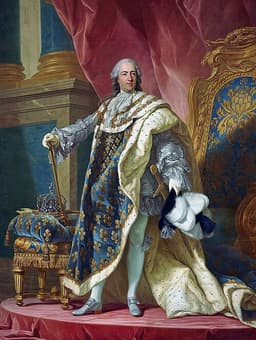
Louis XV
Emperor · Modern
48.2Total
Basic Information
Born
1920
1710
Died
—
1774
Era
Modern
Modern
Nationality
Qatar
France
Occupation
Emperor
Emperor
Civilization
Middle Eastern
Western
Score Comparison
Military (10%)
13.8
55.0
Political (20%)
72.0
39.4
Influence (20%)
53.3
54.9
Legacy (20%)
43.3
42.5
Leadership (15%)
66.0
53.2
Strategy (15%)
28.3
45.0
TOTAL
49.1
48.2
Ahmad bin Ali Al Thani — Complete Timeline
1960 AD
Accession as Emir of QatarPolitical Action◆ Major
Ahmad bin Ali Al Thani became the Emir of Qatar on October 24, 1960, after the abdication of his father, Ali bin Abdullah Al Thani. His reign coincided with Qatar's transition from a British protectorate to an independent state.
SuccessionMonarchyQatar
Impact: national
1971 AD
Qatar's Independence from the United KingdomPolitical Action◆ Major
Under Emir Ahmad bin Ali, Qatar declared independence from the United Kingdom on September 3, 1971, ending the British protectorate. He signed a treaty of friendship with Britain and established Qatar as a sovereign state.
IndependenceDecolonizationStatehood
Impact: nationalconstructive
1972 AD
Deposition by Khalifa bin Hamad Al ThaniPolitical Action◆ Major
On February 22, 1972, Emir Ahmad bin Ali was deposed in a bloodless coup led by his cousin, Khalifa bin Hamad Al Thani, while Ahmad was abroad in Iran. The coup was supported by the Al Thani family and the Qatari military.
CoupPower StruggleDeposition
Impact: nationaldestructive
Louis XV — Complete Timeline
1740 AD
War of the Austrian SuccessionWar◆ Major
Louis XV involved France in the War of the Austrian Succession, supporting Prussia against Austria. French forces achieved victories at Fontenoy (1745) but failed to secure lasting gains. The war drained French finances and ended with the inconclusive Treaty of Aix-la-Chapelle.
WarEuropean ConflictDynastic Struggle
Impact: global
1748 AD
Treaty of Aix-la-Chapelle (1748)Political Action◆ Major
Louis XV signed the Treaty of Aix-la-Chapelle, ending the War of the Austrian Succession. France gained little from the war despite military successes, returning conquered territories including the Austrian Netherlands. The treaty was seen as a diplomatic failure and contributed to the decline of royal prestige.
TreatyWar of the Austrian SuccessionDiplomacy
Impact: global
1756 AD
Seven Years' War (French and Indian War)War
Louis XV led France into the Seven Years' War against Great Britain and Prussia. The war resulted in France losing most of its North American colonies (New France) and its influence in India. The Treaty of Paris (1763) confirmed these losses, severely weakening French colonial power.
Colonial WarLoss of TerritorySeven Years' War
Impact: globaldestructive
1771 AD
Suppression of the ParlementsPolitical Action◆ Major
Louis XV, advised by Chancellor Maupeou, abolished the Parlements (high courts) that had opposed royal tax reforms. This authoritarian move centralized power but alienated the nobility and legal classes, creating long-term opposition to the monarchy.
Judicial ReformAbsolutismParlements
Impact: nationaldestructive
This comparison has not been analyzed yet.
One-time AI generation (~1 minute). Scores and timeline are already available below.
Rankings
🥇
Ahmad bin Ali Al ThaniLeader
Mil: 13.8Pol: 72.0Inf: 53.3
49.1
🥈
Louis XV
Mil: 55.0Pol: 39.4Inf: 54.9
48.2
+0.9 behind
How This Comparison Works
Algorithm
Each figure is scored on 6 dimensions (0—100 scale) based on structured historical data: Military (10%), Political (20%), Influence (20%), Legacy (20%), Leadership (15%), Strategy (15%). The weighted total produces the final ranking.
Data Sources
Scores are computed from structured sub-indicators in the database. Scale factors adjust for era (Ancient ×0.85, Modern ×1.0) and civilization size (Eastern ×1.05, Other ×0.80) to account for differences in population and military scale.
Maximum 3 Figures
Comparisons are limited to 2—3 figures to ensure readability and statistical meaningfulness.
Error Margins
±5 points per dimension — Sub-scores are derived from historical records with inherent uncertainty. Two figures within 5 points on a dimension should be considered roughly equivalent in that area.
Total Score Accuracy
±3 points overall — The weighted combination of 6 dimensions produces a total score with approximately ±3 points of uncertainty. Differences of less than 3 points are not statistically significant— the figures are effectively tied.
Known Limitations
- Historical records are incomplete and uneven across civilizations
- Figures from oral-tradition societies may be underrepresented
- Occupation labels can misclassify multi-role figures
- Scores measure capability and impact, not moral character
- Quantitative scoring is a comparison tool, not absolute truth
Capability Radar
Military (10%) — Battles & Warfare
Battles
4
45
Win Rate
6
40
Expansion
11
20
Political (20%) — Governance & Reform
Reform
55
20
Diplomacy
65
30
Economy
50
25
Influence (20%) — Cultural & Global Reach
Cultural
30
40
Global
30
30
Legacy (20%) — Historical Impact
Historical
40
35
Longevity
30
30
Leadership (15%) — Power & Stability
Tenure
60
80
Stability
55
20
Strategy (15%) — Tactics & Innovation
Strategy
18
30
Tactics
17
35
Reform
19
25
Similar Comparisons
Comments & Discussion
No comments yet. Be the first to share your thoughts!