Loading...
This comparison has not been analyzed yet.
One-time AI generation (~1 minute). Scores and timeline are already available below.
Agilulf vs Edward V of England
Edward V of England leads by 1.8 pts · 2 figures compared
…
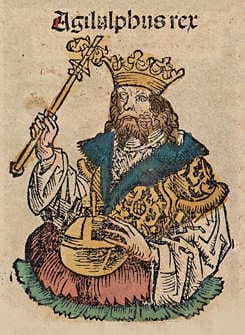
Agilulf
Emperor · Medieval
45.7Total

Edward V of England
Emperor · Medieval
47.5Total
Basic Information
Born
555
1470
Died
616
1483
Era
Medieval
Medieval
Nationality
Lombards
England
Occupation
Emperor
Emperor
Civilization
Western
Western
Score Comparison
Military (10%)
50.0
16.6
Political (20%)
36.5
68.0
Influence (20%)
49.4
45.5
Legacy (20%)
40.8
37.5
Leadership (15%)
58.8
70.4
Strategy (15%)
38.6
43.0
TOTAL
45.7
47.5
Agilulf — Complete Timeline
590 AD
Conversion from Arianism to CatholicismCultural◆ Major
Agilulf converted from Arian Christianity to Catholicism, aligning the Lombard kingdom with the Papacy and the majority of the Italian population. This shift reduced religious tensions and facilitated integration with the Romanized populace.
Religious ConversionLombard KingdomCatholic Church
Impact: regionalconstructive
593 AD
Siege of RomeWar
Agilulf besieged Rome, threatening the city and Pope Gregory I. The siege was lifted after negotiations, with the Lombards withdrawing in exchange for tribute. This event highlighted the Lombard military threat to the Papacy.
SiegeLombard-Papal ConflictMilitary Campaign
Impact: regionaldestructive
598 AD
Peace Treaty with the Byzantine EmpirePolitical Action◆ Major
Agilulf negotiated a peace treaty with the Byzantine Exarch of Ravenna, ending decades of intermittent warfare. The treaty secured Lombard control over much of northern Italy and established a period of stability.
DiplomacyByzantine-Lombard RelationsPeace
Impact: regionalconstructive
Edward V of England — Complete Timeline
1483 AD
Accession to the ThronePolitical Action◆ Major
Edward V became king of England at age 12 after the death of his father, Edward IV. His reign was brief and dominated by his uncle Richard, Duke of Gloucester, who acted as Lord Protector.
SuccessionMinor KingYorkist
Impact: national
Deposition by Richard IIIPolitical Action
Edward V was declared illegitimate by Parliament under the Titulus Regius, and his uncle Richard was crowned as Richard III. Edward and his brother Richard were placed in the Tower of London, where they disappeared.
DepositionPrinces in the TowerUsurpation
Impact: nationaltragic
Disappearance of the Princes in the TowerOther◆ Major
Edward V and his brother Richard, Duke of York, vanished from the Tower of London after being declared illegitimate. Their fate remains unknown, but they are widely believed to have been murdered, likely on orders of Richard III.
MysteryMurderPrinces in the Tower
Impact: nationaltragic
This comparison has not been analyzed yet.
One-time AI generation (~1 minute). Scores and timeline are already available below.
Rankings
🥇
Edward V of EnglandLeader
Mil: 16.6Pol: 68.0Inf: 45.5
47.5
🥈
Agilulf
Mil: 50.0Pol: 36.5Inf: 49.4
45.7
+1.8 behind
How This Comparison Works
Algorithm
Each figure is scored on 6 dimensions (0—100 scale) based on structured historical data: Military (10%), Political (20%), Influence (20%), Legacy (20%), Leadership (15%), Strategy (15%). The weighted total produces the final ranking.
Data Sources
Scores are computed from structured sub-indicators in the database. Scale factors adjust for era (Ancient ×0.85, Modern ×1.0) and civilization size (Eastern ×1.05, Other ×0.80) to account for differences in population and military scale.
Maximum 3 Figures
Comparisons are limited to 2—3 figures to ensure readability and statistical meaningfulness.
Error Margins
±5 points per dimension — Sub-scores are derived from historical records with inherent uncertainty. Two figures within 5 points on a dimension should be considered roughly equivalent in that area.
Total Score Accuracy
±3 points overall — The weighted combination of 6 dimensions produces a total score with approximately ±3 points of uncertainty. Differences of less than 3 points are not statistically significant— the figures are effectively tied.
Known Limitations
- Historical records are incomplete and uneven across civilizations
- Figures from oral-tradition societies may be underrepresented
- Occupation labels can misclassify multi-role figures
- Scores measure capability and impact, not moral character
- Quantitative scoring is a comparison tool, not absolute truth
Capability Radar
Military (10%) — Battles & Warfare
Battles
20
8
Win Rate
25
11
Expansion
20
9
Political (20%) — Governance & Reform
Reform
30
51
Diplomacy
35
52
Economy
30
56
Influence (20%) — Cultural & Global Reach
Cultural
20
5
Global
15
5
Legacy (20%) — Historical Impact
Historical
25
15
Longevity
20
10
Leadership (15%) — Power & Stability
Tenure
40
46
Stability
35
58
Strategy (15%) — Tactics & Innovation
Strategy
25
14
Tactics
20
19
Reform
15
19
Similar Comparisons
Comments & Discussion
No comments yet. Be the first to share your thoughts!