Loading...
Abdullahi Yusuf Ahmed vs Aldo Moro
Aldo Moro leads by 9.9 pts · 2 figures compared
…
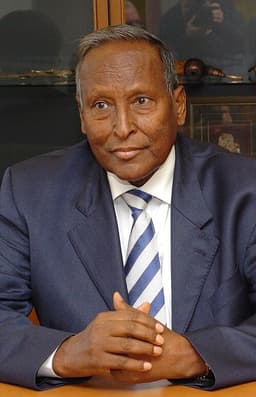
Abdullahi Yusuf Ahmed
Politician · Modern
42.8Total

Aldo Moro
Politician · Modern
52.7Total
Basic Information
Born
1934
1916
Died
—
1978
Era
Modern
Modern
Nationality
Somalia
Italy
Occupation
Politician
Politician
Civilization
Other
Western
Score Comparison
Military (10%)
36.6
48.4
Political (20%)
35.1
55.0
Influence (20%)
47.1
62.0
Legacy (20%)
38.3
56.0
Leadership (15%)
48.4
40.0
Strategy (15%)
52.8
40.6
TOTAL
42.8
52.7
Abdullahi Yusuf Ahmed — Complete Timeline
2004 AD
Became First President of Transitional Federal GovernmentPolitical Action◆ Major
Abdullahi Yusuf Ahmed was elected as the first president of the Transitional Federal Government (TFG) of Somalia, established in Kenya. This was an attempt to restore central governance after decades of civil war and state collapse.
Transitional GovernmentSomaliaPresidency
Impact: nationalconstructive
2006 AD
Ethiopian Military InterventionWar◆ Major
As president, Abdullahi Yusuf requested and facilitated Ethiopian military intervention to oust the Islamic Courts Union from Mogadishu. This intervention led to a protracted insurgency and further destabilized southern Somalia.
Ethiopian InterventionIslamic CourtsWar
Impact: regionaldestructive
2008 AD
Resigned from PresidencyPolitical Action◆ Major
Facing internal divisions, a stalled peace process, and the rise of the Islamic Courts Union, Abdullahi Yusuf resigned as president. His resignation highlighted the failure of the TFG to establish effective control over Somalia.
ResignationPolitical FailureSomalia
Impact: nationaldestructive
Aldo Moro — Complete Timeline
1963 AD
Election as Prime Minister of ItalyPolitical Action◆ Major
Aldo Moro became Prime Minister of Italy for the first time, leading a center-left coalition government. His premiership aimed to implement social reforms and include the Socialist Party in government, a historic shift.
Prime MinisterCenter-LeftSocial Reforms
Impact: nationalconstructive
1964 AD
Formation of the Organic Center-Left GovernmentPolitical Action◆ Major
Moro formed his second government, solidifying the 'organic center-left' alliance between Christian Democracy and the Socialist Party. This coalition pursued nationalizations and social welfare expansion, but faced internal divisions.
CoalitionCenter-LeftSocialist Party
Impact: nationalconstructive
1978 AD
Kidnapping by the Red BrigadesPolitical Action
Aldo Moro was kidnapped in Rome by the Red Brigades, a left-wing terrorist group. His capture occurred during a period of political crisis and negotiations for a historic compromise with the Communist Party.
KidnappingRed BrigadesTerrorism
Impact: nationaltragic
Murder by the Red BrigadesPolitical Action
After 55 days of captivity, Aldo Moro was murdered by the Red Brigades. His body was found in a car in central Rome. The assassination shocked Italy and ended any prospect of a historic compromise with the Communists.
AssassinationRed BrigadesPolitical Crisis
Impact: nationaltragic
Expert Analysis
Origins
Abdullahi Yusuf Ahmed was born in 1934 in the Mudug region of Somalia, into a prominent Darod clan family. He received early Islamic education before attending military school in Italy and later the Soviet Union, becoming an officer in the Somali National Army. His background was shaped by the clan-based politics and the collapse of Siad Barre's regime.
Aldo Moro was born in 1916 in Maglie, southern Italy, to a middle-class family. He studied law at the University of Bari and became a professor of criminal law. His early life was marked by Catholic activism, joining the Christian Democracy party after World War II. His intellectual and legal background contrasted sharply with Yusuf's military upbringing.
Rise to Power
Abdullahi Yusuf rose through military ranks, participating in the 1969 coup that brought Siad Barre to power. However, he later fell out with Barre and fled to Ethiopia, where he founded the Somali Salvation Democratic Front (SSDF) in 1978, a rebel group fighting Barre's regime. His key turning point came in 2004 when he was elected the first President of the Transitional Federal Government (TFG) of Somalia, a UN-backed initiative to restore order after years of civil war. He took office in October 2004, but his authority was limited to Baidoa and parts of Mogadishu.
Aldo Moro entered Parliament in 1946 and quickly rose within the Christian Democracy party. He became Prime Minister for the first time in 1963, leading a center-left coalition. His rise was marked by the formation of the "organic center-left" alliance with the Socialist Party, which he cemented in his second government in 1964. Moro's political skill lay in navigating factional politics within his own party and with coalition partners.
Leadership & Governance
Abdullahi Yusuf's leadership was characterized by a military approach to governance. He prioritized security and sought to reestablish state control through force, notably requesting Ethiopian military intervention in December 2006 to oust the Islamic Courts Union from Mogadishu. This move temporarily succeeded but led to a protracted insurgency. His governance was hampered by clan divisions, lack of resources, and a stalled peace process. He resigned in December 2008 after failing to unite the country, scoring 48.4 in leadership and 52.8 in strategy on our scale.
Aldo Moro's governance style was conciliatory and diplomatic. He focused on building coalitions and advancing social reforms, such as the nationalization of electricity and the expansion of education. His leadership was marked by a cautious, consensus-driven approach, scoring 40.0 in leadership. He believed in dialogue with the left, including the Communist Party, which earned him enemies on both sides. His strategy score of 40.6 reflects his inability to foresee the threat from the Red Brigades.
Triumph & Tragedy
Abdullahi Yusuf's greatest success was establishing the TFG and gaining international recognition, which kept Somalia on the path to a federal system. However, his failure to extend control beyond Baidoa and his reliance on Ethiopian troops led to a humanitarian crisis and the rise of Al-Shabaab. His resignation was a personal and national tragedy.
Aldo Moro's triumphs include stabilizing Italy's political system during the Cold War and implementing social reforms. His greatest tragedy was his kidnapping and murder by the Red Brigades in 1978, which ended his life and dealt a blow to Italy's democratic institutions. The 55-day captivity and his eventual murder highlighted the fragility of the state.
Character & Destiny
Abdullahi Yusuf was pragmatic and determined, but his military background made him distrustful of political negotiation. His decision to bring in Ethiopian forces, while tactically effective, alienated many Somalis and fueled insurgency. His character shaped his fate: a strongman unable to adapt to the complexities of clan reconciliation.
Aldo Moro was intellectual and patient, but his willingness to engage with the far left made him a target. His refusal to harden security measures or compromise his principles led to his death. Historians view him as a martyr for democracy, but also as a figure who underestimated the revolutionary left.
Legacy
Abdullahi Yusuf's legacy is mixed: he laid the groundwork for the Federal Government of Somalia, but his tenure is remembered for the Ethiopian intervention and the rise of extremism. His political score of 35.1 and legacy score of 38.3 reflect limited lasting impact.
Aldo Moro's legacy is profound: his murder galvanized anti-terrorism efforts and led to the strengthening of Italian state security. He is remembered as a symbol of democratic resilience. His political score of 55.0 and legacy score of 56.0 reflect enduring influence.
Conclusion
Aldo Moro had greater impact. While Abdullahi Yusuf's total score of 42.8 is significantly lower than Moro's 52.7, the difference is not just numerical. Moro's legacy shaped Italian politics and anti-terrorism policies for decades, while Yusuf's impact was limited to a transitional period that ultimately failed to stabilize Somalia. Moro's murder became a pivotal moment in European history, whereas Yusuf's resignation marked a failed state's continued descent. Thus, Aldo Moro's influence is more enduring and broad.
Rankings
🥇
Aldo MoroLeader
Mil: 48.4Pol: 55.0Inf: 62.0
52.7
🥈
Abdullahi Yusuf Ahmed
Mil: 36.6Pol: 35.1Inf: 47.1
42.8
+9.9 behind
How This Comparison Works
Algorithm
Each figure is scored on 6 dimensions (0—100 scale) based on structured historical data: Military (10%), Political (20%), Influence (20%), Legacy (20%), Leadership (15%), Strategy (15%). The weighted total produces the final ranking.
Data Sources
Scores are computed from structured sub-indicators in the database. Scale factors adjust for era (Ancient ×0.85, Modern ×1.0) and civilization size (Eastern ×1.05, Other ×0.80) to account for differences in population and military scale.
Maximum 3 Figures
Comparisons are limited to 2—3 figures to ensure readability and statistical meaningfulness.
Error Margins
±5 points per dimension — Sub-scores are derived from historical records with inherent uncertainty. Two figures within 5 points on a dimension should be considered roughly equivalent in that area.
Total Score Accuracy
±3 points overall — The weighted combination of 6 dimensions produces a total score with approximately ±3 points of uncertainty. Differences of less than 3 points are not statistically significant— the figures are effectively tied.
Known Limitations
- Historical records are incomplete and uneven across civilizations
- Figures from oral-tradition societies may be underrepresented
- Occupation labels can misclassify multi-role figures
- Scores measure capability and impact, not moral character
- Quantitative scoring is a comparison tool, not absolute truth
Capability Radar
Military (10%) — Battles & Warfare
Battles
5
30
Win Rate
5
34
Expansion
5
35
Political (20%) — Governance & Reform
Reform
20
60
Diplomacy
25
70
Economy
15
55
Influence (20%) — Cultural & Global Reach
Cultural
10
45
Global
10
55
Legacy (20%) — Historical Impact
Historical
20
60
Longevity
10
50
Leadership (15%) — Power & Stability
Tenure
30
65
Stability
10
30
Strategy (15%) — Tactics & Innovation
Strategy
5
36
Tactics
5
39
Reform
5
41
Similar Comparisons
Comments & Discussion
No comments yet. Be the first to share your thoughts!