Loading...
This comparison has not been analyzed yet.
One-time AI generation (~1 minute). Scores and timeline are already available below.
Abdullah al-Salim al-Sabah vs Vimaladharmasuriya I
Abdullah al-Salim al-Sabah leads by 4.8 pts · 2 figures compared
…

Abdullah al-Salim al-Sabah
Emperor · Modern
55.0Total
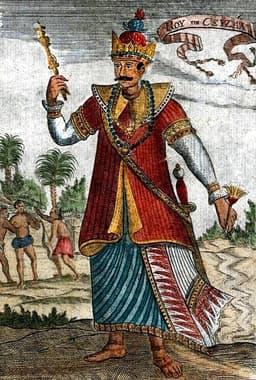
Vimaladharmasuriya I
Emperor · Modern
50.2Total
Basic Information
Born
1895
1592
Died
1965
1604
Era
Modern
Modern
Nationality
Kuwait
Sri Lanka
Occupation
Emperor
Emperor
Civilization
Middle Eastern
Indian
Score Comparison
Military (10%)
47.7
30.0
Political (20%)
65.0
54.7
Influence (20%)
52.5
51.8
Legacy (20%)
43.3
41.7
Leadership (15%)
80.0
64.0
Strategy (15%)
45.0
60.0
TOTAL
55.0
50.2
Abdullah al-Salim al-Sabah — Complete Timeline
1961 AD
Iraqi Threat and British Military InterventionWar◆ Major
Following Kuwait's independence, Iraq claimed sovereignty over Kuwait and massed troops on the border. Abdullah al-Salim requested British military assistance. British forces deployed to Kuwait, deterring an Iraqi invasion and securing Kuwait's borders.
Kuwait-Iraq RelationsMilitary InterventionSecurity
Impact: regional
Kuwait Independence from BritainPolitical Action◆ Major
Abdullah al-Salim al-Sabah negotiated the end of the British protectorate, making Kuwait a fully independent sovereign state. He became the first Emir of independent Kuwait. The independence was formalized with the abrogation of the 1899 Anglo-Kuwaiti Agreement.
Kuwaiti IndependenceDecolonizationSovereignty
Impact: nationalconstructive
1962 AD
Promulgation of the Kuwaiti ConstitutionReform◆ Major
Abdullah al-Salim oversaw the drafting and adoption of Kuwait's first constitution. The constitution established a parliamentary system with an elected National Assembly, guaranteed civil liberties, and defined the powers of the emir. It remains the basis of Kuwaiti governance.
Kuwaiti ConstitutionDemocracyPolitical Reform
Impact: nationalconstructive
Vimaladharmasuriya I — Complete Timeline
1592 AD
Establishment of Kandy as CapitalPolitical Action◆ Major
Vimaladharmasuriya I established Kandy as the capital of the Sinhalese kingdom. He fortified the city and made it the center of resistance against Portuguese expansion.
CapitalFoundationResistance
Impact: nationalconstructive
1594 AD
Battle of DantureWar
Vimaladharmasuriya I's forces ambushed and defeated a Portuguese army at Danture. The Portuguese commander, Pedro Lopes de Sousa, was killed, and the Kandyan kingdom secured its independence.
BattlePortugueseIndependence
Impact: regional
1595 AD
Restoration of Buddhism in KandyPolitical Action◆ Major
Vimaladharmasuriya I restored Buddhism as the state religion in the Kandyan kingdom. He brought the Tooth Relic of the Buddha to Kandy and built a temple to house it, reviving Buddhist traditions.
BuddhismRestorationRelic
Impact: nationalconstructive
Construction of the Temple of the Tooth in KandyCultural◆ Major
Vimaladharmasuriya I built the first Temple of the Tooth in Kandy to house the sacred Tooth Relic. This established Kandy as the primary Buddhist center in Sri Lanka.
ArchitectureBuddhismRelic
Impact: nationalconstructive
This comparison has not been analyzed yet.
One-time AI generation (~1 minute). Scores and timeline are already available below.
Rankings
🥇
Abdullah al-Salim al-SabahLeader
Mil: 47.7Pol: 65.0Inf: 52.5
55.0
🥈
Vimaladharmasuriya I
Mil: 30.0Pol: 54.7Inf: 51.8
50.2
+4.8 behind
How This Comparison Works
Algorithm
Each figure is scored on 6 dimensions (0—100 scale) based on structured historical data: Military (10%), Political (20%), Influence (20%), Legacy (20%), Leadership (15%), Strategy (15%). The weighted total produces the final ranking.
Data Sources
Scores are computed from structured sub-indicators in the database. Scale factors adjust for era (Ancient ×0.85, Modern ×1.0) and civilization size (Eastern ×1.05, Other ×0.80) to account for differences in population and military scale.
Maximum 3 Figures
Comparisons are limited to 2—3 figures to ensure readability and statistical meaningfulness.
Error Margins
±5 points per dimension — Sub-scores are derived from historical records with inherent uncertainty. Two figures within 5 points on a dimension should be considered roughly equivalent in that area.
Total Score Accuracy
±3 points overall — The weighted combination of 6 dimensions produces a total score with approximately ±3 points of uncertainty. Differences of less than 3 points are not statistically significant— the figures are effectively tied.
Known Limitations
- Historical records are incomplete and uneven across civilizations
- Figures from oral-tradition societies may be underrepresented
- Occupation labels can misclassify multi-role figures
- Scores measure capability and impact, not moral character
- Quantitative scoring is a comparison tool, not absolute truth
Capability Radar
Military (10%) — Battles & Warfare
Battles
23
45
Win Rate
25
60
Expansion
32
25
Political (20%) — Governance & Reform
Reform
70
35
Diplomacy
75
45
Economy
60
30
Influence (20%) — Cultural & Global Reach
Cultural
30
30
Global
25
20
Legacy (20%) — Historical Impact
Historical
40
35
Longevity
30
25
Leadership (15%) — Power & Stability
Tenure
65
40
Stability
70
35
Strategy (15%) — Tactics & Innovation
Strategy
31
50
Tactics
35
55
Reform
39
30
Similar Comparisons
Comments & Discussion
No comments yet. Be the first to share your thoughts!