Loading...
This comparison has not been analyzed yet.
One-time AI generation (~1 minute). Scores and timeline are already available below.
Abdullah al-Salim al-Sabah vs Mutesa II of Buganda
Abdullah al-Salim al-Sabah leads by 10.6 pts · 2 figures compared
…

Abdullah al-Salim al-Sabah
Emperor · Modern
55.0Total
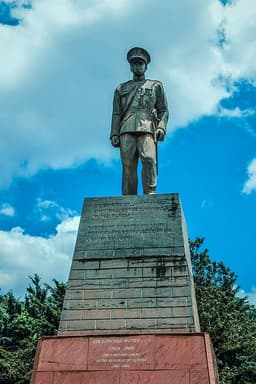
Mutesa II of Buganda
Emperor · Modern
44.4Total
Basic Information
Born
1895
1924
Died
1965
—
Era
Modern
Modern
Nationality
Kuwait
Uganda
Occupation
Emperor
Emperor
Civilization
Middle Eastern
Other
Score Comparison
Military (10%)
47.7
20.0
Political (20%)
65.0
39.4
Influence (20%)
52.5
53.3
Legacy (20%)
43.3
40.0
Leadership (15%)
80.0
51.9
Strategy (15%)
45.0
54.3
TOTAL
55.0
44.4
Abdullah al-Salim al-Sabah — Complete Timeline
1961 AD
Iraqi Threat and British Military InterventionWar◆ Major
Following Kuwait's independence, Iraq claimed sovereignty over Kuwait and massed troops on the border. Abdullah al-Salim requested British military assistance. British forces deployed to Kuwait, deterring an Iraqi invasion and securing Kuwait's borders.
Kuwait-Iraq RelationsMilitary InterventionSecurity
Impact: regional
Kuwait Independence from BritainPolitical Action◆ Major
Abdullah al-Salim al-Sabah negotiated the end of the British protectorate, making Kuwait a fully independent sovereign state. He became the first Emir of independent Kuwait. The independence was formalized with the abrogation of the 1899 Anglo-Kuwaiti Agreement.
Kuwaiti IndependenceDecolonizationSovereignty
Impact: nationalconstructive
1962 AD
Promulgation of the Kuwaiti ConstitutionReform◆ Major
Abdullah al-Salim oversaw the drafting and adoption of Kuwait's first constitution. The constitution established a parliamentary system with an elected National Assembly, guaranteed civil liberties, and defined the powers of the emir. It remains the basis of Kuwaiti governance.
Kuwaiti ConstitutionDemocracyPolitical Reform
Impact: nationalconstructive
Mutesa II of Buganda — Complete Timeline
1939 AD
Accession as Kabaka of BugandaPolitical Action◆ Major
Mutesa II became Kabaka of Buganda after the death of his father Daudi Cwa II. He inherited a kingdom that was a British protectorate, with limited autonomy under colonial rule.
SuccessionBugandaUganda
Impact: regional
1953 AD
Exiled by the British over the Kabaka crisisPolitical Action
Mutesa II was exiled by the British governor Andrew Cohen after demanding Buganda's independence from Uganda. The exile sparked widespread protests in Buganda, leading to negotiations and his eventual return in 1955.
ExileColonialismBuganda
Impact: regionaltragic
1955 AD
Returned from exile and signed the Buganda Agreement of 1955Political Action◆ Major
Mutesa II returned to Buganda after negotiations with the British. He signed a new agreement that restored his position but limited his powers, making Buganda a constitutional monarchy within Uganda.
ReturnTreatyBuganda
Impact: regional
1963 AD
Became first President of UgandaPolitical Action◆ Major
Mutesa II was elected as the first President of Uganda, a largely ceremonial role, while Milton Obote served as Prime Minister. This arrangement was part of Uganda's independence constitution.
PresidencyUgandaIndependence
Impact: national
1966 AD
Exiled by Milton ObotePolitical Action
Mutesa II was forced into exile in the United Kingdom after Prime Minister Milton Obote suspended the constitution and attacked the Lubiri (his palace). Obote abolished the kingdoms and declared himself president, ending Mutesa's political role.
ExileCoupUganda
Impact: nationaltragic
1969 AD
Death in exilePolitical Action◆ Major
Mutesa II died in exile in London under mysterious circumstances, reportedly from alcohol poisoning. His death ended the Buganda monarchy's active role in Ugandan politics, though the kingdom was later restored in 1993.
DeathExileBuganda
Impact: nationaltragic
This comparison has not been analyzed yet.
One-time AI generation (~1 minute). Scores and timeline are already available below.
Rankings
🥇
Abdullah al-Salim al-SabahLeader
Mil: 47.7Pol: 65.0Inf: 52.5
55.0
🥈
Mutesa II of Buganda
Mil: 20.0Pol: 39.4Inf: 53.3
44.4
+10.6 behind
How This Comparison Works
Algorithm
Each figure is scored on 6 dimensions (0—100 scale) based on structured historical data: Military (10%), Political (20%), Influence (20%), Legacy (20%), Leadership (15%), Strategy (15%). The weighted total produces the final ranking.
Data Sources
Scores are computed from structured sub-indicators in the database. Scale factors adjust for era (Ancient ×0.85, Modern ×1.0) and civilization size (Eastern ×1.05, Other ×0.80) to account for differences in population and military scale.
Maximum 3 Figures
Comparisons are limited to 2—3 figures to ensure readability and statistical meaningfulness.
Error Margins
±5 points per dimension — Sub-scores are derived from historical records with inherent uncertainty. Two figures within 5 points on a dimension should be considered roughly equivalent in that area.
Total Score Accuracy
±3 points overall — The weighted combination of 6 dimensions produces a total score with approximately ±3 points of uncertainty. Differences of less than 3 points are not statistically significant— the figures are effectively tied.
Known Limitations
- Historical records are incomplete and uneven across civilizations
- Figures from oral-tradition societies may be underrepresented
- Occupation labels can misclassify multi-role figures
- Scores measure capability and impact, not moral character
- Quantitative scoring is a comparison tool, not absolute truth
Capability Radar
Military (10%) — Battles & Warfare
Battles
23
5
Win Rate
25
5
Expansion
32
5
Political (20%) — Governance & Reform
Reform
70
25
Diplomacy
75
30
Economy
60
20
Influence (20%) — Cultural & Global Reach
Cultural
30
40
Global
25
20
Legacy (20%) — Historical Impact
Historical
40
30
Longevity
30
20
Leadership (15%) — Power & Stability
Tenure
65
30
Stability
70
15
Strategy (15%) — Tactics & Innovation
Strategy
31
5
Tactics
35
5
Reform
39
5
Similar Comparisons
Comments & Discussion
No comments yet. Be the first to share your thoughts!