Loading...
Abd el-Kader vs Maharana Pratap
Abd el-Kader leads by 13.3 pts · 2 figures compared
…
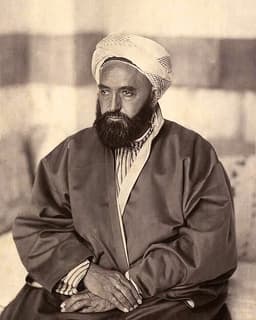
Abd el-Kader
General · Modern
67.1Total
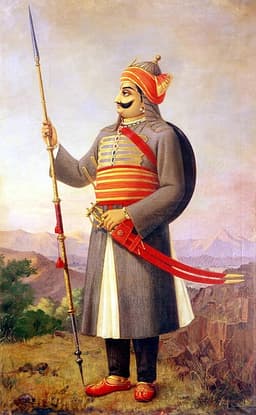
Maharana Pratap
General · Modern
53.8Total
Basic Information
Born
1808
1540
Died
1883
1597
Era
Modern
Modern
Nationality
Algeria
India
Occupation
General
General
Civilization
Middle Eastern
Indian
Score Comparison
Military (10%)
60.0
55.0
Political (20%)
78.0
39.4
Influence (20%)
88.0
55.0
Legacy (20%)
40.0
55.0
Leadership (15%)
70.4
64.0
Strategy (15%)
68.7
52.5
TOTAL
67.1
53.8
Abd el-Kader — Complete Timeline
1837 AD
Treaty of TafnaPolitical Action◆ Major
Abd el-Kader signed the Treaty of Tafna with French General Thomas Bugeaud. The treaty recognized Abd el-Kader's control over the interior of western Algeria, temporarily halting French expansion and establishing a defined territory for his emirate.
TreatyAlgerian ResistanceFrench Colonization
Impact: regional
1843 AD
Capture of the SmalaWar◆ Major
French forces under the Duke of Aumale captured Abd el-Kader's mobile camp (smala) at Taguin, taking thousands of prisoners including his family. This defeat destroyed his administrative base and severely weakened his resistance movement.
BattleAlgerian ResistanceFrench Colonization
Impact: regionaltragic
1847 AD
Surrender to FrancePolitical Action◆ Major
Abd el-Kader surrendered to French General Louis de Lamorici
SurrenderAlgerian ResistanceFrench Colonization
Impact: regionaltragic
1860 AD
Protection of Christians in DamascusPolitical Action◆ Major
During sectarian violence in Damascus, Abd el-Kader personally intervened to protect Christian communities, sheltering thousands in his home. His actions saved many lives and earned him international recognition, including the French Legion of Honour.
HumanitarianInterfaithDamascus
Impact: regionalconstructive
Maharana Pratap — Complete Timeline
1572 AD
Refusal to submit to AkbarPolitical Action◆ Major
Maharana Pratap refused to accept Mughal suzerainty under Emperor Akbar, unlike other Rajput rulers. He rejected diplomatic overtures and military pressure. This defiance made him a symbol of Rajput independence and resistance.
DefianceMughal EmpireRajput Pride
Impact: regional
1576 AD
Battle of HaldighatiWar
Maharana Pratap led Rajput forces against the Mughal army under Man Singh of Amber at Haldighati. The battle was indecisive, with both sides claiming victory. Pratap retreated to the hills and continued guerrilla resistance against the Mughals.
Mughal-Rajput WarGuerrilla WarfareResistance
Impact: regional
1585 AD
Recapture of Chittorgarh FortWar◆ Major
Maharana Pratap recaptured the Chittorgarh Fort from the Mughals after a prolonged guerrilla campaign. The fort had been lost to Akbar in 1568. Pratap's forces held the fort temporarily, but it was later abandoned due to Mughal pressure.
VictoryFort RecaptureGuerrilla Campaign
Impact: regionalconstructive
Establishment of new capital at ChavandPolitical Action◆ Major
Maharana Pratap established his new capital at Chavand in the Aravalli hills after losing Chittorgarh. The capital served as a base for his resistance against the Mughals. It remained the capital of Mewar until his death.
Capital EstablishmentResistanceMewar
Impact: regionalconstructive
Expert Analysis
Origins
Abd el-Kader was born in 1808 near Mascara, Algeria, into a religious family of the Qadiriyya Sufi order. His father, Muhyi al-Din, was a respected marabout. Abd el-Kader received a traditional education in Islamic sciences, theology, and literature, and also trained in horsemanship and warfare. His early life was marked by the decline of Ottoman authority in Algeria and the growing threat of French colonization after 1830.
Maharana Pratap was born in 1540 in Kumbhalgarh, Rajasthan, into the Sisodia Rajput clan. His father, Maharana Udai Singh II, was the ruler of Mewar. Pratap was trained in martial arts, swordsmanship, and statecraft from a young age. He grew up in a period of Mughal expansion under Emperor Akbar, who had already subjugated many Rajput kingdoms through alliances or force.
Rise to Power
Abd el-Kader rose to prominence in 1832 when local tribes elected him as their leader in the struggle against the French. His father initially led the resistance but stepped aside, recognizing his son's capabilities. At age 24, Abd el-Kader was proclaimed Emir. He quickly organized a centralized state with a standing army, administrative divisions, and tax collection. His authority was recognized through the Treaty of Tafna in 1837, which granted him control over the interior of western Algeria.
Maharana Pratap became the ruler of Mewar in 1572 after the death of his father. Unlike other Rajput rulers who accepted Mughal suzerainty, Pratap refused to submit to Emperor Akbar. Akbar sent multiple diplomatic missions demanding allegiance, but Pratap rejected them, preparing for war. The turning point was the Battle of Haldighati in 1576, where Pratap led a coalition of Rajput and Bhil forces against the Mughal army commanded by Man Singh of Amber.
Leadership & Governance
Abd el-Kader governed through a combination of religious authority and military discipline. He established a structured state with ministers, a treasury, and a justice system based on Islamic law. He maintained a professional army of up to 10,000 men, using guerrilla tactics against the French. He also promoted agriculture and trade to sustain his state. His leadership scored 70.4, reflecting his ability to unite diverse tribes and maintain cohesion.
Maharana Pratap ruled Mewar from the remote stronghold of Chavand after losing Chittorgarh. His governance was based on feudal Rajput traditions, with loyalty from clan chiefs and local communities. He relied on guerrilla warfare, using the Aravalli hills for ambushes and raids. Unlike Abd el-Kader, he did not create a centralized state; his authority was personal and tribal. His leadership score of 64.0 is lower, partly due to limited institutional development.
Triumph & Tragedy
Abd el-Kader's greatest success was the Treaty of Tafna, which secured him a recognized state. He also protected Christians in Damascus in 1860, earning international praise. His major failure was the loss of the Smala in 1843, which broke his military capability and led to his surrender in 1847. He was exiled to France and later to Damascus, but his legacy as a chivalrous warrior endured.
Maharana Pratap's triumph was his refusal to submit, symbolizing Rajput resistance. He recaptured Chittorgarh Fort and established a new capital at Chavand. However, he never regained full control of Mewar; his kingdom remained impoverished and under constant threat. His greatest failure was the indecisive Battle of Haldighati, which did not achieve a decisive victory. He died in 1597 from injuries sustained in a hunting accident, his kingdom still independent but diminished.
Character & Destiny
Abd el-Kader was pragmatic, diplomatic, and religiously committed. He balanced warfare with negotiation, knowing when to fight and when to compromise. His character shaped his fate: his willingness to surrender preserved his life and allowed him to later become a humanitarian figure. He scored 78.0 in political acumen, indicating his skill in navigating complex power dynamics.
Maharana Pratap was stubborn, proud, and uncompromising. He chose resistance over submission, even when outmatched. His character led to a life of hardship and constant struggle. He scored 39.4 in political ability, reflecting his refusal to engage diplomatically. His destiny was to be a symbol of defiance rather than a successful ruler.
Legacy
Abd el-Kader's legacy is complex: he is a national hero in Algeria and also remembered for his humanitarian acts. He influenced later anti-colonial movements and is respected in both Islamic and Western worlds. His total score of 67.1 reflects balanced contributions across military, political, and influence domains.
Maharana Pratap is a folk hero in Rajasthan and parts of India, celebrated for his courage and refusal to submit. However, his legacy is largely symbolic; he did not achieve lasting political or military change. His total score of 53.8 is lower, due to weaker political and strategic impact.
Conclusion
Abd el-Kader had greater overall impact than Maharana Pratap, with a 13.3-point score gap. While both were resistance leaders, Abd el-Kader built a functioning state, achieved diplomatic recognition, and left a legacy of humanitarianism. Maharana Pratap's resistance was heroic but ultimately ineffective in altering the course of Mughal dominance. Abd el-Kader's ability to combine military resistance with political pragmatism and moral leadership gives him a more enduring and wider influence.
Rankings
🥇
Abd el-KaderLeader
Mil: 60.0Pol: 78.0Inf: 88.0
67.1
🥈
Maharana Pratap
Mil: 55.0Pol: 39.4Inf: 55.0
53.8
+13.3 behind
How This Comparison Works
Algorithm
Each figure is scored on 6 dimensions (0—100 scale) based on structured historical data: Military (10%), Political (20%), Influence (20%), Legacy (20%), Leadership (15%), Strategy (15%). The weighted total produces the final ranking.
Data Sources
Scores are computed from structured sub-indicators in the database. Scale factors adjust for era (Ancient ×0.85, Modern ×1.0) and civilization size (Eastern ×1.05, Other ×0.80) to account for differences in population and military scale.
Maximum 3 Figures
Comparisons are limited to 2—3 figures to ensure readability and statistical meaningfulness.
Error Margins
±5 points per dimension — Sub-scores are derived from historical records with inherent uncertainty. Two figures within 5 points on a dimension should be considered roughly equivalent in that area.
Total Score Accuracy
±3 points overall — The weighted combination of 6 dimensions produces a total score with approximately ±3 points of uncertainty. Differences of less than 3 points are not statistically significant— the figures are effectively tied.
Known Limitations
- Historical records are incomplete and uneven across civilizations
- Figures from oral-tradition societies may be underrepresented
- Occupation labels can misclassify multi-role figures
- Scores measure capability and impact, not moral character
- Quantitative scoring is a comparison tool, not absolute truth
Capability Radar
Military (10%) — Battles & Warfare
Battles
75
55
Win Rate
65
60
Expansion
60
20
Political (20%) — Governance & Reform
Reform
72
20
Diplomacy
85
35
Economy
55
20
Influence (20%) — Cultural & Global Reach
Cultural
70
65
Global
65
40
Legacy (20%) — Historical Impact
Historical
75
70
Longevity
70
65
Leadership (15%) — Power & Stability
Tenure
68
45
Stability
50
30
Strategy (15%) — Tactics & Innovation
Strategy
78
60
Tactics
80
65
Reform
70
30
Similar Comparisons
Comments & Discussion
No comments yet. Be the first to share your thoughts!