Loading...
A.N.R. Robinson vs Lev Kamenev
A.N.R. Robinson leads by 9.7 pts · 2 figures compared
…
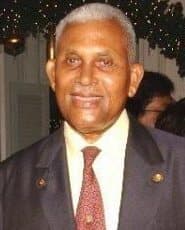
A.N.R. Robinson
Politician · Modern
57.3Total

Lev Kamenev
Politician · Modern
47.6Total
Basic Information
Born
1926
1883
Died
—
1936
Era
Modern
Modern
Nationality
Trinidad
Russia
Occupation
Politician
Politician
Civilization
Western
Western
Score Comparison
Military (10%)
50.0
50.0
Political (20%)
60.0
39.4
Influence (20%)
59.0
49.4
Legacy (20%)
54.0
43.3
Leadership (15%)
72.0
62.2
Strategy (15%)
43.0
42.2
TOTAL
57.3
47.6
A.N.R. Robinson — Complete Timeline
1986 AD
Became Prime Minister of Trinidad and TobagoPolitical Action◆ Major
Robinson led the National Alliance for Reconstruction (NAR) to a landslide victory in the 1986 general election, ending 30 years of PNM rule. He became Prime Minister, promising economic reform and national unity.
Election VictoryChange of GovernmentNAR
Impact: nationalconstructive
1989 AD
Proposed the International Criminal CourtPolitical Action
As Prime Minister of Trinidad and Tobago, Robinson proposed the creation of a permanent International Criminal Court to the UN General Assembly. His initiative, driven by the need to prosecute drug traffickers, led to the Rome Statute and the ICC's establishment in 2002.
International LawICCJusticeUN
Impact: globalconstructive
1990 AD
Survived the 1990 Jamaat al Muslimeen Coup AttemptPolitical Action◆ Major
Robinson was taken hostage by the Jamaat al Muslimeen during a coup attempt. He was held for six days and was shot in the leg. The crisis ended with a negotiated surrender, but Robinson's government was severely weakened.
Coup AttemptHostage CrisisPolitical Violence
Impact: nationaltragic
1997 AD
Served as President of Trinidad and TobagoPolitical Action
After his term as Prime Minister, Robinson was elected President of Trinidad and Tobago, serving from 1997 to 2003. The presidency is a largely ceremonial role, but Robinson used it to advocate for regional integration and international justice.
PresidencyCeremonial RoleRegionalism
Impact: nationalconstructive
Lev Kamenev — Complete Timeline
1917 AD
Opposition to the October RevolutionPolitical Action◆ Major
In October 1917, Kamenev and Zinoviev publicly opposed Lenin's plan for an armed uprising against the Provisional Government. They argued that the Bolsheviks were not strong enough to seize power, leading to a temporary split with Lenin and accusations of betrayal.
Russian RevolutionBolsheviksDisagreement
Impact: national
1918 AD
Chairman of the Moscow SovietPolitical Action
Kamenev served as chairman of the Moscow Soviet (city council) from 1918 to 1926. In this role, he managed the administration of Moscow during the early Soviet period, overseeing the implementation of Bolshevik policies in the capital.
Soviet GovernmentMoscowAdministration
Impact: national
1925 AD
Formation of the United Opposition with ZinovievPolitical Action◆ Major
Kamenev joined Zinoviev in forming the United Opposition against Stalin's policies. They criticized the growing bureaucracy and Stalin's moderate approach to the NEP, advocating for more radical industrialization and world revolution, but were defeated at the 14th Party Congress.
Soviet PoliticsPower StruggleOpposition
Impact: national
1936 AD
Execution in the Great PurgePolitical Action◆ Major
Kamenev was tried alongside Zinoviev in the first Moscow Show Trial in August 1936. Accused of terrorism and plotting with Trotsky, he was found guilty and executed on August 25, 1936, marking a key event in Stalin's elimination of Old Bolshevik rivals.
Great PurgeShow TrialExecution
Impact: nationaltragic
Expert Analysis
Origins
**A.N.R. Robinson** (born 1926 in Trinidad) came from a middle-class family; his father was a businessman. He studied at Oxford University, earning a degree in law, and later practiced as a barrister. His early exposure to colonial politics shaped his commitment to independence and justice.
**Lev Kamenev** (born 1883 in Moscow) was the son of a railway engineer. He joined the Russian Social Democratic Labour Party in 1901, becoming a close ally of Lenin. Educated at Moscow University, he was exiled multiple times for revolutionary activities.
Rise to Power
Robinson entered politics in the 1960s, serving as a minister in Eric Williams's government. He broke away to form the National Alliance for Reconstruction (NAR). In 1986, the NAR won a landslide victory, and Robinson became Prime Minister, ending 30 years of PNM rule (score: Political 60.0).
Kamenev rose as a key Bolshevik organizer. He chaired the Moscow Soviet from 1918 to 1926, managing the city's administration during the Russian Civil War. He was a member of the Politburo but opposed Lenin's plan for the October Revolution (score: Political 39.4).
Leadership & Governance
Robinson's leadership focused on economic diversification and anti-corruption. He established the Revenue Authority to improve tax collection. However, austerity measures led to public discontent. His most notable governance achievement was proposing the International Criminal Court (ICC) at the UN in 1989, which materialized in 2002 (score: Leadership 72.0).
Kamenev's governance was overshadowed by his rivalry with Stalin. As chairman of the Moscow Soviet, he implemented Bolshevik policies but lacked administrative independence. He co-led the United Opposition with Zinoviev, criticizing Stalin's bureaucracy and moderate policies. His political maneuvering was ineffective against Stalin's consolidation of power (score: Leadership 62.2).
Triumph & Tragedy
Robinson's triumph was the ICC proposal, which cemented his legacy in international law. He also survived the 1990 Jamaat al Muslimeen coup attempt, during which he was shot in the leg but remained defiant. His tragedy was the electoral defeat in 1991 due to unpopular economic reforms; he later served as President (1997-2003), a ceremonial role.
Kamenev's greatest success was his early role in the Bolshevik revolution and organizing the Moscow Soviet. His tragedy was his opposition to the October Revolution, which damaged his standing, and his subsequent execution in 1936 after the first Moscow Show Trial. He was rehabilitated posthumously in 1988.
Character & Destiny
Robinson was a principled but pragmatic politician. His persistence on the ICC showed long-term vision. His character allowed him to survive the coup and later serve as President, demonstrating resilience. Historical assessments praise his integrity but note his inability to sustain popularity.
Kamenev was an intellectual Bolshevik, loyal to Lenin but indecisive during crises. His opposition to the October Revolution revealed a cautious nature. Under Stalin, he vacillated between submission and resistance, leading to his downfall. Historians view him as a tragic figure caught in Stalin's purges.
Legacy
Robinson's legacy is the ICC, a permanent court prosecuting genocide, war crimes, and crimes against humanity. He also impacted Trinidad's politics by breaking the PNM's dominance. His scores: Influence 59.0, Legacy 54.0.
Kamenev's legacy is as a victim of Stalinism, remembered in historical studies of the Soviet purges. His writings and policies had limited lasting influence. Scores: Influence 49.4, Legacy 43.3.
Conclusion
A.N.R. Robinson had greater impact due to his concrete achievement in founding the ICC, which continues to shape global justice. Kamenev's political influence was ephemeral, and his legacy is largely cautionary. Robinson's total score of 57.3 vs Kamenev's 47.6 reflects this difference. The ICC stands as a permanent institution, while Kamenev's role is confined to a tragic chapter of Soviet history.
Rankings
🥇
A.N.R. RobinsonLeader
Mil: 50.0Pol: 60.0Inf: 59.0
57.3
🥈
Lev Kamenev
Mil: 50.0Pol: 39.4Inf: 49.4
47.6
+9.7 behind
How This Comparison Works
Algorithm
Each figure is scored on 6 dimensions (0—100 scale) based on structured historical data: Military (10%), Political (20%), Influence (20%), Legacy (20%), Leadership (15%), Strategy (15%). The weighted total produces the final ranking.
Data Sources
Scores are computed from structured sub-indicators in the database. Scale factors adjust for era (Ancient ×0.85, Modern ×1.0) and civilization size (Eastern ×1.05, Other ×0.80) to account for differences in population and military scale.
Maximum 3 Figures
Comparisons are limited to 2—3 figures to ensure readability and statistical meaningfulness.
Error Margins
±5 points per dimension — Sub-scores are derived from historical records with inherent uncertainty. Two figures within 5 points on a dimension should be considered roughly equivalent in that area.
Total Score Accuracy
±3 points overall — The weighted combination of 6 dimensions produces a total score with approximately ±3 points of uncertainty. Differences of less than 3 points are not statistically significant— the figures are effectively tied.
Known Limitations
- Historical records are incomplete and uneven across civilizations
- Figures from oral-tradition societies may be underrepresented
- Occupation labels can misclassify multi-role figures
- Scores measure capability and impact, not moral character
- Quantitative scoring is a comparison tool, not absolute truth
Capability Radar
Military (10%) — Battles & Warfare
Battles
29
28
Win Rate
30
33
Expansion
35
33
Political (20%) — Governance & Reform
Reform
70
35
Diplomacy
75
30
Economy
50
25
Influence (20%) — Cultural & Global Reach
Cultural
30
15
Global
65
20
Legacy (20%) — Historical Impact
Historical
60
40
Longevity
55
20
Leadership (15%) — Power & Stability
Tenure
65
40
Stability
55
20
Strategy (15%) — Tactics & Innovation
Strategy
40
36
Tactics
39
42
Reform
45
44
Similar Comparisons
Comments & Discussion
No comments yet. Be the first to share your thoughts!